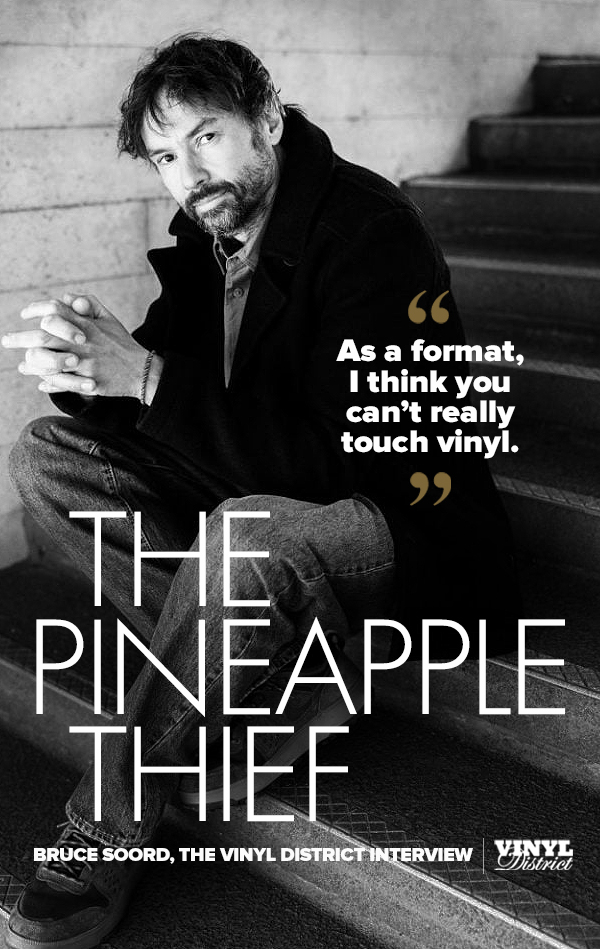
PHOTO: ANNE MARIE FORKER | I have been a prog fan for as long as I have owned a turntable. The genre’s long-form ambition, its odd time signatures, and its insistence that an album be heard from start to finish have shaped the way I listen to music, so the chance to sit down with Bruce Soord of The Pineapple Thief was, quite simply, an honor.
What began in 1999 as Soord’s one-man studio project in the UK has grown, record by record, into one of modern progressive rock’s most respected bands. Alongside bassist Jon Sykes, keyboardist Steve Kitch, and drummer Gavin Harrison—now a decade into his tenure behind the kit—Soord has built a catalog that carries as much emotional weight as technical precision. Their new album, Far and Wide, arrived on October 9 on InsideOut Music, and it finds the band deliberately stripping things back: no more than two guitar parts at a time, a sound built to be played live, and songs that wrestle with a world in turmoil, moral courage, and personal loss.
We spoke just days before the release about the little UK festival gig that first convinced him he was in a real band, the Alan Parsons Project record that rewired his brain, writing in 5/4 with Harrison in the same room, the loss of his father, and why—after years of mixing in Atmos and 5.1—he still believes vinyl is the format you can’t touch. As a lifelong prog listener writing for a vinyl publication, I could not have asked for a better answer.
The Pineapple Thief started in 1999 as essentially a studio project. Take me back to the first time you stood in front of a real audience with these songs. What do you remember, and did you have any sense it would turn into a 16-album life?
That pretty much sums it up. It definitely didn’t make any sense at the time that it would be 16 albums, 26 years, or whatever. But I remember the early days. It was just me in my little studio, and you had to be a bit of a nerd to run a studio in your home back then. It was lots of wires and cables and computers.
But for some reason, it had a bit of momentum, and with every album we’d get a few more fans. When we got to the third record, which was Variations on a Dream, all of a sudden we had some people asking us to play live. I think it was 2003. We were offered this show, a little progressive rock festival here in the UK, and it was headlined by Caravan, you know, the old Canterbury scene band. I was like, wow, this is amazing. Then I thought, oh, I really need to get a band, because I played everything.
So I got my friends in, we rehearsed, and we went up to this little festival and played to this packed room, and I remember the audience loving it. I remember walking out of the room and seeing this big queue of people, and I said to this guy, “What are these people queuing up for?” And he said, “They’re queuing up for you. They want to buy your merch. They want you to sign some stuff.” And I went, “What?” I remember vividly thinking, “Oh my goodness, this is actually a band, and people actually like it.” Luckily, I had some CDs in the car, so I ran to the car, got some CDs out, and that was it. That was the first time.
Who rewired the way you heard music? Was there a record that made you think “I want to do that”?
Well, I remember very vividly the moment in my life when I heard the record that made me know I wanted to be a musician, a guitarist, a songwriter, or whatever. It was actually an album called Tales of Mystery and Imagination by the Alan Parsons Project, which I think was a 1976 record. I went to my friend’s house, and he had this amazing vinyl collection and a Linn Sondek turntable, so it was amazing. We picked this record, which was a gatefold. It had a Hipgnosis cover. I’d never seen anything like it, and when I heard the record, I was like, “Wow, that is unbelievable.” Ever since that day—that was when my brain got rewired. Completely.
You set yourselves a rule on this album: no more than two guitar parts at once. When did you realize the layering had to stop, and what did that discipline give you that four or five guitars never could?
Well, you certainly had to work harder. A song had to be a song. You couldn’t hide behind layers or production, and I think that really did focus our minds. There were two reasons we did this, actually. One was that we wanted to play live really authentically. We didn’t want to have to rely on gimmicks or backing tracks or things like that in order to bring the studio to the stage. And also, I’ve been spending a lot of time with Jethro Tull, of all people. I’ve been remixing a lot of Jethro Tull, and I was listening to the way that they recorded and the way they performed, and it was very much like that. It was stripped back. It was like a band, and it worked brilliantly, obviously. That was a big inspiration.
It just made me realize: “What is it to be in a band?” To be in a band is that there’s five of you. I mean, there’s five of us on stage, four of us in the studio, playing together. I wanted to get that. We wanted to get that in the studio. So yeah, it was nice. I think authentic is probably the word to describe it.
It’s been a decade and seven albums with Gavin Harrison behind the kit. How has playing with him changed the way you write? Do you hear his drums in your head before a song is finished?
Well, it’s certainly developed. We’ve been together now for 10 years, so I know him very well. When I really think back to what I was like before I met Gavin, the writing process has changed. With this new record, I would go to Gavin’s house and he would play me his rhythmic compositions, and obviously they’re very inspiring. He’s one of the best drummers in the world, and everybody knows the kind of creativity he has when it comes to composing his rhythmic parts. He also composes other stuff—he’s got little Wurlitzers in his room as well—so it is inspirational.
You listen to these pieces, and it forces you to go places with the guitar, with the vocal, with the arrangements and the songwriting that you would never, ever go to if you were sat on your own in a room saying, “Let’s pick up the guitar and write a song,” which is how we used to do it. So yeah, when you have someone like that, it’s a collaborative, democratic process of writing, and it’s brilliant. You can take yourself so much further than you would on your own.
It Leads To This looked at what the next generation will inherit. Far and Wide takes in turmoil, moral courage, and personal loss. Is this a continuation of that record, or did something shift? And how close to home is the loss on this album?
Yeah, I think so. If anything, It Leads To This was fear of the future. My children, the next generation—what are we leaving these people? I guess this record is fear of what is actually the present, what is happening right now. And there was a loss in my life. Nothing extraordinary. At this age, if you’re lucky enough for your parents to still be here, chances are they’re very old, and they’re going to die. Unfortunately, my father died with very messy dementia, Alzheimer’s. So, very slow. You’re bound to let that influence you. You start to think about mortality and life and things like that.
I frame that around the future of my children, looking at the world, and also reassessing the present, because I read a lot of history. You go back to 1918 to ’45, and you compare that with what’s happening in the world now. All of those things are a mix of emotions that go into writing these songs. I’ve always said that I could never write about stuff I make up. It has to be stuff that I’m experiencing. When you sing on stage, it has to be sincere, and I guess that’s what makes it so challenging and hard, because you’ve got to get it right.
Why was “New World Order” the song you wanted the world to hear first?
Well, that was the first song we wrote, actually. I think it was “New World Order” and “Hold the Ashes” when I went up to Gavin’s studio, and Gavin played me his riff, his rhythm, which was a 5/4 piece. He said, “Bruce, could you play something on this?” Straight away he was looking at me, and I had my guitar, and I was like, “Oh, right, okay.” It really focuses your mind. You can’t just go, “You know what, Gav? I’ll think about that and come back tomorrow,” which is what you might do if you’re just sending files backwards and forwards over the internet, which is what people tend to do now. So it really is old school. You sit in a room together and you write, and that’s how that song came together. I remember the whole thing came together with just me and Gavin in his studio.
As for the sentiment, if It Leads To This was about what’s coming, Far and Wide is about what is now. “New World Order” is, I guess, the frightening state of the world in 2026. We’re at war. We’re killing each other. Why? How can this be? It doesn’t make sense. And the moral courage in it all is that we, as humanity, can stand up and change it, because everybody I know and speak to doesn’t want this. They want people to get along, to be nice, be kind. So I thought it was a good way to kick off the album.

Your North American run starts November 17 in Washington, DC, and comes through Southern California in December, with San Diego on the 6th and The Bellwether in Los Angeles on the 8th. The album will be only a few weeks old by then. How much of Far and Wide makes the set, and how do you balance it against 16 albums of catalog?
It’s difficult, yeah, really hard, and I think coming up with the set list is a bit of a science. Quite often, with the first couple of shows, you can tell—an audience is like an organism. You can tell when you’ve got them and when they’re engaged, and you can tell when you think, “Oh, hold on, maybe this song is the wrong one.” So we do tweak the set.
As a band, we want to play the new stuff because it’s exciting and it’s new, but we realize there are people coming who may be hearing us for the first time, and we know there are tracks in our catalog that people just love, that we will always have to play. So yeah, we’re definitely going to play some new stuff, and some stuff from the catalog that we haven’t played for a long time. But like you say, 16 albums is a lot to choose from.
Far and Wide is coming out on gatefold LP in several colors, plus Atmos, 5.1, and stereo. Does writing for two sides of vinyl change how you sequence a record?
It does influence the sequencing, actually. I guess it shouldn’t. You do want to keep the length in check. If it’s going to be a single vinyl—well, I guess you know more than anyone what the arguments are for the ideal length of a 33—but we never really want to go more than 20 or 21 minutes a side. I remember back in the day we were doing 13-minute sides. So it’s a real toss-up.
And there’s also the weight of the vinyl, with the resurgence of vinyl. When I was a kid, we used to go to record shops, and I’ve got 500 vinyl albums here, but none of them are 180 grams. I don’t think the 180-gram thing was happening in the ’70s—it might well have been, but not on the records I was getting in the second-hand record shop. For me, it’s the black vinyl, and I think that’s 140 gram. People tell me there is no audible difference between 180 gram and 140 gram, but I bet the vinyl community would beg to differ.
I think the new record especially, fidelity-wise, is one of my favorite Pineapple Thief mixes, and I think one of the reasons for that is the space the record has, because it hasn’t got the layering. It’s very 3D, certainly when I listen to it, and I think that is absolutely perfect for vinyl. So yeah, I’m looking forward to getting my record player set up. I’ve just moved house, so I’m just getting my hi-fi plugged back in.
You’ve spent years mixing in Atmos and 5.1, the most advanced formats out there, yet so many listeners swear that vinyl’s warmth and imperfection bring them closer to the music. When you sit down with Far and Wide on a turntable versus a high-res digital stream, do you hear a different record? Is there something analog captures that digital never quite will, or is that romance more in the ritual than in the sound?
I think there’s a bit of both. There’s certainly a ritual with vinyl, but I think there’s something magical about the fact that it’s analog—the fact that this needle is bouncing over the grooves and the sound is coming out, as opposed to the noughts and ones traveling through microchips and eventually out of a speaker. It’s this analog chain, transferred through the needle into an amplifier and through a speaker. There’s something about that. As a format, I think you can’t really touch vinyl. If you were to be scientific, you would say, okay, yes, the 24-bit/96-kilohertz Blu-ray is probably it in terms of fidelity. If you were to look at the science, that would probably be it. But I don’t think you can compare them.
When I listen to the record on my setup, which is an average Rega system, it sounds really nice. It’s something really special. Even my wife, who doesn’t get into the details of audio, says, “Oh, that sounds so nice, doesn’t it? Listen to the bottom end.” It sounds really full and warm. So that’s someone who, just by sitting there and putting the vinyl on, can hear that. So yeah, it’s a very special format. I’m really, really glad that it’s had a resurgence.

What is the one piece of vinyl on your shelf you would grab if the house were on fire?
There’s one record. It’s actually Supertramp, Crime of the Century. When me and my friends were kids, we used to go to second-hand record shops. In the ’80s, we were all listening to ’70s music, lots of ’70s prog, and a lot of it was in second-hand shops going quite cheap. So we would come back with bags and bags of it, and I found this special edition. We were talking about weights—some of them were really light back in the ’70s, but this was a special audiophile release of Crime of the Century, and I just fell in love with it. I played that to death, and I’ve still got it. It’s a little gatefold, and that’s the record I would grab. I think it was 1974. It’s one of the best-sounding records I’ve got.
After 16 albums, solo records, and side projects, what still scares or excites you creatively? What haven’t you done yet?
Every day I wake up, music and songwriting are still so exciting for me, because there’s an infinite number of possibilities. I’m still developing this relationship with the band, with Gavin, and with every album we do, there are new things that we’re discovering. The other thing—and this is something I recommend to all bands—is that you start small and you work your way up very gradually, which is what we’ve done. So we’re lucky that we’re playing to bigger crowds and selling more records, and that keeps it really, really exciting. Everything still feels really fresh and new. So luckily, ironically, after 26 years of doing it, it still feels as exciting as ever.
When it’s all said and done, set aside the chart positions and the sold-out rooms. What do you want people to say The Pineapple Thief meant?
I think what I really want them to remember is that the band and I were trying to connect, trying to share this thing that you can’t really convey with words alone. Music and lyrics are somehow able to connect at a level that surpasses anything I know, even painting. I think music is the ultimate. So if people can go away and feel that they’ve had a connection—and it works both ways—then that’s a victory. That’s what I hope people take from The Pineapple Thief: a real, deep emotional connection.
PHOTO: MARTIN BOSTOCK