“The greatest rock and roll band you have ever heard.” That was what jazz legend Miles Davis, impressed by the likes of Hendrix and Sly Stone not only for their innovation but for the ability to draw the kiddies to their shows, set out to put together at the dying end of the sixties.
And if any rebopper could do it, Miles “Prince of Darkeness” Davis could. Over the course of his decades-long career he’d set standards in bebop, more or less pioneered cool jazz, moved on to hard bop, and kept on moving, like a boxer inventing a new technique every round. He couldn’t sit still, had ants in his trumpet, and had one last great move up his sleeve—he was going to go rock, just like Dylan, and just like Dylan he was going to do it with arrogance and attitude. Never look back.
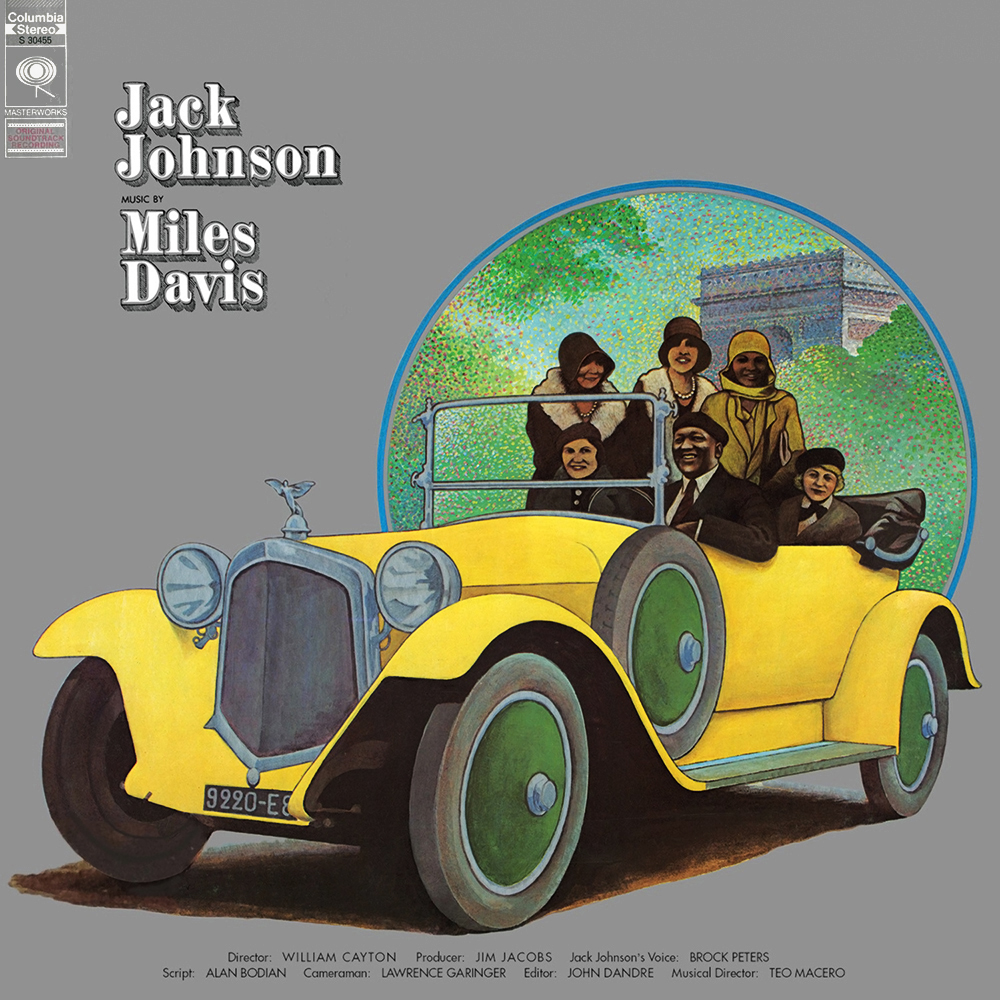
He’d already gone jazz fusion, but by the time he got around to recording 1971’s Jack Johnson, a sound track for a documentary about the great black boxer who refused to bow to the racism of white America, he was dead-set on incorporating hard rock and funk into his fusion. It was a move that would alienate plenty in the jazz community in the process.
Jack Johnson wasn’t the most controversial album of Davis’ career—those would come later. But some jazz traditionalists howled. Leonard Feather (a long-time music critic of very pale complexion) was appalled by “the thumping, clinking, whomping battering ram that passes for a rhythm section” on Jack Johnson. Noted trumpeter (and retro-jazz traditionalist) Wynton Marsalis dismissed Davis as “a genius who decided to go into rock, and was on the bandstand looking like, basically, a buffoon.” As for the noted critic Stanley Crouch, who is no slouch, it was his expert opinion that everything Miles had recorded since his first foray into jazz fusion, 1969’s landmark In a Silent Way, made him “the most brilliant sellout in the history of jazz.”
Dunderheads, the lot of them. The worst you can accuse Davis of, and it’s not his fault, is giving birth to the uncool—none of the jazz fusion that would follow in his wake would come remotely close to his exalted standards, and it would get worse and worse until bands like Spyro Gyra and Hiroshima came along to prove that dreams all too often beget nightmares. Who knows—had Davis seen Hiroshima in his headlights, he may never have dropped the atomic bomb that was Jack Johnson on the world in the first place.
Davis had a positive genius for gathering around him the young sidemen who could produce the jazz/hard rock sound he heard in his head: guitarists like John McLaughlin and Sonny Sharrock, keyboardists like Herbie Hancock and Chick Corea, horn players like Steve Grossman and Bennie Maupin, electric bassists like Michael Henderson and Dave Holland, and drummers like Billy Cobham and Jack DeJohnette. All were jazz guys, except Henderson, but they all could kick out the jams, although I don’t hear an iota of rock in Grossman’s playing.
(That Davis knew what he wanted and was willing to go to any length to get it is perfectly represented by Henderson. He heard him playing with Stevie Wonder, went backstage afterwards and bluntly informed Wonder, “I’m taking your fucking bassist.” What was poor blind Stevie to do? Fight for him? Miles had a personal trainer and was in the best shape of his life, and he was a notoriously violent prick to boot. Wonder, unless he had ESP or a seeing-eye middleweight, was bound to go down in the first round.)
About those sidemen. Some would go on to produce some quality fusion, but none would go on to produce anything of Davis caliber. Most (all?) cut the edges off their music because they wanted to eat money sandwiches. Others just didn’t have it in them. The Village Voice’s Robert Christgau has a more specifically musical reason: “pretty good or very bad, their fusion doesn’t sound much like papa’s. Without the hint of a doubt, they all compose, they all arrange, and they all solo to beat the band.” None of these things, of course, have anything to do with what makes Jack Johnson a landmark. Except soloing, and with the exception of McLaughlin none of them had it in them to do what they’d done on Jack Johnson.
Traditionally, the jazz albums of the time were recorded the old-fashioned way—the musicians would play live in the studio, just like they would in a club, and that would be that. Not so with Miles and producer Ted Macero, who employed a cut-and-paste approach, using a snippet from a jam here and a snippet from a jam there and using them to make sound collages. Lots of splicing went into the making of Jack Johnson—while most of the LP was recorded on April 7, 1970, a significant chunk (almost ten minutes) of the second track was recorded earlier, with some different musicians, on February 18, 1970, and air-dropped in. Macero also spliced some of a Davis solo from way back in 1969 into the opening cut. In short, what you’re hearing often isn’t what happened—the production is a work of art in and of itself.
About the LP’s two songs. If Robert Christgau described Jack Johnson as “one brilliant illumination,” I’m relatively certain he was talking about the incendiary first track, “Right Off.” And if Jack Johnson isn’t the perfect album by the “greatest rock and roll band you have ever heard,” it’s because too much of the second track doesn’t rock, unless you want to call it space rock. Side one runs you over like the Cannonball Express. Side two, at least until you get to the second session Macero dropped in at the 14-minute mark, is quieter, more laid back, more out there.
But “Right Off” is a miracle, and for much of the time it does seem to be a one-take, this-is-really-how-it-happened miracle, because according to the historical record, Davis’ sidemen were in the studio when they kicked into a killer groove, but why not let Henderson have the honors? “John [McLaughlin] started playing and I answered that and then Billy [Cobham] joined in. We were just warming up like fighters do to get ready for what we’d done the day before. It was a hell of a groove, and the next thing I know Miles is out playing with us. And we just kept on playing.”
And talk about serendipity—mid-jam Herbie Hancock happened to saunter into the studio, and without so much as calling a pause to the proceedings a sound engineer plugged in a cheap keyboard, and bingo Hancock was in the fray and cooking too.
That intro is unforgettable—Cobham is a force of nature, Henderson has the baddest bass sound ever and gallops, while McLaughlin cuts Chuck Berry and everybody else, throwing off sparks and tossing off short, sharp phrases. And the best part from this guy’s point of view is that McLaughlin’s guitar doesn’t have that “jazz guitar” sound that I’ll always associate with Jeff Beck and his Wired and Blow by Blow albums. McLaughlin’s playing like he’s auditioning for a heavy metal band.
Then, just as they calm down some in strolls Davis at exactly the 2:19 mark, and proceeds to tear the roof off the mother. Davis isn’t playing, he’s boxing, and for sure this isn’t cool jazz—Davis sounds like he has an extra pair of lungs, and his trumpet is electric even though I don’t see a plug anywhere. And McLaughlin’s sparring with Davis the entire time—playing all around him, filling spaces, laying down notes right over Davis, but there’s simply no beating the Jack Johnson on the trumpet.
Then around the eleven-minute mark everybody drops out and Miles plays this echoing space jazz against a strange humming backdrop and then in comes Steve Grossman on soprano saxophone sounding a lot like one John Coltrane to me, but what do I know for jazz’s sake? Henderson’s right there with him, playing this really muscular bass line, until Cobham comes in followed by McLaughlin and then Hancock, who plays this totally fuzzed-out organ that is all kinky afro until he holds this great sustained note at which point McLaughlin and Cobham lively things up for Davis to come roaring back in. Hancock’s going one, two, three, with the static electricity going everywhere, McLaughlin’s busy playing these fractured notes after which he starts playing this great repeated phrase that is so cool Jesus would have died for its sins while Cobham hits the cymbals like they said something about his mother of an offensive nature.
And on it goes, McLaughlin throwing jabs and Hancock coming in and out and getting fancier but freakier as he goes along until it’s like he’s playing Bach with his elbows, until in comes Grossman again blowing really hard and fast, and McLaughlin meanwhile is all raw power and fuzz and feedback. Everybody’s busy doing everything all the time but what’s mainly happening is McLaughlin is completely cutting loose at last, and I’ve never heard anything like it. Nothing. Something tells me this is what Hendrix was aiming at but never got to, because he croaked a few months later.
But man doesn’t McLaughlin play until suddenly he isn’t, and the song just sort of fades out, vanishes, leaving us to wonder how this led to Weather Report, because they’re not even of the same species. McLaughlin would have his moments, and more than just a few, with the Mahavishnu Orchestra later on, but he was never in as fine company, and he took to soaring like a spiritual being rather than just pointing his guitar at shit and blowing it up.
“Yesternow” is a more pensive affair at start, just Miles playing off a Henderson bass line while McLaughlin quietly vamps. To be honest it’s kind of a let down for this guy after “Right Off”—this sounds like jazz, not rock and roll or even some fusion thereof. Why, even the jazzbo twerps in Steely Dan would find it unobjectionable. Which isn’t to say Davis isn’t in top form, or that Henderson’s bass line isn’t quietly funky as shit.
Then we take a detour into some collective moon walking. I’m talking really laid-back stuff—Miles has gone into radio silence mode, McLaughlin lays out the occasional rough and tumble guitar line but doesn’t overdo it, while Hancock chimes. Sometimes (and I know this is blasphemy) I could swear I’m in Grateful Dead drums and space territory, even after Davis comes back in. Finally at the fourteen-minute mark Macero does some magic splicing and we’re at an entirely different session and the band is playing “Willie Nelson,” which yes is an homage to the highest man on the planet this side of Snoop Dogg. Why Miles and Willie didn’t put something together I’ll never know.
Suddenly we’re dealing with a very different set of players that includes Bennie Maupin on bass clarinet, McLaughlin and the great Sonny Sharrock on electric guitars, Chick Corea on electric piano, Dave Holland on electric bass, and Jack DeJohnette on drums, and things get wilder fast, thanks largely to Sharrock, who adds an element of fuck-it-all chaos to the proceedings.
This is a band working on all cylinders, with everyone throwing in to produce a layered din that isn’t rock, that isn’t jazz, that won’t sound “contemporary” for years. If Davis considered this his finest jazz rock record it’s not only for “Right Off”—the crazoid interlude that commences at around the nineteen minute mark, when everybody REALLY cuts loose, must have made Jimi Hendrix set his hair on fire, and may even have been what killed him!
Because while the first word that comes to mind is “repetition” so much is going on—especially from Sharrock, who is playing demented Martian rock. If this had become the template for jazz fusion what a wonderful world we’d be living in! Because while the band seems to going nowhere they’re going places no one would ever go again, until the 23:55 mark, when Macero time-warps us back to the original sessions and the band plays an elegiac coda to a heroic life. And just to remind us what the whole album’s been about, actor Brock Peters defiantly intones the words “I’m Jack Johnson, heavyweight champion of the world. I’m black. They never let me forget it. I’m black all right. I’ll never let them forget it.”
I just happened to hear Herbie Hancock’s “Watermelon Man” after listening to Jack Johnson and it tells the whole sad story—nice melody, tasteful playing, with some homogenized funk that wouldn’t upset my dead grandmother. And not a smidgeon of rock. That’s what became of Miles’ dream. But then I suspect Miles knew damn well nobody was going to be able to follow in his footsteps. He was the champion of the world, and everybody else was a punk. How could he expect more? An album this monstrous couldn’t produce progeny. Monsters never can.
No, nobody could follow Miles. Hell, not even Miles could follow Miles, although he came close. On Jack Johnson he tossed subtlety out the window and commenced to throw haymakers, and not only is this album the champion of the world after all these years, nobody’s so much as laid a finger on it. And nobody ever will. Float like a butterfly, sting like a motherfucker.
GRADED ON A CURVE:
A