I first encountered the name Slim Gaillard in the pages of Jack Kerouac’s novel On the Road. In the book it’s Slim—not Bird or Dizzy or Miles or any of the others—who stands as the epitome of Beatness in a frantic club scene in which Dean Moriarty is driven to ecstasies by the singer and multi-instrumentalist who invented his own language (“Vout-o-Reenee,” for which he wrote a dictionary), performed with the likes of Bird and Dizzy, and in general flipped audience’s wigs with his crazy hep cat shtick.
It’s worth recounting Kerouac’s description of the scene: “Dean stands in the back, saying, ‘God! Yes!’—and clasping his hands in prayer and sweating. ‘Sal, Slim knows time, he knows time.’” Then: “Now Dean approached him, he approached his God; he thought Slim was God; he shuffled and bowed in front of him and asked him to join us. ‘Right-orooni,’ says Slim; he’ll join anybody but won’t guarantee to be there with you in spirit. Dean got a table, bought drinks, and sat stiffly in front of Slim. Slim dreamed over his head. Every time Slim said, ‘Orooni,’ Dean said ‘Yes!’ I sat there with these two madmen. Nothing happened. To Slim Gaillard the whole world was just one big orooni.’”
Listening to Gaillard is to be transported into another world, where Alice leaves Wonderland and bops on over to Birdland and nonsense rules the roost—the man awes you with every word, and he knew a lot of them—when he wasn’t speaking or singing in plain English or Vout-o-Reenee he might come at you in Spanish, German, Greek, Arabic, and Armenian—all of which he could speak with varying levels of fluidity. Like his contemporary hipster and philosopher of cool Lord Buckley, he was a comedian at heart and was tuned as far in as you can get. Buckley may as well have been introducing Gailliard to the world when he said, “Hipsters, flipsters and finger-poppin’ daddies: knock me your lobes.”
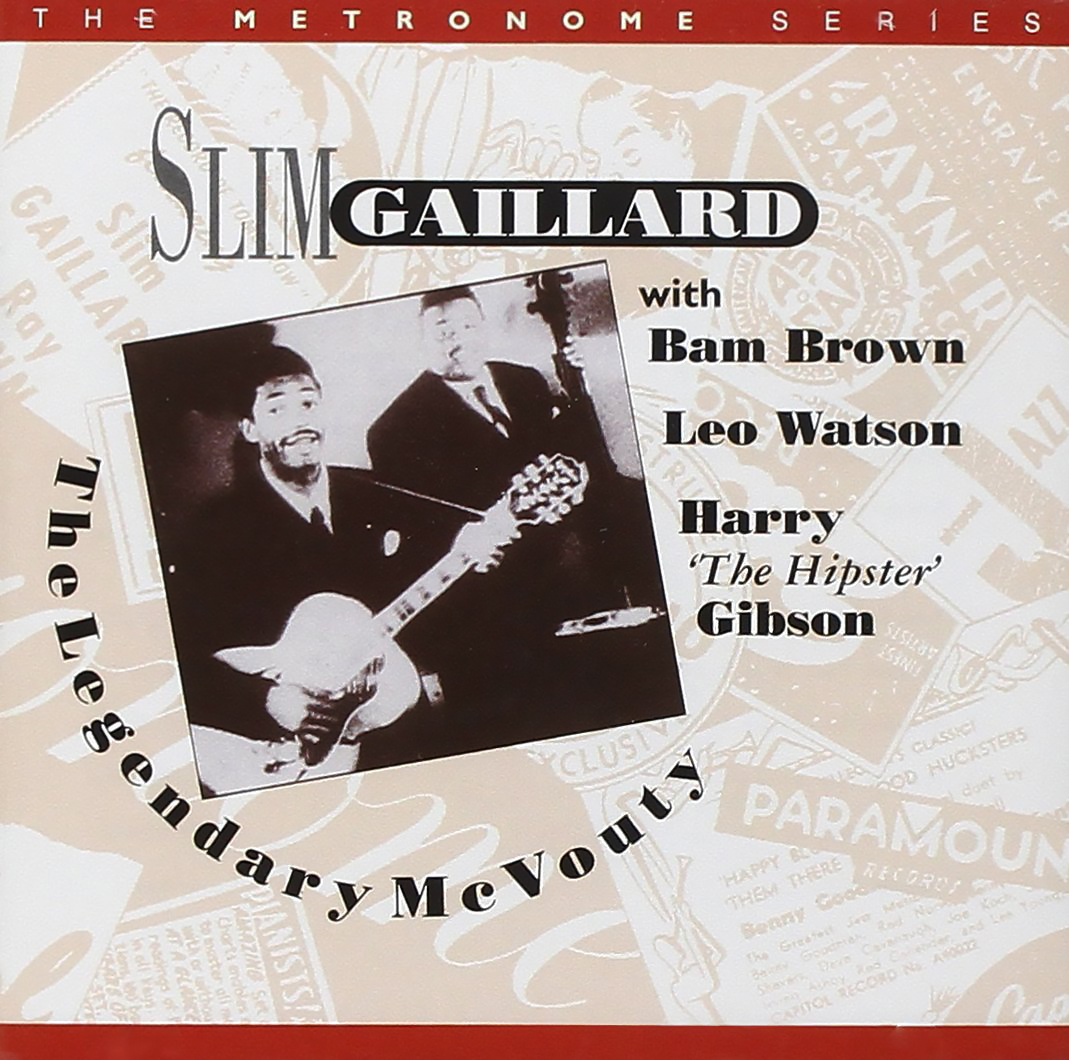
There are a lot of Slim Gailliard albums and compilations out there, and I haven’t run across one that reeks of cash-in or inferior product, but my personal favorite is the 1989 compilation The Legendary McVouty, a collection of live performances recorded in 1945 and 1946 (although one track dates back to 1941) in Los Angeles. This was only several years before Kerouac would write about him—On the Road took place between 1947 and 1950. One of the great advantages of The Legendary McVouty is it features a wild assortment of supporting musicians, including the likes of Chico Hamilton, Harry “The Hipster” Gibson, and Scatman Crothers.
The other reason I chose it is because it’s a live LP, and Gaillard could really only be fully appreciated live. Lunatic introductions, manic verbal interplay between musicians during songs, comic monologues delivered in media res—Gailliard needed the feedback of a live audience to really cut loose, and you simply don’t get Slim in all his manic glory on the studio recordings, although they’re well worth a listen. His songs are funny in and of themselves, and on occasion he even condescends to play a completely serious number.
A few words on Slim Gailliard. His birthdate is contentious, although he most likely came into the word spouting Vout-o-Reenee in 1918 in Florida. His career spanned nearly six decades; he first achieved prominence with hits such as “Flat Foot Floogie (with a Floy Floy)” and “Cement Mixer (Put-Ti-Put-Ti)” in the late thirties, and was still playing the European jazz circuit in the mid-eighties. Gailliard also appeared in numerous films (he’s a party singer in 1986’s Absolute Beginners) and TV shows. Charlie’s Angels? Righterooti. The Flip Wilson Show? Checkerooni. Marcus Welby, M.D.? Hand me the scalperooni! The Love Boat? No, unfortunately.
The album has to be heard to believed—as I mentioned, Gailliard could play straight up jazz (see his Live at Birdland, 1951 LP) but he doesn’t do it here. And to make the album even better, several guest singers get to do their thing, and they shine. Listening to drummer Leo Watson “sing” “Operatic Aria” is a joy; after mock-crooning, “I can’t sing/Because I don’t look like Bing” he interjects his scat singing with pure nonsense, and his sense of timing is impeccable. And the piano accompaniment by Fletcher Smith is slickavouti.
Even better is Harry “The Hipster” Gibson on “Hey Stop That Dancing Up There.” He sounds like a tuned-in wiseguy, and turns the song into a winner before it even starts by saying, “Let’s smoke up the joint, so a man can breathe.” At which the point the MC laughs and says “How do you do that?” Gibson’s reply”: “Well, I’d rub a couple pianos together.” He then says, apropos of nothing, “When did I leave Brooklyn? I’d better check me passport.” He then proceeds to play some knock-down, drag out piano, while tossing off surreal lines like “Living in the cellar, on the seventh floor” but always returns to a shouted, “Hey, stop that dancing up there!”
One of my faves is “Gailliard Special,” a four-minute-and-change song with a three-minute introduction that would have to be transcribed to be believed. It’s all hipster jive and, as is so often the case, Gailliard gives it a made-up title and names the imaginary film you can hear it in (“And now we have a special request for our new song ‘Our Grapes Have Tough Leaves’, that’s from the new RKO picture Rhapsodies in Avocados.”) He then describes the song’s “recipe,” which culminates with “then you take and you nail an avocado seed on the ceiling and you let it vout for a while.” When the song finally starts it’s just Gailliard on piano and Tiny “Bam” Brown on bass, and it’s a pity I wasn’t there because Gailliard’s doing something that has the audience in stitches.
Then there’s the great “Yep Roc Heresi,” on which Gailliard plays some boogie woogie on the piano, and by that I mean he really pounds the eighty-eights. Gailliard is joined on vocals by Bam Brown, and as for that title it’s pronounced “Yep Roc Herasi,” with a hard “a.” Gailliard opens things up by saying “We’re going to sing ‘Candy,’ that’s from the new picture My booti O Scrooti” and then instructs Brown as to how the song goes, saying, “You take the intro. Make a twelve-bar-and-a-quarter intro,” before they launch into the song and trade vocal gibberish.
Look, I could do this all day long, but we all have better things to do, so let me just say that you won’t want to miss the madcap “Matzoh Balls” (“from the new picture,” says Gailliard, “Question Mark: When the Vouts Come Back to Capistrano”… a rooti-roooti”) a guitar and bass number with Gailliard and Brown cutting it up throughout, and Brown hitting some crazy high notes.
“African Jive” is all percussion and natives-in-the-bush nonsense, with Gailliard occasionally tossing off words like “scotch and soda” and “fried ice cream” while another guy provides commentary and somebody else does some serious humming. It will put you in a trance, guaranteed. “Chicken Rhythm” is a swinging number with lots of clucking, with Gailliard at one point playing a kind of chicken cluck saxophone solo, which is followed by a short bass solo and all kinds of madness, including Gailliard delivering a speed rap in what may or may not be Spanish. It’s out of control. This one, along with two others, was recorded in NBC Studios in Hollywood, and the announcer introduces Gailliard as a “mad savage boy,” which was sadly meant as a compliment.
Follow-up “Fried Chicken O Routie” is a nonstop scat rap with one guy doing one thing, another guy doing something else, with somebody in there saying he wants some fried chicken. “Cement Mixer,” which was also recorded at NBC Studios, starts as a nonsense number, before Gailliard does some straight lounge singing before breaking into a rapid-fire Spanish rant. I’m not even going to attempt to describe the going-ons in the nine-minute-plus “Avocado Seed Soup Symphony, Part 1,” except to say that things get weird from the very start, when Gailliard says, “Hey, just a minute there, we have a little special opera we would like to open our symphony, Opus 3, Sonata 5,” before he jumps in on guitar and the guys sing “Buckdance rhythm, buckdance rhythm, buckdance rhythm, let your feet go down.” After that, you’re on your own. Suffice it to say you’ve never heard its likes before. The Latin interlude is particularly jaw-dropping.
Dean Moriarty may have been right—maybe Slim Gailliard WAS God. He was doing what Frank Zappa would do later, in a sense, but he was doing it organically and with a smile, not a sneer. There is joy in this music. And there may be more pure zany joy in this album than you’ll find on any album ever produced in this galaxy. Gailliard never claimed to be from another planet, the way Sun Ra did, but birth certificate notwithstanding, he didn’t come from here. Like Lord Buckley, he was one of a kind, and a testament to the power of unleashed word power, even if the words are in a language you need to consult a dictionary (is it even out there?) to comprehend.
Vouti rooti!
GRADED ON A CURVE:
A+