Author Archives: Michael H. Little

Graded on a Curve:
War,
Best of

Has there ever been a band as balls-out funky, that actually got played on the radio, as War? The horns, the inimitable percussion, the great group vocals—War had it all, to say nothing of some of the chillest songs of the rock era. Every time I hear them I think of the opening of the great “Summer”: “Riding ‘round town with all the windows down/8-track playin’ all your favorite sounds/The rhythm of the bongos fill the park/The street musicians trying to get a start.” I don’t know about you, but in my imagination it’s War I’m listening to on that 8-track, and if the 8-track player eats it there’s going to be hell to pay.
The L.A. band had something for everybody: soul, funk, R&B, jazz, reggae, and last but far from least, the Latino sound of the Mexican-American barrios of East L.A. From their start with Eric “Spill the Wine” Burdon to their later mostly upbeat takes on the life in the barrio, War was the dopest commodity around. Their songs spoke not only to their community but to everybody, as is demonstrated by the fact that if you don’t like “Low Rider” or “The Cisco Kid,” you are an ignoramus.

When it comes to packaging, Best Of is a less-is-better proposition, and I like it that way. No losers, you know? “Spill the Wine,” “Cisco Kid,” “Low Rider,” “The World Is a Ghetto,” and even the smooth grooves of “All Day Music” and “Why Can’t We Be Friends?” are all irresistible, as is every other tune on this compilation, with the exception of “Gypsy Man,” which I can’t listen to without seeing flashing disco balls.

The band’s recorded history opened with two LPs fronted by the white English bluesman Eric Burdon, and they gave us the great “Spill the Wine,” with its supercool organ riff, thank-you-Jesus percussion, and far-out monologue by Burdon, who calls himself a gnome. Oh, and did I fail to mention the funky flute? Or the chorus, which breaks up the song’s repetitive riff quite nicely? There’s even some Hispanic chick chattering away in the background. “All Day Music” is as smooth as good champagne, a pacifying tune featuring some great vocals that will, in the vocalist’s words, “soothe your mind.” The organ is cool, as is the breakdown in the middle, and while I tell myself this one is a bit too laid-back for my likings, I can never turn it off, perhaps due to the fellow who shouts, “Hoy!” and, “Uhh!”
Read More »

Posted in The TVD Storefront | Leave a comment

Graded on a Curve:
Berlin Brats,
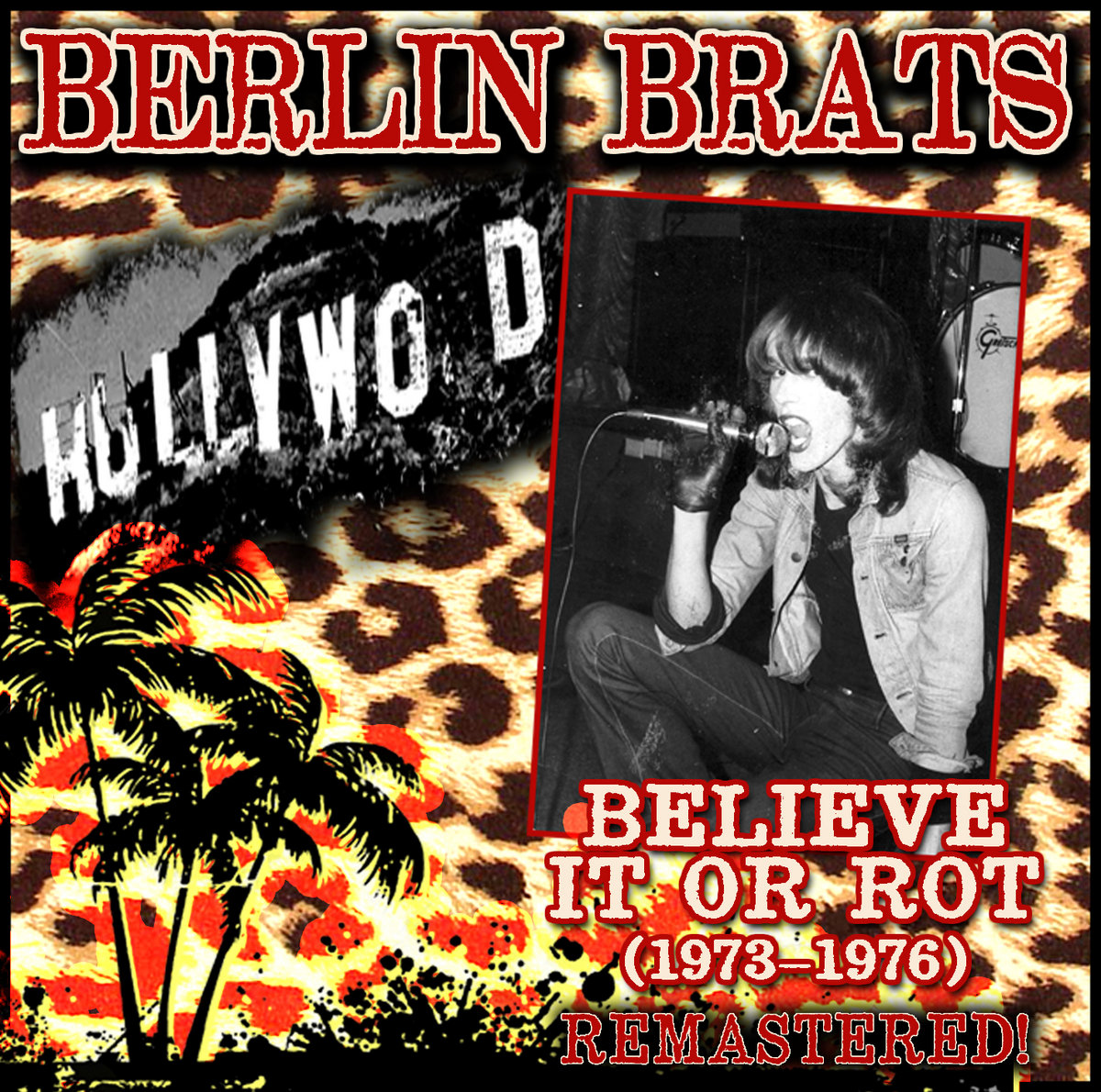
Believe It or Rot:
1973–1976

Hollywood’s answer to the New York Dolls, The Berlin Brats didn’t leave much of a footprint on the gutter glam, proto-punk era; there’s this 2010 half studio, half live compilation Believe It or Rot, a few mentions in Marc Spitz’ We Got the Neutron Bomb: The Untold Story of L.A. Punk, and a guest appearance on the 1978 Rhino compilation Saturday Night Pogo.

Indeed, tThe Berlin Brats’ main claim to immortality may be their role as competitors in the “Battle of the Bands” scene in Cheech & Chong’s marijuana masterpiece Up in Smoke, where they get pelted by food and lose by a two-foot joint to Alice Bowie’s heavy metal classic “Earache My Eye.”

But The Berlin Brats deserve more than a footnote. At their best , these L.A. drug abusers gave the Dolls a run for their money—like the latter band they had great songs, loads of glitter garage charisma, and a front man with a Mick Jagger fixation. And like the Dolls, the Brats definitely didn’t suffer from a personality crisis.

The Berlin Brats denied being influenced by the Dolls, and it may even have been true. It’s anything but implausible that bands at the opposite ends of the country were channeling the early R&B of The Rolling Stones and such garage murk forebearers as The Standells and The Sonics. And it’s hardly surprising that both the Brats and the Dolls were tapping into the transvestite Zeitgeist and playing dress up.

Read More »

Posted in The TVD Storefront | Leave a comment

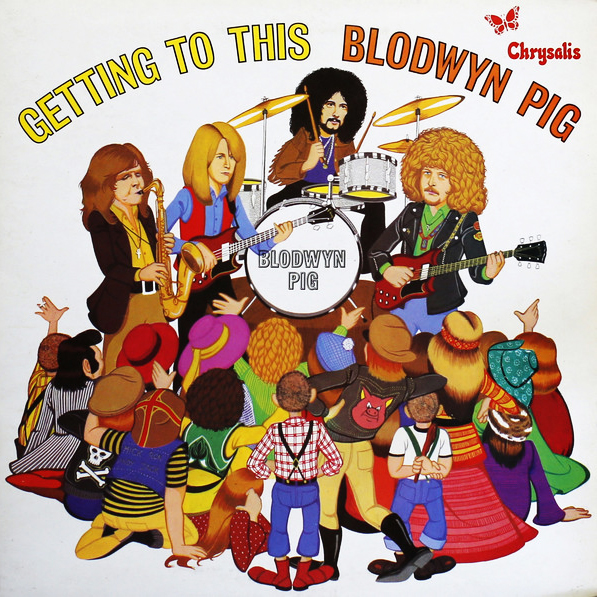
Graded on a Curve: Blodwyn Pig,
Getting to This

When friends recommended I check out Blodwyn Pig’s 1970 sophomore LP Getting to This, I was dubious. This was, after all, the band England’s New Musical Express praised for its promising blend of “Hooting grunting blues mingled with snorts of jazz.” The only adjective they omitted was squealing. Then there’s the issue of the awful band name, which only beats Pearls Before Swine by snout. You really shouldn’t name your band after livestock, unless you’re The Cows.

But now that I’ve listened to Getting to This, I can only say the above description is an understatement. Ex-Jethro Tull guitarist Mick Abrahams and gimcrack saxophonist/flautist Jack Lancaster (who’s been known to play two saxes at once just like Rahsaan Roland Kirk!) do more than hoot, grunt and snort—on Getting to This they whip up a pig’s ear stew, and toss in everything but the trotters.

The eclectic shtick doesn’t always work. Take “San Francisco Sketches.” It opens with some ocean atmospherics ala the Who’s “Sea and Sand,” then cuts to Lancaster sitting beneath a tree in Sherwood Forest playing a fey flute. Then a high school jazz band enters stage right, Abrahams plays a hot dog of a guitar solo, and a choir of heavenly voices enters stage left and pulls a Godspell on ya. Then things kick into overdrive, Abrahams’ guitar adds kraut to the dog, and Lancaster follows up with a tasty sax solo. Me, I want to take a surgical knife to the damn thing and remove the parts that irk me. I guess this is what your aficionados call progressive rock. I prefer to call it attention deficit disorder.

“Variations on Nanos” is even more out there. Lancaster opens on a freak flute note, launches into a flitting butterfly of a solo, then hands things over to Abrahams, who serves up a subdued but classy guitar solo. All’s as should be until Abrahams (who sounds a whole lot like nemesis Ian Anderson) decides to sing from the deep end of a swimming pool before climbing out, drying himself off, and launching into a dead-on impersonation of Captain Beefheart. Weird, but not as weird as “To Rass Man,” a Deutsche Schlager Oompah reggae tune designed to excite the lederhosen hacky-sack crowd.

Read More »

Posted in The TVD Storefront | Leave a comment

Graded on a Curve: 10,000 Maniacs,
In My Tribe

Some things you should know about the 10,000 Maniacs:

1. There only five of them. None of them are maniacs.

2. Natalie Merchant has a voice so lovely I’d dive into an icy lake to rescue it. Kinda husky, but not husky in a hockey player kinda way. More like Stevie Nicks without the cockatoo on her shoulder kinda way.

3. 10,000 Maniacs have yet to receive their due for spawning the Lilith Fair.

4. Natalie Merchant’s a folk artist in the grand tradition of the late Dan Fogelberg.

5. The word that best sums up the the music of 10,000 Manias is placid. But not placid as in Lake Placid, the horror movie where a 30-foot-long saltwater crocodile chows down on the citizens of Maine.

5.1. Had the man-eating crocodile in Lake Placid put In My Tribe on heavy rotation, today he’d be the owner of a New Age boutique.

6. “Like the Weather” is a fantastic song and I love to sing along with it in the car, despite the fact I don’t know the words. This tends to irk the other people in the car.

7. Cat Stevens’ “Peace Train” appeared on the original release of In My Tribe, but was omitted from later U.S. releases. I don’t want to go into the religious issues involved, but suffice it to say that had Salman Rushdie jumped aboard the peace train, Stevens would have pushed him off.

Read More »

Posted in The TVD Storefront | Leave a comment

Graded on a Curve:
La Düsseldorf,
La Düsseldorf

You’ve got to love a band with a proofreader. (La Düsseldorf has one and he’s listed on the credits!) Lord knows Slade could have used one. But unlike we English-speaking types, your Germans are a punctilious people and good spelling is important to them, probably because they regularly gutteral up words like Unabhaengigkeitserklaerungen, which if I understand correctly means cow.

But enough with the spelling bee. La Düsseldorf were a trio of art-rocking sauerbraten eaters who climbed from the wreckage of Neu! when that band exploded like a V-2 in 1975. Its embers included Kraftwerk/Neu! multi-instrumentalist Klaus Dinger and Neu! collaborators Thomas Dinger and Hans Lampe, and boy did they like to get their drone on.

On their 1976 eponymous debut, La Düsseldorf split the difference between Neu!’s trademark motorik beat and Bowie/Eno atmospherics, but spiced things up so you could dance to their songs in Berlin discotheques with frosty Helgas in black leather and frosty Ernsts in black leather and frosty dachshunds in black leather if that’s your scene.

The title track is the standout. “ La Düsseldorf” is the band’s equivalent of Neu!’s “Hallogallo”–you get the same I can’t drive 88–in kilometers that is–motorik beat and a cool keyboard drone, but unlike “Hallogallo” you also get explosions, Who-sized power chords, scat singing, piano plonk, soccer chants, what sounds to me like the banjo playing kid in Deliverance, screaming crowds, and enough other stuff to build a Teufelberg with.

Read More »

Posted in The TVD Storefront | Leave a comment

Graded on a Curve:
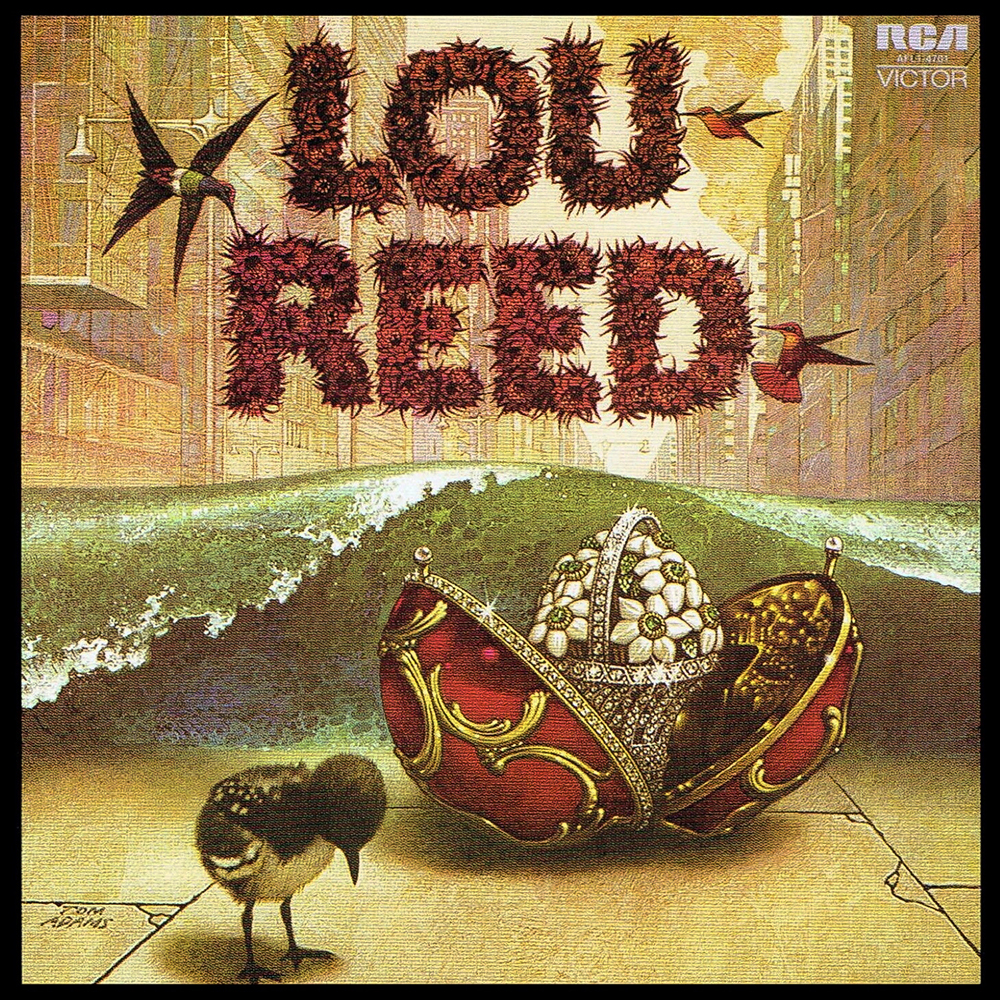
Lou Reed,
Lou Reed

Long derided as the failed predecessor of 1972’s Transformer, at first glance Lou Reed’s eponymous debut is a utter disappointment, slapdash, marred by perfunctory playing, poorly produced and short on new material. According to sideman Rick Wakeman of Yes fame, Reed insisted the lights in the recording studio be kept off “so nobody could see.” An apt metaphor that–by all accounts, Reed was a man blindly feeling his way through the darkness that followed upon the collapse of the Velvet Underground. So why is it I prefer Lou Reed to Transformer? I’ll get around to that.

Lou Reed followed a 15-month hiatus that gave Reed ample time to write new songs. But his muse was clearly comatose on a couch somewhere, because eight of the ten songs he brought to the table dated back to his days with the Velvet Underground. Reed’s inexplicable failure to come up with new songs isn’t Lou Reed’s only failing. Everybody’s favorite control freak let RCA Records pick his band, and he got what he deserved.

The guys from Yes and the guy from Elton John’s band and the other guys I’ve never heard of are hardly the B-listers Victor Bockris made them out to be in his 1994 book Transformer: The Lou Reed Story, but in this outing their performances are uniformly uninspired. (And they were hardly suited to back Reed in the first place. Try to imagine Wakeman in the Velvet Underground, I dare you.) Add to that Reed’s decision to hand off axe duties to Elton John band guitarist Caleb Quaye and Yes’ Steve Howe and it’s hard to avoid the suspicion that Lou was, whether he knew it or, dead set on sabotaging his solo career before it had even begun.

Read More »

Posted in The TVD Storefront | Leave a comment

Graded on a Curve:
The Beach Boys,
Wild Honey

Following the disastrous Smile sessions and amidst the continuing psychic disintegration of band auteur Brian Wilson, the Beach Boys took a daring step; they dispensed with Brian’s meticulously brilliant studio wizardry—not that they had any choice, given his poor mental condition—and their choir boy image at the same time, and put out an album, 1967’s Wild Honey, that shocked the world by demonstrating that the Beach Boys, those sexless avatars of surf rock in matching striped shirts—had actual huevos.

Instead of paeans to hanging ten, little deuce coupes, or teenage symphonies to God, the band settled into Brian Wilson’s living room and recorded a swear-to-God soul and R&B LP, one that downplayed the band’s group vocals and actually rocked. It’s to their credit that the Beach Boys, faced with the drug-induced abdication of Brian Wilson as the band’s sole creative force, didn’t retreat back to their roots as a harmony-oriented surf band. Instead they recorded an album that was, for them, every bit as groundbreaking as Pet Sounds. It’s been described as “California soul,” and the title fits; they even cover a Stevie Wonder song, and make it work. The pity is Brian Wilson had already basically given up; he told one interviewer, “I think rock n’ roll–the pop scene–is happening. It’s great. But I think basically, the Beach Boys are squares. We’re not happening.”

There was no denying that the Beach Boys were stuck with an un-hip image, but Wild Honey proves they were still “happening.” It sounds downright lo-fi in comparison to the Beach Boys’ previous LPs, and that’s one of its chief charms. Another is the vocals of Carl Wilson, which are loud and soulful and pure rock’n’roll. He’s especially great on the title cut, on which he practically screams. Throw in some great backing vocals, a rollicking melody, and one strange organ solo, and what you’ve got is a killer tune. Carl even shouts, “Sock it to me!” likes he’s a cast member of Rowan & Martin’s Laugh-In. “Aren’t You Glad” is pure pop, and a happy-go-lucky tune featuring horns, hand claps, and the vocals of Mike Love and Carl and Brian Wilson. It sounds as fresh today as the day it was recorded, as does the band’s take on Stevie Wonder’s “I Was Made to Love Her,” on which Carl Wilson shows off his chops as a soul shouter to the accompaniment of some great backing vocals.

Read More »

Posted in The TVD Storefront | Leave a comment

Graded on a Curve:
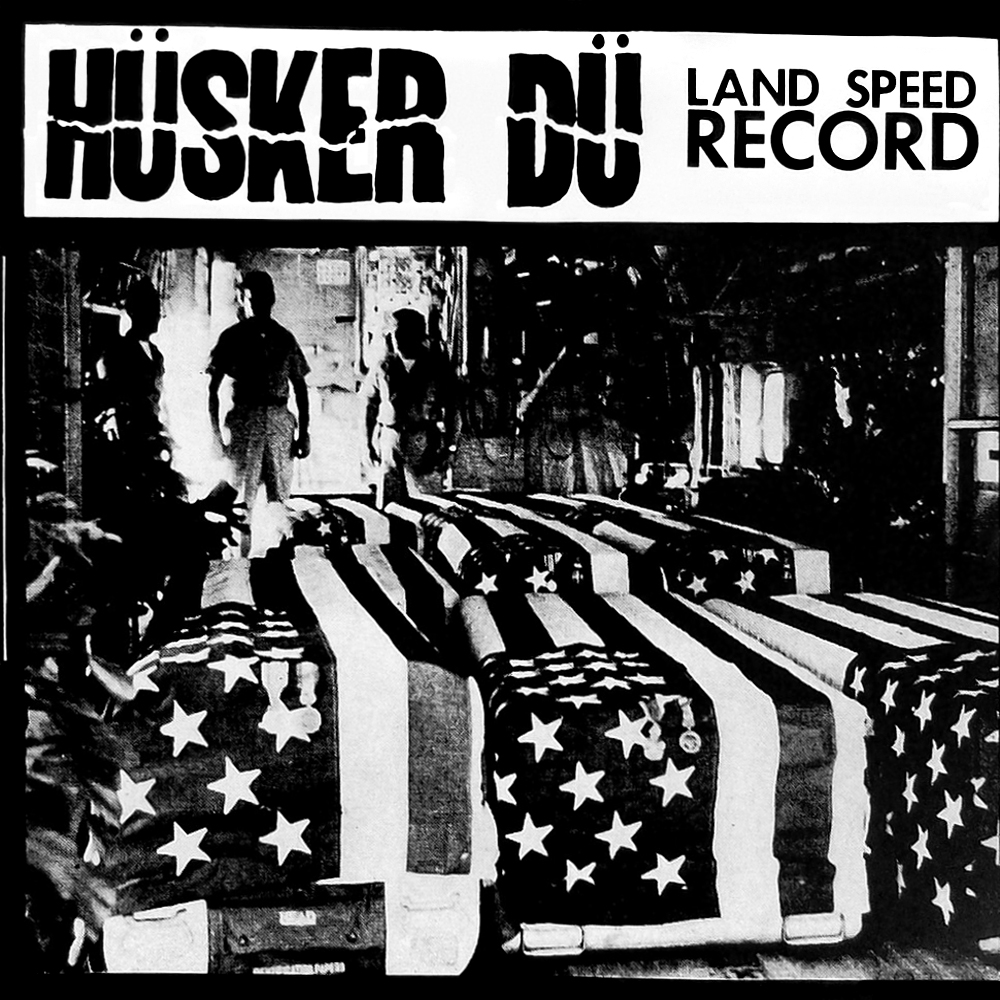
Hüsker Dü ,
Land Speed Record

I’ve set myself a 27-minute time limit on writing a review of this 17-track amphetamine blur of an LP–recorded live on a 4-track soundboard tape at the 7th Street Entry in Minneapolis, Minnesota on August 15, 1981 for $300 bucks–seeing as how that’s the album’s run time and people of conscience (Black Lives Matter!) have more important things to do than read record reviews.

On the appropriately titled Land Speed Record you can hardly make out where one song ends and the other begins, the lyrics are unintelligible, and good luck finding a melody. The Hüsker Dü that recorded Land Speed Record had a long way to go in the songwriting department, but they would carry one thing into the future, namely Bob Mould’s rage. Even if you need a lyric sheet to figure out exactly what he’s so enraged about.

Land Speed Record has a savage and nihilist bent that Mould himself would soon lambast in the anthemic “Your Anarchy I Bullshit” anthem “Real World.” “Don’t Have a Life” and “Let’s Go Die” are characteristic hardcore tropes, but then again neither were Mould/Hart creations. They were written instead by bass player Greg “King of the Handlebar Mustache” Norton, whose songwriting credits soon fell to nil, perhaps because the other guys feared “Let’s Go Die” might become the hardcore equivalent of Blue Öyster Cult’s “Don’t Fear the Reaper.”

Read More »

Posted in The TVD Storefront | Leave a comment

Graded on a Curve:
Shaun Cassidy,
Wasp

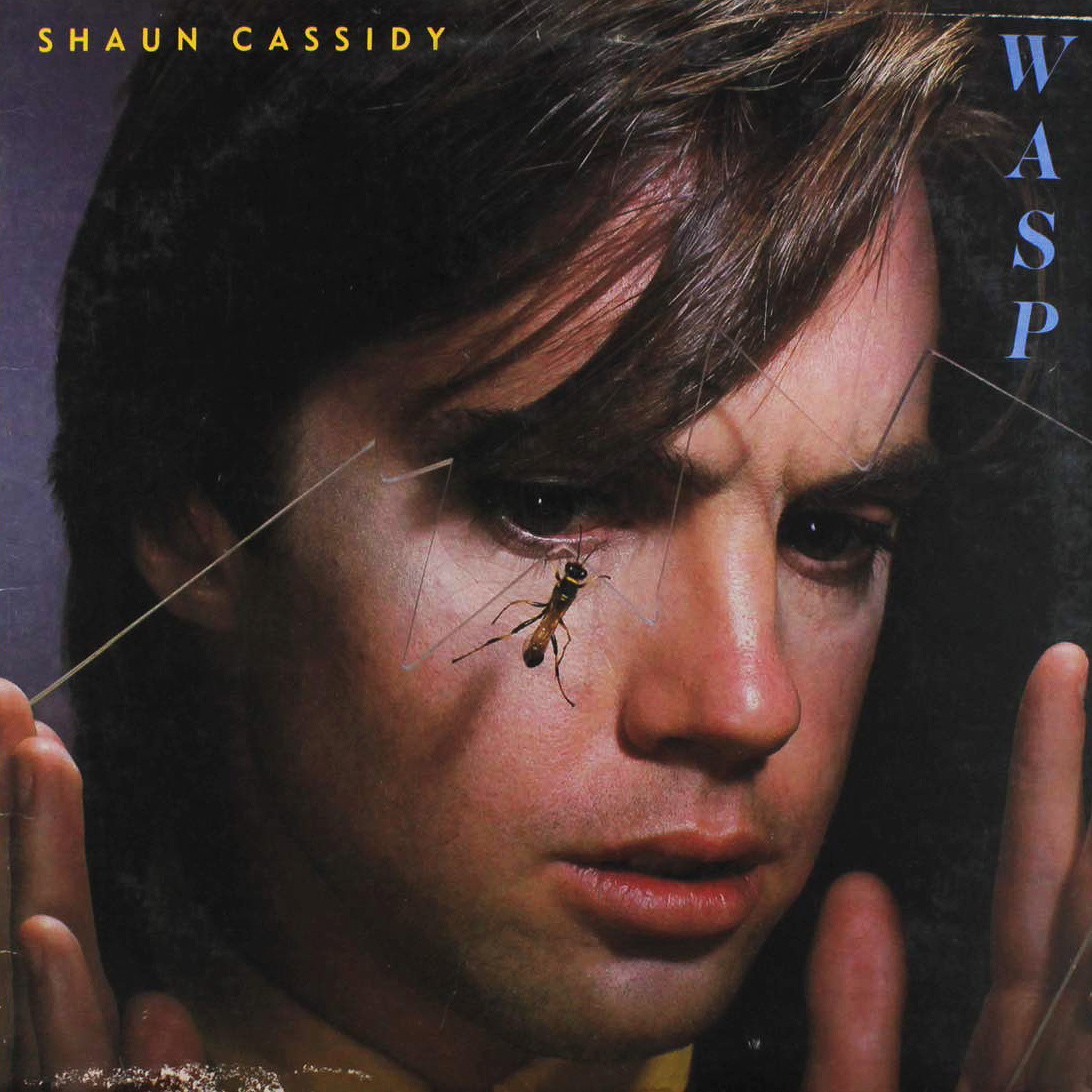
If David Bowie was so weird, how come former teen hottie Shaun Cassidy’s cover of “Rebel Rebel” on his 1980 LP Wasp makes the Bowie original sound so … tame? Sure, Bowie’s half-pooch self on the cover of 1974’s Diamond Dogs is what you might call weird even though his dog dick’s been airbrushed out, but Shaun doesn’t have to resort to such gimmickry–he looks just like his White Anglo-Saxon Protestant (as in WASP!) self on the cover of Wasp, although he seems understandably nervous cuz he’s got a stinging insect on his face.

Often derided as a last ditch effort to resuscitate Cassidy’s moribund career, Wasp was produced by Utopian Todd “I’ll produce something/anything” Rundgren, who might have turned the album into a New Wave Bubble Freak masterpiece. Unfortunately, Sir Wizard and True Star stopped short at “Rebel Rebel” (more about which later), and filled the rest of the LP with what are largely workman-like covers of largely pedestrian material.

Wasp includes three Utopia songs–exactly three more, if you do the math, than any sane listener wants to hear. None deviate much from the originals, which is to say they’re once, twice, three times redundant, which in corporate terms means they’d be given severance packages and shown the door. Except wait: the title track is fascinating indeed: Shaun shouts “Hey cowboy, didn’t you used to be a faggot bartender in the West End?” (the lyric sheet reads “packy back” but I know homophobia when I hear it ), then confuses New Wave with punk (“You’re looking mighty New Wave/I hardly recognize you with that shish kabob through your face.”) In short it’s a hoot, in large part because it betrays poor Todd’s complete ignorance of current events.

The other two Rundgren tracks are useless: on “Selfless Love” Cassidy gets his heart broken and threatens to jump off a mountain, which is a pretty selfless thing to do if you ask me. “Pretending” gives Shaun the chance to get all theatrical, and gives the impression he’s auditioning for a role in Cats.

Read More »

Posted in The TVD Storefront | Leave a comment

Graded on a Curve:
No Trend,
Too Many Humans/
Teen Love

Drag City Records’ May 29 release of the No Trend Too Many Humans/Teen Love box set comes during a resurgence of interest in the Ashton, Maryland hardcore band turned three-ring circus. While the band went on to record three additional LPs and an EP with Lydia Lunch, the Drag City compilation chronicles the band’s early years, when their Flipper meets PiL grind and black humor made them the enfants terribles of Washington, DC’s hardcore scene.

I exchanged e-mails with the duo who co-produced the set: former No Trend guitarist Buck Parr (who played with the band in 1985-86) and writer Jordan Mamone, and together they cast light on how the project came about. But first, here’s Parr’s rundown of the box set’s contents:

“The box set includes exact vinyl facsimiles of the Too Many Humans LP and the “Teen Love” 7″ and 12″ right down to the original inserts, and how things are folded. It comes with 40-page booklet with a great interview I did (tooting my own horn, but whatever), plus the French Too Many Humans bootleg book, one of the ‘lost’ dance books, and all manner of other nonsense. (The box set also includes flyers from a variety of shows, as well as bonus CDs consisting of demos and live recordings from San Francisco’s Mabuhay Gardens and LA’s Cathay de Grande.) Comedian Neil Hamburger (aka Gregg Turkington) actually recorded one of these shows. How weird is that?”

“For decades,” Parr added, “people had been writing to Jeff (band leader Jeff Mentges) in an effort to re-release the material on this set (the Too Many Humans LP and the “Teen Love” EP). Jeff, for reasons known only to himself, would refer these inquiries to me. I’d check them out–some of them seemed rather worthy–and report back to Jeff, who would invariably kill the idea. He really had little interest in seeing this material out again. He’s never been altogether concerned with the band’s legacy and saw releasing old material as pointless.”

Read More »

Posted in The TVD Storefront | Leave a comment

Graded on a Curve: Emerson, Lake & Palmer,
Tarkus

It’s the coup of the century! I’m talking about my exclusive interview with the shade of the late Greg Lake, singer, bassist and guitarist of the greatest pomp rock band in history, Emerson, Lake & Palmer! Greg had a prior commitment (“I’m off to jam with Rachmaninoff”) but he set aside a few moments from his busy schedule to answer a few questions. So without further ado, let’s get to it.

For starters, I would just like to say how much I love “Nights in White Satin.”

GL: That was by the Moody Blues.

My bad. “Lucky Man” then. And that song, I can’t remember the name of it, that starts “Welcome back my friends to the show that never ends.” Are you talking about the song, which seems to go on forever?

I see “Karn Evil 9″ a a stripped-to-the-basics rock ’n’ roller. We wrote it in the spirit of Carl Perkins.

I hear that simplicity in all of your work. It has an almost garage-like feel that brings to mind the Standells’“Dirty Water.” With Hammond organ, St. Mark’s Church organ, piano, celesta, and Moog modular synthesizer thrown in.

We liked to think we were playing Chuck Berry with a tip of the old orchestra to Tchaikovsky.

Some would say your music is pretentious.

Is it our fault we were the first band to realize the potential of artificially inseminating rock with the jism of classical music? Why restrain yourself to playing three chords when you could be playing 4017?

Read More »

Posted in The TVD Storefront | Leave a comment

Graded on a Curve:
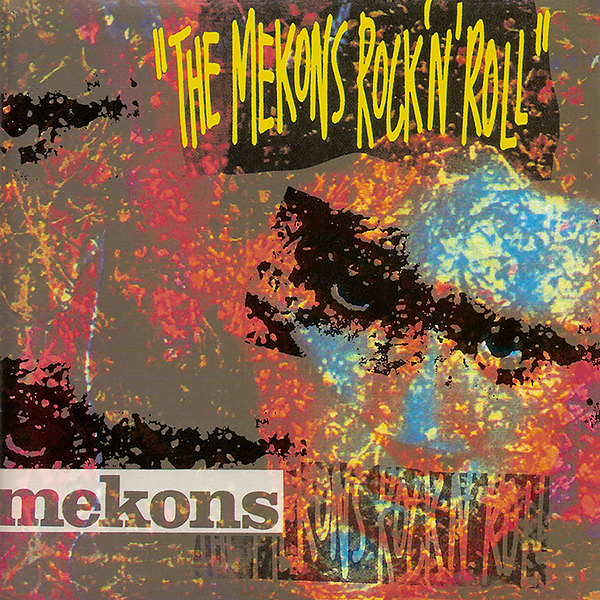
The Mekons,
The Mekons Rock ‘N’ Roll

It’s a rare occasion for the TVD reviews team to have weighed in on the same LP several years apart. We put them side by side today—with surprisingly similar results.Ed.

You don’t have to be a dyed in the wool Marxist to know that rock ’n’ roll is product—just another consumer item to be consumed by consumers who live to consume. It’s everybody’s not-so-secret dirty secret, as obvious as a turd suspended in Jello, but when push comes to shove only a limited number of bands—I can think of the Minutemen, the Fall, and Fugazi off the top of my head—have addressed the issue both in the way they do business and as subject matter in their songs. And no band has ever done it with such passion, fatalistic humor, and rage as The Mekons do on their 1989 walk on the riled side, The Mekons Rock n’ Roll.

Formedon in 1977 by a rowdy bunch of University of Leeds art students, the Mekons combined rank amateurism, left-wing politics, and a wry sense of humor (the title of their 1979 full-length debut, The Quality of Mercy is Not Strenen, doesn’t make much sense until the album cover reveals it to be a monkeys at typewriters producing Shakespeare joke). The Mekons gradually evolved, practically inventing alt-country in the process, but returned to their punk roots (at a stage in their career when most bands have settled into comfortable conformity) to produce what is both a howl of unbridled savagery and probably their masterpiece.
Upon first listen, The Mekons Rock n’ Roll is exactly what it purports to be—a rough and raucous celebration of the glories of rock ‘n’ roll. Except it isn’t. What it is a sly critique of rock as commodity, of sex as commodity, of a world where everything is commodity—a veritable “Empire of the Senseless,” to cite just one of the wonderfully intelligent and derisory tunes on this savage assault on capitalism disguised as an LP. “They took away our films and tapes and notebooks/But it’s ok ‘cos we’ve self-censored this song,” sneers Tom Greenhalgh, before running down a long list of the lies and deceits and casual everyday treacheries that constitute life in a materialistic society where everything has its price. As for the song itself, it boasts a great chorus, one wonderful melodica, and some truly brilliant fiddle by the wonderful Susie Honeyman.

Read More »

Posted in The TVD Storefront | Leave a comment

Graded on a Curve: Teenage Jesus and
the Jerks,
Live 1977–1979

In 1979 I was living out my lifelong dream of a being a failed painter in a rat-infected loft on the Lower East Side when I first saw Teenage Jesus and the Jerks. Their 3-minute 78-song set changed my life.
The next day I gathered up the money I was going to spend on bread and bologna and put down a deposit on a guitar and a blown amp. I went home and tuned the guitar to the key of dreadful, tortured it with a pair of plyers until it confessed, then dropped it into my bathtub where it sizzled, blacking out the entirety of Alphabet City.
And just like that I was a No Wave Star.

Except I wasn’t and Lydia Lunch told me so. I played her something and she said, “Look, I appreciate all the bologna you’ve given me over the years, but there’s a big difference between good shit and bad shit and your shit is probably the worst shit I’ve heard in my entire life.”

I was so hurt I cut off her bologna supply and moped around the loft pretending to be a nihilist. After nine hours of deliberation I decided I was going to buy some heroin and become a junkie, but ended up spending the money on a TV Guide instead.

After returning to the loft I tried to figure out what I was doing wrong. I practiced for exactly 13 minutes per day just like everybody else, and owned the exact same La Monte Young album they owned but never listened to. I used mine as an impromptu lap table.

Read More »

Posted in The TVD Storefront | Leave a comment

Graded on a Curve:
9353,
To Whom It May Consume

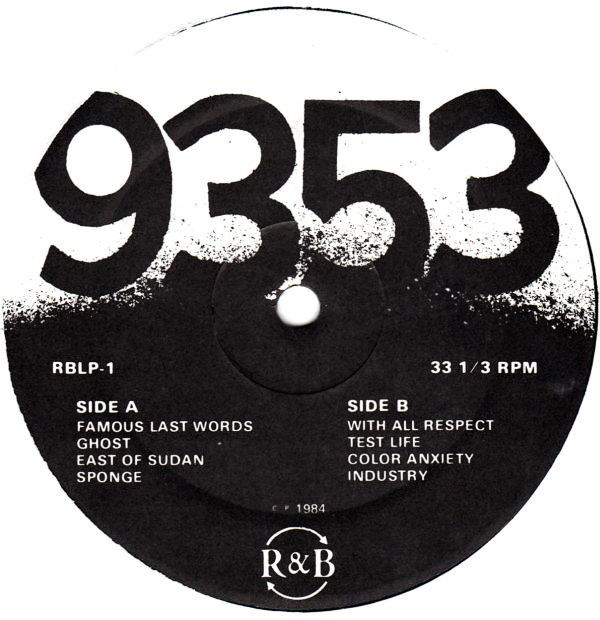
The only time I saw legendary DC hardcore crowd displeasers 9353, vocalist Bruce Merkle spent the entire set tied to a chair. If that doesn’t give you an idea of how extraordinarily bizarre they were, listen to their music.

Like fellow scene outcasts No Trend, 9353 went out of their way to mock the unwritten shibboleths dictating the behavior of the Dischord Records crowd. 9353 gave the old middle digit to sincerity, seriousness, self-righteousness, responsibility, common decency, virulent puritanism, inbred tribalism, and sexually repressed male teenage hormonal rage. No wonder many of your earnest Emo progenitors hated the black-hearted jesters in 9353–they didn’t flex your head so much as fuck with it.

I was as much a victim as anybody. If my finely tuned sense of the absurd was in accordance with theirs (the repeated mantra of “Famous Last Words” goes “It’s okay, it’s not loaded/I’m a good driver, don’t worry honey”), their music befuddled me. It was totally out of sync with the times, and just the sort of thing to piss off audiences looking to see the latest Positive Force band do some fancy sermonizing. 9353 may as well have crash landed on the National Mall in a UFO, before emerging in paisley leisure suits.

Stylistically speaking, the songs on 9353’s 1984 debut To Whom It May Consume run the gamut. “Color Anxiety” and “Spooky Room” are mutant new wave fuckabouts. “Famous Last Words” and “Ghost” evoke John Lydon and Public Image Ltd. “Egnossponge” is a spaced-out Krautrock extravaganza. “Test Life” and “Industry” are warp-speed loony-tunes jaw droppers.

Read More »

Posted in The TVD Storefront | Leave a comment

Graded on a Curve:
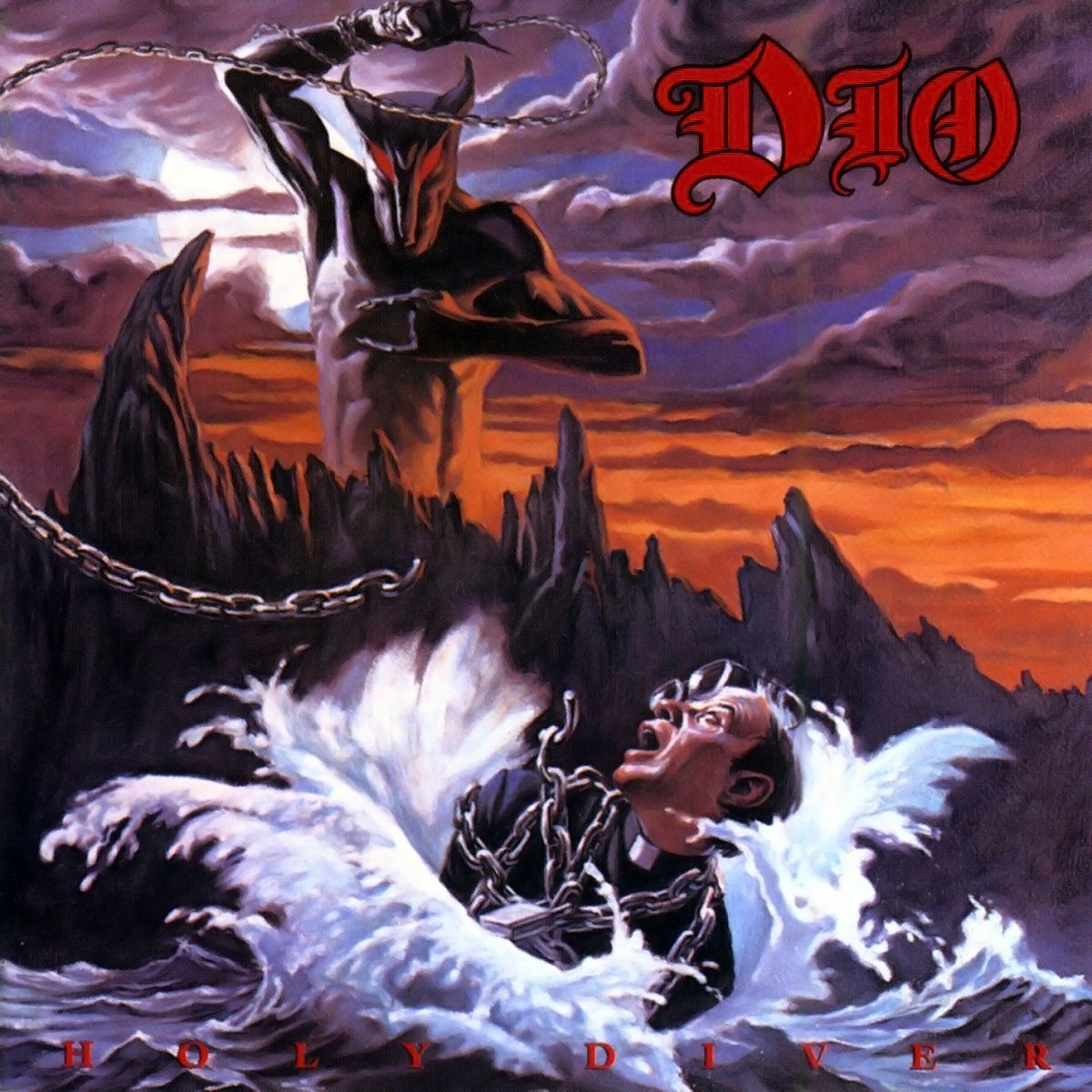
Dio,
Holy Diver

There are 666 things you need to know about Ronnie James Dio.

1. Ronnie is widely credited as having invented the “Sign of the Horns.” Under patent law, you are legally obliged to pay Ronnie 15 cents every time you use it. Per hand.

2. Fact: In 2003 Dio lost part of his thumb to what he called a “killer garden gnome.” Afterwards Ronnie tossed the gnome in the trash, but it kept coming back. “It’s out there,” he would tell friends, peeking out the window. “Waiting. Just waiting.”

3. Ronnie was a big medieval music fan and used to get together with former Rainbow band mate and fellow medievalist Ritchie Blackmore to play flute, sing madrigals, and contract the Black Plague.

4. In a 1991 poll kindergartners were asked what historical personage they would least want to see added to the cast of Sesame Street. Ronnie James Dio came in next to last, just before Adolf Hitler.

5. Ronnie, who was 5′ 4″, was once quoted as saying, “I always wanted to be a basketball player.” He then added, “Preferably with the Delaware Dwarves.”

6. Dio’s first band was called Elf. The name led to a revolt in the Elven community. Haldir, Elf of Lothlórien, told his troops, “We must crush the man on the Misty Mountain before he joins Black Sabbath and lays waste to the band that bequeathed us “Fairies Wear Boots.”

7. The biggest difference between Dio and his predecessor in Black Sabbath was that Dio didn’t have a serious ant addiction.

Read More »

Posted in The TVD Storefront | Leave a comment
  • SUPPORTING YOUR LOCAL INDIE SHOPS SINCE 2007


  • Alternative Text Alternative Text Alternative Text Alternative Text Alternative Text Alternative Text Alternative Text Alternative Text Alternative Text Alternative Text Alternative Text Alternative Text Alternative Text Alternative Text Alternative Text Alternative Text Alternative Text Alternative Text Alternative Text Alternative Text Alternative Text Alternative Text
  • Alternative Text Alternative Text Alternative Text Alternative Text Alternative Text Alternative Text Alternative Text Alternative Text Alternative Text Alternative Text Alternative Text Alternative Text Alternative Text Alternative Text Alternative Text Alternative Text Alternative Text Alternative Text Alternative Text Alternative Text Alternative Text Alternative Text Alternative Text Alternative Text Alternative Text