It’s impossible to tell the story of Andrew Gold’s 1976 album What’s Wrong with This Picture? without first telling the story of how:
Death Came to the Princes of LA on a Horse Named Wildfire
Last night I dreamt I was soaking in a hot tub at Glenn Frey’s place in Laurel Canyon with Don Henley, J.D. Souther, Andrew Gold, and Jackson Browne. We were drinking tequila sunrises and talking past triumphs, our seventies chest hair glistening in the otherworldly light of the deadly wildfire that was roaring towards us.
We’d talked about jumping into our Porsches and making our escape, but in the end had decided to stick it out in the hot tub, outlaws with the voices of angels to the very end. The time seemed right. Down in Hollywood glam had been followed by punk, and both groups mocked our mellow vision with their sounds of sneering derision. The world, it seemed, had wearied of our brand of peaceful, easy LA fornication rock. It made fun of the way our turquoise chains perfectly set off our golden chest hair, made fun of our $9,000 Italian-made cowboy boots and our wonderful, beautiful, perfectly blow-dried man beards, made fun, believe it or not, of our entire way of life.
No, we’d decided this was it—California Narcissist Rock’s Last Stand.
So as the flames closed in, we reminisced and talked about what we’d miss. “The girls,” said Don Henley. “The cocaine on the girls,” said Glenn Frey. “My own unacknowledged supertalent,” said J.D. Souther. “My cloying sensitivity,” said Jackson Browne. “My beard, which is the Platonic ideal of Seventies’ LA facial hair,” said Andrew Gold. We all took a moment to admire Andrew’s Platonic Beard. Andrew was right. Andrew’s beard belonged in a beard museum, behind glass.
“We had a good ride,” said Don. “People considered us arrogant and shallow and greedy and hedonistic, but we had every right to be. We were geniuses, fired in the forge of the Troubadour, and we ruled this town with our fist in its glove of peaceful, easy white privilege.”
“Love ’em and Lear ’em,” said Glenn.
“Getting pretty toasty,” said Andrew. “Good thing we have a bottomless supply of our signature drink, the cool and panic-suppressing Tequila Sunrise.” We all raised our glasses in tribute.
“J.D.” said Jackson, “Your beard’s on fire.”
J.D. calmly hurled his tequila sunrise into his face and said, “Gentleman, the hour is late. I say we conclude our extended engagement in this shallowest and most glorious of towns with a soulful rendition of ‘Take It Easy’.”
And that’s what we did, as the wind howled red and the fire roared through and boiled us, still singing like turquoise angels, in our hot tub.
Except:
Andrew Gold Survived and Put Out a Terrible Album
When the wildfire had passed, Andrew Gold lifted his head from the water, his beard still the golden epitome of Seventies facial hair, spit out some water, said a quick prayer for his dead friends, then headed straight for the studio and recorded a terrible album.
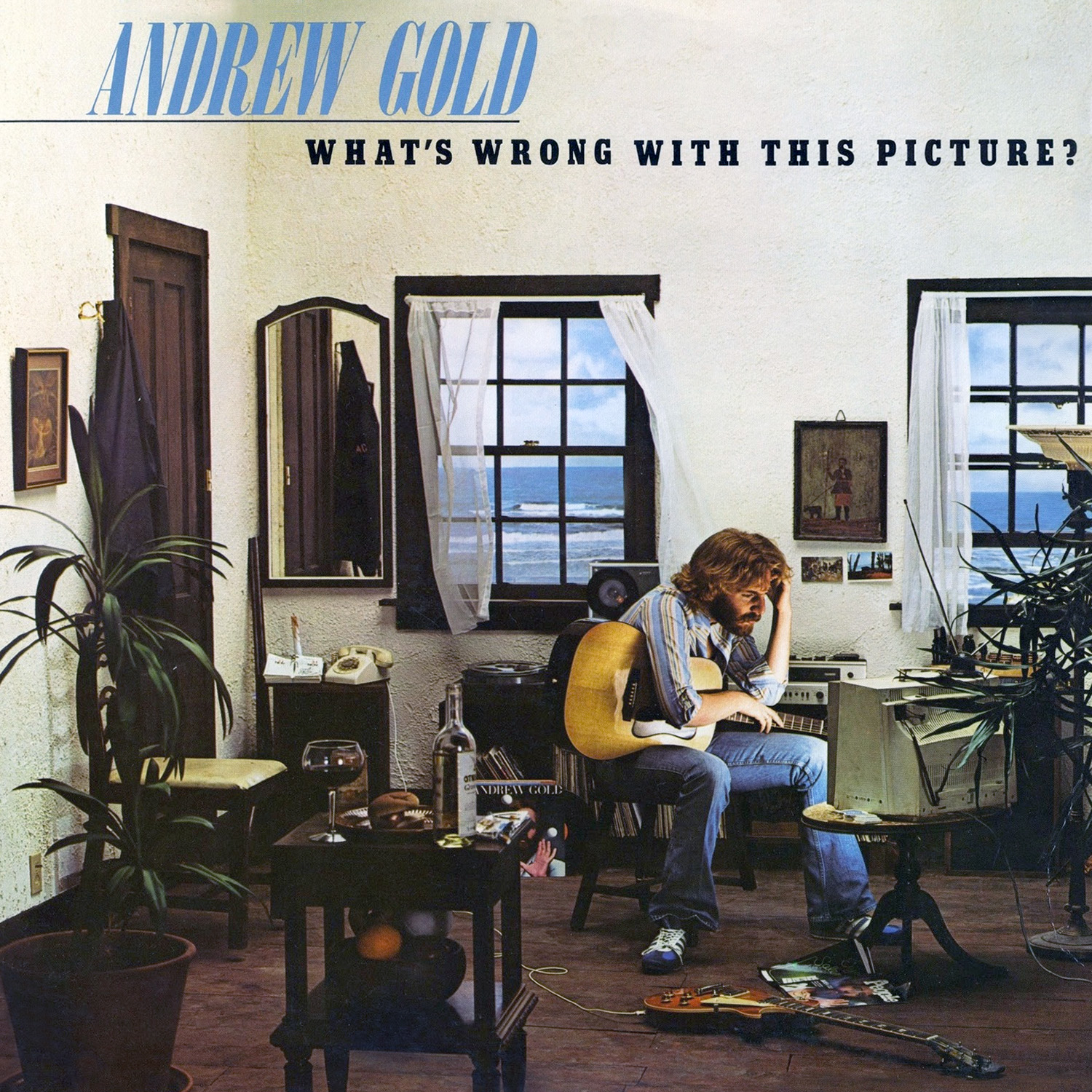
It’s called What’s Wrong with This Picture? and was released in America’s Bicentennial Year, and the album cover is a game. There are people, university researchers and the like, who’ve spent their ENTIRE LIVES studying the album cover, and these people have conclusively determined that there are EXACTLY 32 things wrong with the album cover. For instance, the guitar is plugged into the phone, the wine in the bottle is white, but the wine in the glass is red, and the sea in one window is higher than the sea in the other window. It’s worth buying the album cover (forget the album) just to play yourself. It’s fun.
But here’s the thing. Had Gold called his record What’s Wrong with This Album? you could come up with hundreds of things, or perhaps even thousands of things, wrong with the album, without even trying. It’s undeniable that Gold was the Secret Mover of Seventies El Lay soft rock. He was everywhere—the musician, songwriter, and record producer behind the likes of Linda Ronstadt, Art Garfunkel, Eric Carmen, etc., and if he wasn’t playing on this he was writing that, and if he wasn’t writing that he was arranging this, and if he wasn’t arranging this he was a member of the touring band of this artist or that artist. The Man with the Golden Beard was omnipresent, his resume nothing short of supernaturally stupendous.
But Andrew had solo aspirations, and why not? He was the guy who wrote and recorded “Thank You for Being a Friend,” which went on (in another version, but still) to become the theme song for The Golden Girls! Which probably made him a billion dollars!
The problem was our multi-talented Golden Boy, who plays fifteen (!) different instruments on What’s Wrong with This Picture? including cowbell, wrote boring songs, pedestrian songs, zero-risk songs with no lyrical content and restrained melodies, starting with “Hope You Feel Good,” a slick and bouncy “feel good” song that says exactly nothing and goes on forever and then some. At one point, he sings:
How I’m gonna tell you
Darling what you mean to me
It’s gonna take some real fine poetry
If I only could then I surely would
Get myself to write you a symphony
With the most beautiful melody
That you have ever heard.
Trouble is he doesn’t have it in him to write real fine poetry and he certainly hasn’t written a symphony with the most beautiful melody you have ever heard. He has written a dud, a song so completely devoid of personality that you can’t help but suspect it was written by a computer with a rhyming dictionary.
But you regret it’s being over because he follows it with the vapid ballad “Passing Thing,” a sub-Carole King sub-James Taylor piece of treacle with bad lyrics complete with a shakuhachi (a kind of Japanese bamboo flute) solo in the middle, which you’ve got to hand it to Andrew is an original touch, even if it doesn’t come close to saving the song. No song that opens with the lines “Slowly sailin’ leaves/The children of the trees/Evicted by the wind/And can’t return again” can be saved. That “Evicted by the wind” literally makes me flinch.
He then attempts to liven things up with a completely unnecessary-to-life-on-this-planet cover of the old saw “Do Wah Diddy,” which, being a super-talented producer of the overkill school, he ruins by burdening it with strings. Strings! Horns, sure! Like on the great 1963 version by the Exciters! But strings? It’s madness. The excitement level of the Gold version never rises above a 3 at best. Compared to the Exciters’ 11! And he clutters it up with all kinds of other stuff too. At least the Manfred Mann band was smart enough to keep things simple. Why anyone would listen to the Gold version when we have the Exciters version AND the Manfred Mann version is beyond me. It’s El Lay-produced to death.
He then turns to destroying Buddy Holly’s “Learning the Game,” namely by slowing it to a crawl and singing it in a voice so singer-songwriter touchy-feely sensitive you’ll want to puke. The arrangement is fine, and the mandolin and steel guitar are nice touches, but a quick comparison with the Holly original is enough to demonstrate what’s been lost, namely the song’s heart and soul. “Angel Woman” (horrid title) is another slow piano ballad with strings and while Randy Newman might have been able to do something with the melody, all Gold can do is emote, emote, emote, like he’s Dan Hill for Christ’s sake, and the song’s only positive attribute is that it only goes on for about a minute and a half.
“Must Be Crazy” isn’t nearly crazy enough. It’s an upbeat number, perky even, but it’s so MOR boring and studio slick (he’s using the best studio hacks LA has to offer, after all) you don’t believe that he’s crazy or she’s crazy and I can’t believe James Taylor didn’t get around to covering this one—it’s right up his anodyne alley. As for the “wild” guitar solo and the “wild” saxophone solo that follows the “wild” guitar solo, all they do is underscore how soft rock dull this entire “crazy” affair really is. Note to Andrew: Leave the insanity to Warren Zevon. In all of corporate rock LA, he was the only real crazy in town.
“Lonely Boy” was the hit, and it’s a very strange hit, all about a boy whose life is destroyed because, get this, his parents dared to have a second child. It has to be the most self-pitying song to ever climb into the Billboard Top Ten, but it has this irresistibly jaunty melody and a great piano line and brings 10CC to mind. Boasts a great guitar solo too. Linda Ronstadt sings backing vocals, but I’ll be damned if I can hear her, can you? Had Randy Newman dealt with the same subject matter, the results would have been hilarious. I THINK Gold is trying to make the song funny, but I could be wrong, and if he isn’t trying to make the song funny, it’s a real condemnation of Andrew Gold. Robert Christgau once called Gold “Barry Manilow in a flannel shirt.” He was wrong. Gold was Barry Manilow with a perfect beard.
“Firefly” is an awful little lullaby with acoustic guitar and is as slick as they come, with lush backing vocals. Avoid it the way you would an Ebola patient. “Stay” is Gold’s take on the Maurice Williams doo-wop song that Jackson Browne would do a definitive contemporary version of the next year, and the reason Browne’s version is the definitive contemporary version is that it’s relaxed. Gold really busies it up and gives it a peppy Caribbean flavor (dig those congas). He tosses in backing vocals by Ronstadt and Peter Asher too. But it’s too complicated. Browne had the good sense to keep things simple and relaxed. If you’re going to be a successful singer-songwriter, the first thing to remember is that less is more. Always.
“Go Back Home Again” is an uptempo “rocker” with bad lyrics that have Loggins & Messina written all over it. Gold is unconvincing as a tough guy, and this soft hard rocker really has nothing to distinguish it from the pack—it seems less a song than a genre exercise. The same goes for the pop ballad “One of Them Is Me,” which is overproduced and features lush vocal harmonies and an electric piano that really gets on my nerves. But its biggest problem is its message, which is so muddled and complex that there’s no way a record buyer can relate—it’s built like a hit single, but there’s no way in hell it could have become a hit single. Once again, it’s all about simplicity, in sentiment as well as in production.
Which brings us to the fact that:
No One Escaped The Hot Tub Disaster Caused by the Horse Named Wildfire
Not me. Not Don Henley. Not Glenn Frey. Not Jackson Browne. Not J.D. Souther. And not Andrew Gold. We were all boiled alive while singing “Take It Easy.” And that makes for thirty-three things wrong with the cover of What’s Wrong with This Picture? Andrew Gold’s in it. Or Andrew Gold’s ghost. In the rooms of the Hotel California, which was where the cover photo was taken, you’ll find all kinds of spirits.
GRADED ON A CURVE:
D-