
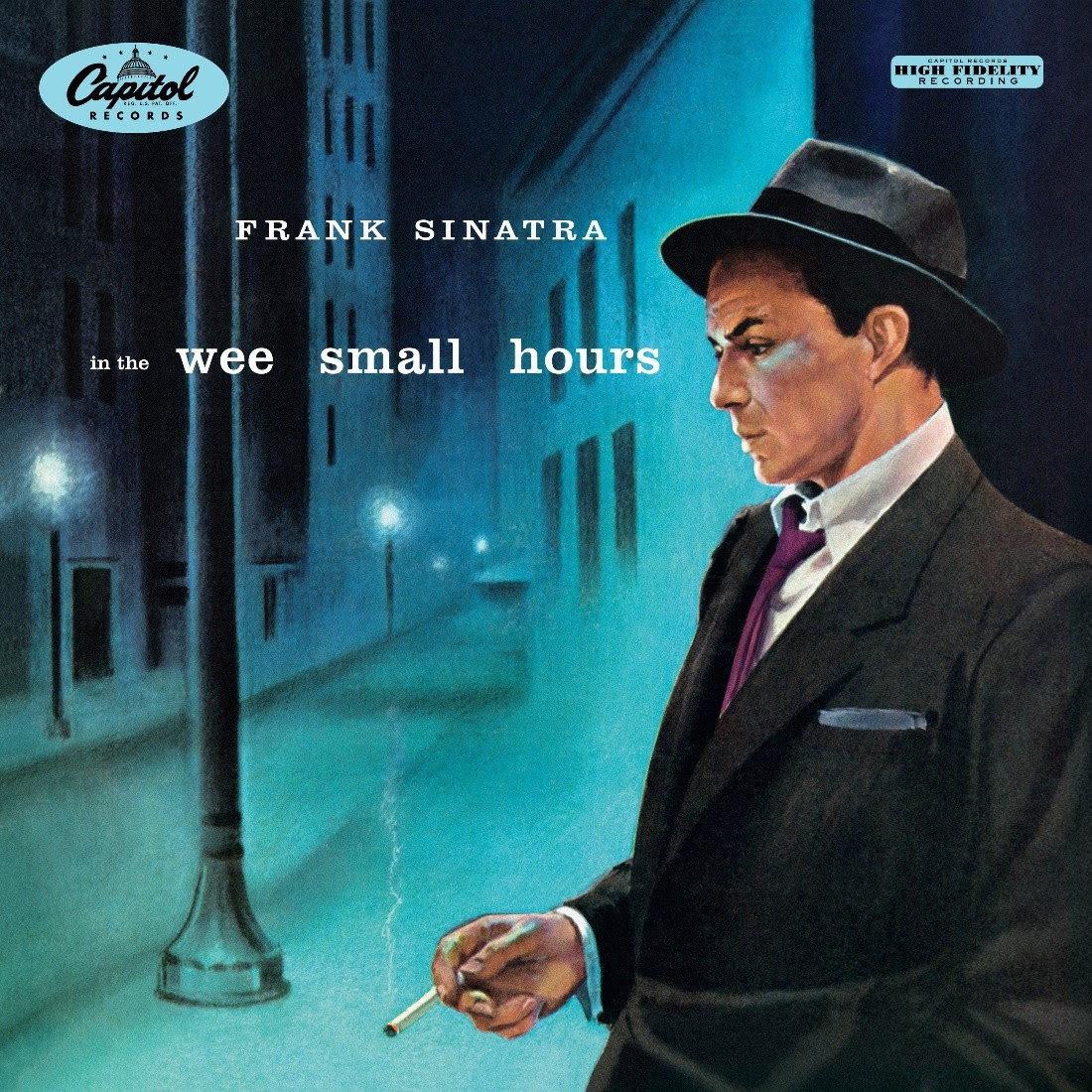
In The Wee Small Hours, the 1955 album from Frank Sinatra, is a recording weighted down by history. Its place in the evolution of 20th-century popular recording history is peerless. The album came out at a key point not only in Frank Sinatra’s career but also for his label, Capitol Records, and the recording world in general.
Capitol was Sinatra’s third label after RCA and Columbia. The album was his third on Capitol. His Capitol tenure up to this point had included producing Voyle Gilmore and, more importantly, the arranging and conducting duties of Nelson Riddle. Riddle is the most important collaborator Sinatra worked with, and it is Riddle’s ability to arrange strings in particular that distinguishes Sinatra’s best music.
Sinatra’s two previous albums on Capitol marked the beginning of the mature Sinatra period. The teen matinee idol was being replaced by a man who, for all his talents, bravado, and success, had been battered by life and wasn’t afraid to let it show. Dropped by Columbia, considered by some to be past his prime, battling voice issues and emotionally scarred by being spurned by actress Ava Gardner, Sinatra didn’t just sing a selection of great American songbook popular songs; he turned them into his own, wearing them like a perfectly fitting dinner jacket.
What he also did, with his producer and arranger, is produce the first fully realized concept album, a full twelve years before Sgt. Pepper’s Lonely Hearts Club Band from The Beatles. The album, through song selection, musical backing, and mood, gives voice to the lonely saloon singer, drinking in the wee small hours of the morning, at a mostly empty dive bar in some run-down part of town. The singer is thinking about that girl: the one that got away—the one who would haunt his dreams for the rest of his life. Of course, the listener can relate, and it’s the simple universal appeal of that feeling that makes this album still sound so powerful 70 years later.
The album went a long way toward solidifying the then-independent Capitol label as a pop powerhouse. The release, while one of the last recorded before Capitol Studios in the Capitol Tower in Hollywood was completed, was recorded at the Capitol Studios recording location at radio station KHJ in Los Angeles. It was not uncommon throughout the history of recorded music for radio station studios to be used to make records. KHJ also holds a special place in the evolution of popular music, especially in the 1960s, as rock became the dominant format. Sinatra would go on to record at Capitol Tower and make more historic recordings, as many pre-rock-and-roll artists did for decades.
Originally released in mono, the album was issued in duophonic stereo in 1963, a full five years after the stereo format was universally adopted. Finding good original mono copies of this album at affordable prices is simply impossible, and even other mono and stereo albums from the pre-Beatles era in decent condition are hard to come by.
Mono is definitely the way this album is meant to be listened to, which provides a direct, yet uncluttered sound. While the highly successful Tone Poet series had so far exclusively reissued jazz, this is the first non-jazz album to be released, although classifying it as a subcategory of jazz would not be a criminal offense. Like all the previous Tone Poet releases, this album was cut from the original analog tapes by Kevin Gray at Cohearent Audio and pressed on 180-gram vinyl at RTI, featuring sturdy Stoughton tip-on jackets and archival RTI sleeves. It also features a plastic sleeve to keep the album in a gatefold and a faithful replica of all the original artwork, which, in this case, includes the black vintage Capitol labels and iconic William Claxton photos.
It’s a remarkable recording, considering it was made 70 years ago in a radio station’s studio. It may lack a little high-end, and one would have to listen pretty hard to hear a little tape degradation in a rare moment. The music is surprisingly sparse in spots, but also lush and enveloping in others, especially where Riddle works his magic on the string arrangements.
The songs themselves are just what one would expect, with Sinatra showing his vast range on compositions from the likes of Cole Porter, Hoagy Carmichael, the duo of Arthur Schwartz and Howard Dietz, Jimmy Van Heusen, and the many collaborations here that Richard Rodgers, Harold Arlen, and Lorenz Hart were involved in, among many others.
This album is the blueprint many singers have employed over the years, whether consciously or unconsciously. Sinatra himself would repeat the format time and again, with varying results, at Capitol and at his own Reprise label, and again upon his return to Capitol. Riddle would make many more of these kinds of albums with him, but Sinatra would also find success with Gordon Jenkins, Billy May, Don Costa, and Quincy Jones.
A review of this reissue can’t fully explore or explain just how important this album is in the history of popular music. And having it in such a bespoke reissue package is quite special. It’s hard to say how long this reissue will be in print, so it’s advised to pick one up as soon as possible.
GRADED ON A CURVE:
A+