
Who put out the first yacht rock album? It’s not just an academic question—it’s a lethal one. Since 2005 thirty-six music critics have died in pitched fights over the question, six alone at a yacht rock symposium in San Diego, California in 2019. One was killed by a harpoon, another by a great white shark. Great whites take their yacht rock very seriously.
Most yacht rock scholars place the birth of yacht rock at 1975 or later, but that time frame has always struck me as both arbitrary and wrong-headed. But not as wrong-headed as some of the songs I’ve seen listed as yacht rockers. The Eagles’ “Life in the Fast Lane”? Seriously? Boston’s “More Than a Feeling”? Great Poseidon’s beard! Blues Image’s “Ride, Captain, Ride”? A hearty yar and a fuck you! No wonder people die in these debates. I would gladly force the moron that came up with “Life in the Fast Lane” to walk the plank.
Look, I’ve been yachting (musically speaking) since I was a teen, and I know of what I speak. And I am here to tell you without the slightest smidgeon of doubt that yacht rock first set sail in October 1973, when Loggins & Messina released their sophomore album Full Sail. There are those pina colada-addled landlubbers who will tell you different—who will try to write off Full Sail as “proto-yacht rock,” but these are the same dunderheads who will try to convince you that Michael Jackson’s “Human Nature” is yacht rock.
Defining yacht rock isn’t as difficult as some would have you think. It’s smooth, mellow even when up-tempo, slickly produced, and most importantly soothing to the mind and spirit. To listen to yacht rock, true yacht rock, is to find yourself on calm seas on a sunny day on a yacht or expensive sailboat, surrounded by frolicking dolphins, the sea breeze in your hair, and the smell of salt in the air. There can be no city in the yacht rock sound, for the simple reason that there are no cities in the middle of the goddamn ocean.
This obviously disqualifies bands with a distinctively urban sound, such as Steely Dan and Hall & Oates, who are mainstays on many critics’ yacht rock passenger manifests. Can you imagine Steely Dan on a yacht? No! You’ll never catch Donald Fagen within seven leagues of a watercraft! You may as well call the MC5 yacht rockers and be done with it.
Mine is an admittedly narrow definition of the genre, so call me a purist if you must, but your average yacht isn’t as large as you think (I happen to own one) and to accommodate all the artists I’ve seen cited as yacht rockers you’d need a vessel the size of the Titanic.
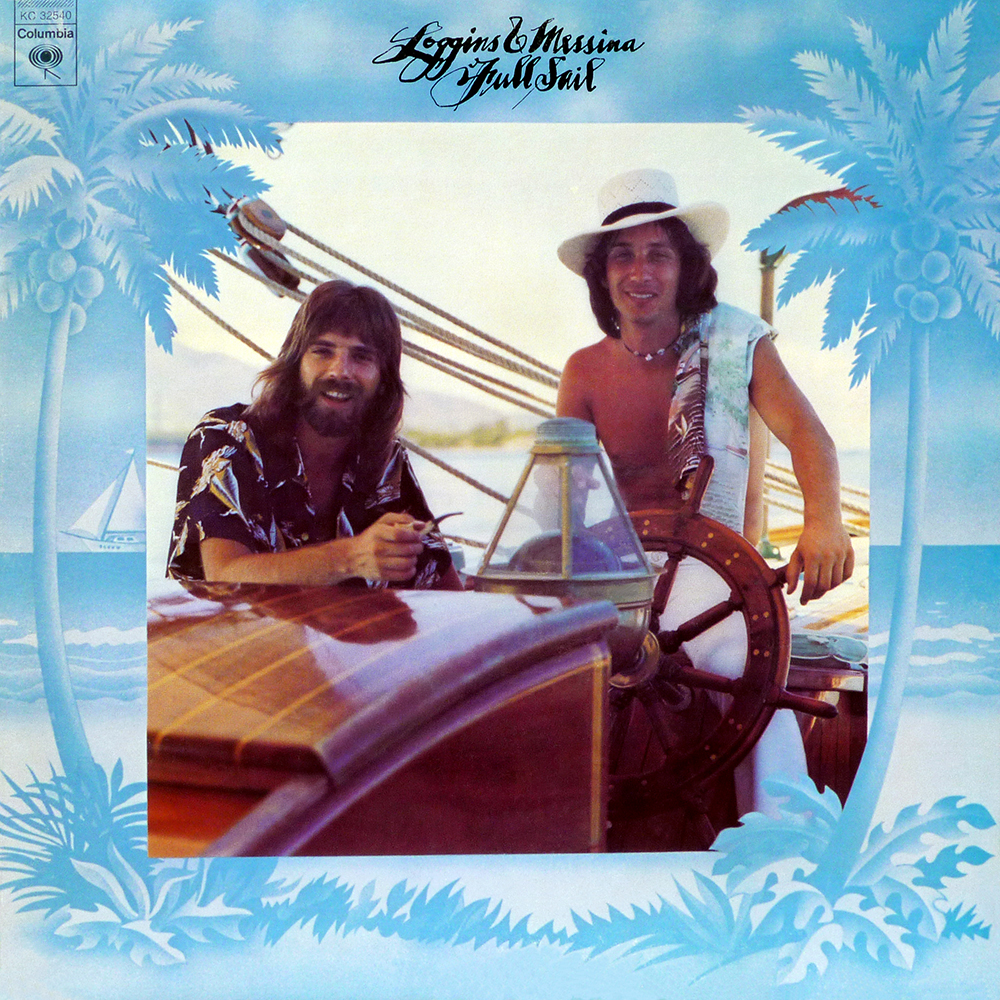
But Full Sail, my hearties, Full Sail is a yacht rock album. The cover tells the tale—our lads look relaxed on a handsome sailboat; Kenny didn’t have full-size yacht money yet, and Jim never will. Kenny’s in a Hawaiian shirt and Jim’s at the helm, bare-chested to facilitate the tanning process, white Panama hat on head and coral necklace around his neck. It may have been too much to ask that the world’s first yacht rock album have an actual yacht on the cover, but Full Sail’s cover is still right up there with the cover of Christopher Cross’ immortal debut as the perfect visual signifier of the yacht rock aesthetic.
About the boys—Messina was a footnote in Buffalo Springfield history before going on to co-found the country rock band Poco. He spent several years with them before deciding that being a producer was his thing. He was producing what would have been Loggins’ debut solo album, but during the course of the sessions he ended up becoming a playing partner, and the rest is history.
Loggins, aka The Overlord of the Movie Soundtrack, had a less illustrious musical pedigree, and few foresaw that one day he would wear a golden robe and carry a glowing orb on the cover of his 1979 solo album Keep the Fire. By that late date he’d long since Garfunkeled Messina, and hooked up with yacht rock avatar Michael McDonald to write “What a Fool Believes.” No way to know it in 1973, but Loggins was Yacht Rock Future; Messina was a future bum sheltering beneath a highway overpass in a refrigerator box. When it comes to musical duos, one of ’em almost always gets the harpoon shaft.
If Full Sail is the first yacht rock LP, it’s an all-things-said-and-done shitty yacht rock album. But it’s an intriguing yacht rock album nonetheless, with three songs clocking in at over six minutes, which led one wag (who I think was serious!) to label it “prog yacht.” A terrifying thought, that, although they do occasionally infuse their folk rock with traces of ersatz jazz.
For the most part, however, it’s your typical Loggins & Messina fare, only less memorable. Songs like “House on Pooh Corner’” and “Danny’s Song” may be purest treacle, and “Your Mama Don’t Dance” may be rock and roll for people who hate rock and roll, but say what you will about them—once you’ve heard them you’ll need an exorcist to drive them from your head. You’ll have a hard time remembering most of the songs on Full Sail, which is without a doubt the best thing about Full Sail.
Messina’s Caribbean-flavored opener “Lahaina” is a bubbly but lackluster sequel to the Viking-Jamaican sing-a-long “Vahevala,” and comes complete with Messina singing in a happy-go-lucky tropical lilt that is as cringe-inducing as the cliched island percussion. Who listens to shit like this? Mamas who don’t dance and daddy’s who can’t rock and roll, that’s who. The urine-yellow mellow “Travelin’ Blues” opens with some smooth jazz saxophone, Messina out-James Taylor James Taylor, and in general this blues has about as much in common with the real blues as Kenny G does with jazz.
“My Music” is a putrid throwback to early rock and roll ala “You’re Mama Don’t Dance,” and is guaranteed to get your grandma boogieing. Has a kind of “Me and Julio Down by the Schoolyard” vibe to it, and the lyrics are a lark. Messina sings about how “Little Smitty” has the van and he has the backstage passes, but he doesn’t mention drugs or booze so prepare to be bored stiff, especially as I get the queasy feeling we’re off to see Three Dog Night. Loggins finally handles lead vocals on “A Love Song” (with that title you don’t have to hear it to hear it) and boy does he sound heartfelt—I like to think of this one as “House on Pooh Corner” with extra poo. Anne Murray would turn the song into a big hit the same year, and I credit it to the fact that unlike Kenny, Anne sounds like she has gonads. Kenny goes full castrato.
The nine-plus-minutes “You Need a Man/Coming to You” isn’t prog-yacht; it’s two songs superglued together for no apparent reason. “You Need a Man” opens with some shakin’ percussion and a big bass line and is about as funky as L&M ever got; its big plus is Kenny sounds like soundtrack Kenny, which is to say funky, white and, uh, white. And it goes out with a long instrumental complete with horn blurt, spunky keybs, and some guitar that is no disgrace, before segueing into another foray into Messina-style tropicana complete with timbales, steel drums, and either recorder or oboe (I’m guessing the former). This one ain’t as plumb dumb as “Lahaina”—Messina doesn’t sing like a parody of a reggae man, thank the ghost of Bob Marley—but it won’t make you want to do the Jamaica Jerk-Off (see Elton John) either.
“Watching the River Run” finds the duo in a profound mood, singing about listening and learning and yearning because that’s what you do when you watch a river, right? Except what I do when I watch a river is think about all the disgusting junk at the bottom of the river and how it’s probably totally polluted and full of mutant fish and how if I sit there long enough a dead body will come floating by. I’m not a healthy person. But to the duo’s credit this isn’t a terrible song, although I’d throw Jon Clarke’s flute in the river if I could. “Didn’t I Know You When” isn’t terrible either—Kenny’s in a rambunctious mood, and you can hear future soundtrack Kenny in every note he sings. And the horns actually add rather than subtract (multiplication and division are beyond them) to the number.
“Sailin’ the Wind” is a lost classic not because it’s a good song qua song (frankly it’s a slow-motion bore with Caribbean flavoring) but because while you expect your standard Christopher Cross sailing song what you get is Kenny sailing in a SKY SHIP, just like the guys in Styx, looking down on HIS OWN FACE miles below, and how does that work? So forget Clarke’s limp and wimpy sax and the straight-out-of-the-box strings and just grok on the freakiness of it all. As for them who would say it’s just a song about Kenny flying a kite, well they can go fly a kite—he’s a footloose starman in the danger zone!
Messina once again handles lead vocals on “Pathway to Glory,” a portentous 8:34-minute slog with CSN&Y ambitions and jazzbo inclinations that would greatly benefit from a melody and a nudge. Or several nudges. Kenny plays a harmonica solo, then some guy named Al Garth plays a violin solo, and then by god somebody does give it just a hint of a nudge after which Jim takes a spin on electric guitar and is this jazz fusion? By God I think it is, but when has that ever been a good thing? Then the violin comes back and Messina jumps back in on vocals, begging his brother not to “listen to the words,” which is damn good advice if you ask me because the words are along the lines of “He rejoices in wedlock with a lover unseen” and “He measures his wisdom from sorrow he leaves.” So yeah, tie yourself to the mast if you have to, but don’t listen to the words!
Loggins & Messina left behind a dubious legacy—they were incorrigible squares who wrote square songs for squares, and unlike fellow squares the Carpenters and John Denver, they lacked the talent and common decency to leave us with a canon of immortal songs that transcended their squareness. Why they didn’t even leave us with one! Not one decent song!
Loggins wouldn’t take flight until he abandoned Messina’s tedious folk rock trappings and tripped off into the danger zone; Messina was a talented musician but a lost cause. But without even knowing, one of history’s dullest duos launched a yacht, even if the yacht they launched wasn’t seaworthy. Don’t even think of buying Full Sail. It will take water, founder, and drown your stereo.
GRADED ON A CURVE:
D+