What’s all the fuss about this guy? And does anyone listen to him for pleasure? Between that sepulchral voice and the black attire and the overheated Gothic death dirges, which split the difference between folk music and lurid (and despite his rep as a “poet,” not very well written) and lugubrious blues melodrama, I just don’t see (or hear) the appeal. His “dark vision” is verbosity for verbosity’s sake and might work as comedy, but the man ain’t in it for the laughs. He’s for dead real serious.
Or is he? “I consider myself to be first and foremost a comic writer,” he once said. “The way I entertain myself—especially in those long and grim hours in the office—is to write stuff I find funny.” Is Cave a black humorist, and I’m simply too dumb to get the joke? I don’t think so. My sense of humor is blacker than Cave’s usual attire, and I’m not laughing. And I find E.M. Cioran funny.
I only have two problems with Nick Cave—his music and his lyrics. The former is dreary, morbid (he’s got a lot in common with the death metal crowd) and should be kept out of the hands of those with suicidal ideation. His lyrics show he spends a lot of time in the company of the Oxford English Dictionary, and it’s not doing him any favors. Take the opening line of a song I picked at random, “We Call Upon the Author”:
“Our myxomatoid kids spraddle the streets
We’ve shunned them from the greasy-grind
The poor little things they look so sad and old
As they mount us from behind.”
“Myxomatoid”? Reach for your medical dictionary—and you won’t find it. (“Myxomatous” you will find.) “Spraddle”? Is this guy serious? And the problems don’t stop there. The second line is incomprehensible, and the final line raises all kinds of questions: are the “they” in the song being sexually mounted by the myxomatoid kids who spraddle the streets? Have we entered into the realm of what Cave, a poetic guy, would colorfully term buggery? And what is one to make of Cave’s assertion in the same poem that his hero John Berryman “wrote like wet papier maché”? I have no idea what that means, but it hardly sounds like a compliment.
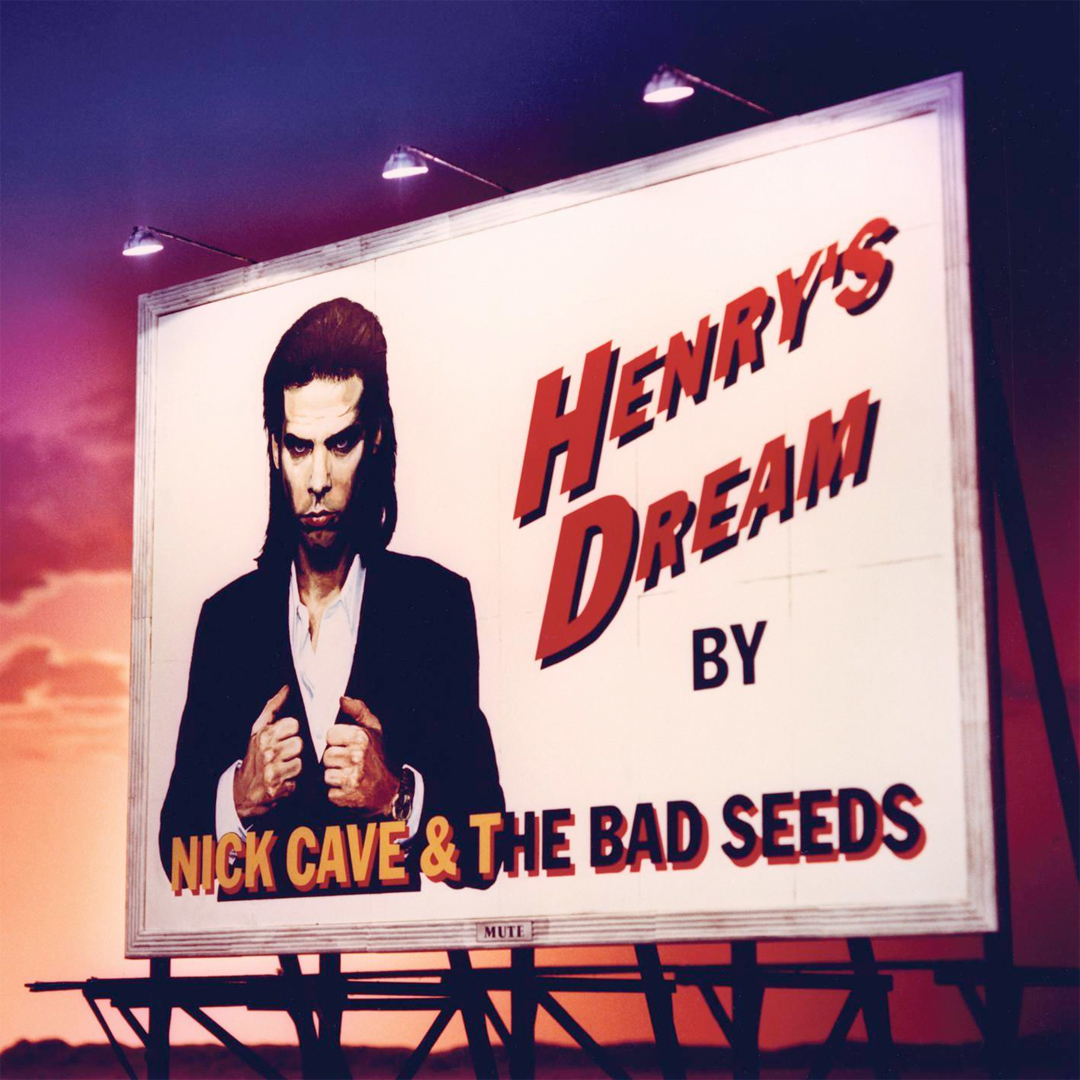
1992’s Henry’s Dream (the title was inspired by Berryman’ poem cycle The Dream Songs, whose hero was an alter ego named Henry) was the seventh studio release of Nick Cave and the Bad Seeds, and received much critical acclaim. “Harrowing,” said one critic. “A masterclass in narrative songwriting,” said another. Critics. To quote Mr. Berryman, “Mr. Bones, we all brutes and fools.” But not me! I see straight through the fake! Henry’s Dream is not a masterclass in narrative songwriting. I can reel off any number of albums that meet that criterion, and write me care of The Vinyl District if you want a list. Cave is a sensationalist mining the realm of the ridiculous, and his poetry is replete with the full repertoire of tired Southern Gothic cliches.
Said Cave once, “I think there is a certain perversity in my music in that I continue, you know, to eat at the same ball of vomit year after year.” This is a colossal understatement. Perversity is Cave’s stock in trade, the one-trick pony he’s been gallivanting about on since he read (I suspect) William Faulkner’s Southern Gothic potboiler Sanctuary. It’s shtick, and it’s tiresome. I’ll say it again; if I could detect black humor in his song stories, if he had the skills of a Randy Newman or Killdozer’s Michael Gerald or the storytelling abilities of an Ian Felice or Mountain Goats’ John Darnielle, I wouldn’t be writing this. But Cave is satisfied to paint the walls with blood, wit being a target he cannot hit.
Henry’s Dream opens with the overbaked Gothic melodrama “Papa Won’t Leave You, Henry,” a lurid and blood-drenched sing-along which finds Henry wandering about a nightmare-scape where he happens upon:
“A little house upon a hill
I entered through and the curtain hissed
Into the house with its blood-red bowels
Where wet-lipped women with greasy fists
Crawled the ceilings and the walls.”
This is Grade-B horror movie stuff, and there’s a “fag in a whale-bone corset” dragging his dick across Henry’s cheek to boot. It’s a low-budget horror remake of “Sister Ray,” a song superior to this one both musically and lyrically. “Sister Ray” is funny and ugly and has a beat you can dance to. “I Had a Dream, Joe” is similar, except nothing happens. But you get the same backing chorus that you can sing along with while waving a beer mug in the air. What are these things? Folk songs for hipsters captivated by the lurid and the nightmarish? In both cases what you’re left to hang onto is Cave’s dolorous voice and the frisky tempos, which are welcome because let’s face it, if these songs limped or dragged themselves along nobody would be able to stomach them.
The LP’s one unalloyed triumph is the mid-tempo love song “Straight to You.” The melody is lovely, the sentiment simple and direct, and it’s easy to ignore lines like “All the towers of ivory are crumbling/And the swallows have sharpened their beaks.” There’s real yearning in the song, and yearning is a real emotion. And it’s absolutely blood free!
Unfortunately it’s followed by the drinker’s lament “Brother, My Cup Is Empty,” which comes in at exactly the 4,274 spot on my list of drinker’s songs. I’m appalled by the line “I am the captain of my pain” (who does he think he is, Sting?) and the lines “Well I’ve been sliding down on rainbows/Well I’ve been swinging from the stars” are recycled straight from “Straight to You,” where he sings “Gone are the days of rainbows/And gone are the nights of swinging from the stars.” They’re cliches, and he sees fit to use them twice? Not good. I hear this and I think of Bob Dylan’s “Please Mrs. Henry” and I know the difference between bad and good, and between pomposity and poignant humor.
“Christina the Astonishing” is a Catholic crawl, and what more it’s a drag what with its organ and Cave’s sepulchral moaning about a 12th Century saint who rose from the dead, which is more than this song can do. To lend you a flavor of the song I give you the lyrics: “She fled to remote places/Climbed towers and trees and walls/To escape the stench of human corruption/Into an oven she did crawl.” Is she Linda Blair, saint or Sylvia Plath? Hearing Nick moan the lines I hope he’s joking, but he simply gives the listener no clues that he is.
The melody of “When I First Came to Town” draws me in, as do the strings and the harmonica at the end, and its subject—a fella who is welcomed into town after town, only to fall under suspicion and be driven out, actually works because he doesn’t toss in any bad gothic poetry but instead keeps it simple. Understated. And there’s something biblical about the song’s end that works:
“And god-damn this town
For I am leaving now
But one day I will return
And the people of this town will surely see
Just how quickly the tables turn.”
“John Finn’s Wife,” different story. The cinematic strings are a bit too much, as is his overheated to the point of combustion poetry, which runs to bad metaphors along the lines of “Dancers writhed and squirmed and then/Came apart and then writhed again/Like squirming flies on a pin.” Who compares dancers to flies on pins? Can you SEE that? Isn’t the whole point of a fly on a pin that it can’t move? And on and on it goes.
“And in she came, did John Finn’s wife
With legs like scissors and butcher’s knives
A tattooed breast and flaming eyes
And a crimson carnation in her teeth”
Why scissors AND butcher’s knives? Is one leg a pair of scissors and the other a butcher’s knife? And who walks around with a carnation in her teeth outside a bad Spanish opera? And then there’s the “And a gang of garrotters were all giving me stares/Armed, as they were, with machetes,” which raises several questions. Do garrotters generally hang in packs? Do they have a union or something? And why are garrotters walking around with machetes? Shouldn’t they be holding garrotes? And John Finn sounds Irish. Do they even have machetes in Ireland? The deeper you dig, the more ridiculous it gets.
Cave doesn’t embarrass himself poetically on “The Loom of the Land,” but he doesn’t distinguish himself either. It’s a long slow crawl, this one, and depressing (need that even be said?) as hell, but the melody has a certain understated beauty and if you’re a sucker for songs that go on and on “The Loom of the Land” may not bore you the way it bores me.
Closer “Jack the Ripper” is as close as Cave and the Bad Seeds come to a rocker (love the clamorous percussion and the urgency in Cave’s vocals). It’s also the only song in which I detect a sense of humor at work. Cave’s got himself a woman who rules with an iron fist and the joke is every time he tries to kiss her she calls HIM Jack the Ripper. I could do without the snakes under the floorboards and the snakes on the roof and the snakes in the fridge for all I know—I don’t see any reason why they should be there other than that snakes are creepy, you know? As for the lines “We bed in a bucket of butcher’s knives/I awake with a hatchet hanging over my head” I’m going to give Nick the benefit of the doubt and assume he was chuckling when he wrote them.
Nick Cave is, I think, one of the more overrated commodities out there—a cult artist whose cult confounds me, and whose members make me wonder if there isn’t something essential missing in my make-up. Tom Waits I get—I don’t listen to him, but I understand his appeal. He occasionally writes some very good poetry. I can’t say the same for Cave, and the sanguine, macabre, and dolorous subject matter he wallows in leaves me cold. I’m not into death trips, unless they’re handled humorously. To quote the great Jim Stafford, “I don’t like spiders and snakes/And that ain’t what it takes to love me.” Or for me to love you. I think I’ll stick with Killdozer.
GRADED ON A CURVE:
D+