And now for something completely deviant. Robert Christgau hit the nail on the head when he wrote of the Swans’ early music, “Not only isn’t it for everybody, it isn’t for hardly nobody.”
Swans emerged from the NYC No Wave scene and made music that was brutal, ugly, remorseless, minimalist, grinding, unmelodic, and had all the charm of a very dangerous piece of industrial machinery. And the question I’ve always asked myself is, “Who could possibly like this stuff?”
Not because I think their early music is bad music, per se. I happen to think it’s good music. I simply can’t listen to it, because it’s some of the least user-friendly music I’ve ever been subjected to. And I can’t help but wonder what makes a person WANT to be subjected to it. Swans frontman Michael Gira once said, “Swans are majestic, beautiful looking creatures. With really ugly temperaments.” I get the temperament part, but I’m wondering about the majesty and beauty.
Is there beauty in the purity of purpose? Because the Swans’ music is pure, there’s no denying it. Gira talked about the “bludgeoning, single-minded violence of the music.” “Single-minded” is the keyword there. Single-minded, as in no concessions whatsoever. And can there be majesty in music that grinds you into the mud like the tread of a King Tiger tank? Can beauty be ugly? Can majesty be brutal, monstrous?
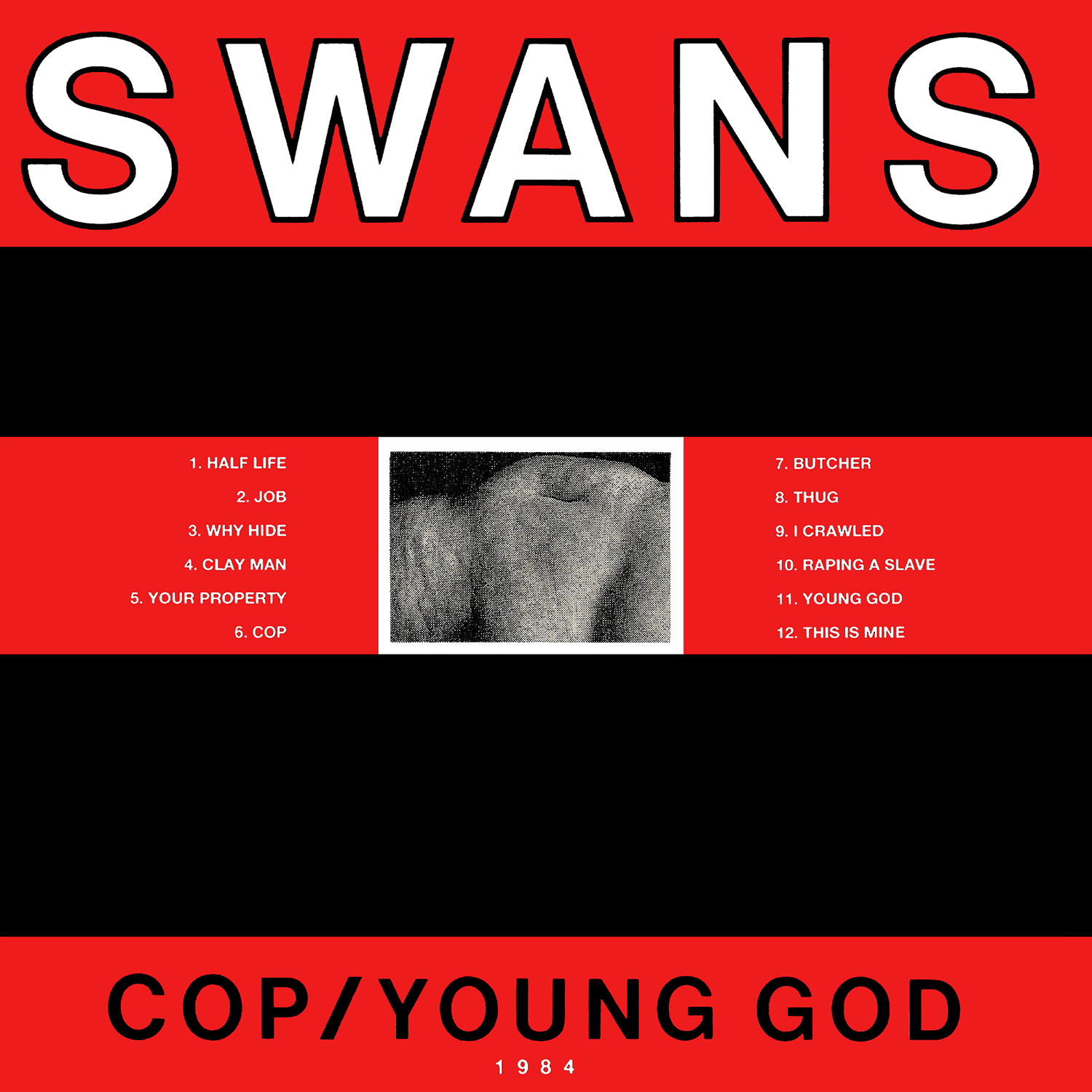
I’ve been listening to Swans’ 1984 “Young God” EP, largely because the four songs on the EP are at least three more songs than I’m psychologically prepared to listen to at one time. And I’m a NOISE ROCK GUY. The part of me that wants to survive the experience laughs when I listen to it, because it’s so over-the-top ugly, I begin to suspect the whole thing is an inside joke, shtick. Or conversely, if it isn’t a joke, it’s so over the top it’s funny, whether the band is in on the joke or not.
Robert Christgau was saying the latter, I think, when he concluded his analysis of Swans’ legendary 1983 debut LP Filth with the words, “I think it’s a hoot.” I don’t think they’re as much of a hoot as he does, I suspect. Joke or no joke, they depress me, but then making music to depress people is as valid an artistic enterprise as making music to make people happy. And in some way, perhaps, more honest. The world is a very depressing place.
Sometimes Michael Gira sings like he’s on Thorazine, like he’s in a locked psych ward after having emerged from the abandoned subway tunnel he retreated to for a couple of years because the horrifying realities of living above ground amongst other human beings were more than he could bear. And sometimes he sings like one of the uglier specimens of humanity that led him to retreat to the subway tunnels in the first place. In either case, he makes you uneasy. He doesn’t sound like the kind of guy you’d want on the next bar stool. He sounds like the kind of guy you’d cross a street of speeding cars to avoid.
And the subject matter of the songs on “Young God” reinforces my suspicion that the Gira of “Young God” was not a happy guy. We have the self-explanatory “Raping a Slave,” a song (the title track) about Ed Gein, the rural Wisconsin murderer/bodysnatcher who was the inspiration for the film Psycho, another number (“I Crawled”) told from the point of view of a sexual submissive, and a song (“This Is Mine”) that I find amusing and I would like to think Gira finds amusing too, although I could very well be granting Gira a sense of humor that in fact he does not possess. I will go so far as to say that if Michael Gira does not find “This Is Mine” funny I worry about Michael Gira and is the only thing about Michael Gira that worries me. I think existence is awful too, but a guy’s gotta laugh.
As for the band it was Gira on vocals and tapes, Norman Westberg on guitar, the late Roli Mosimann (who would go on to work as a producer for everyone from Celtic Frost to New Order) on drums and tapes, and the somewhat mysterious Harry Crosby (could he have copped his name from Harry Crosby, the colorful Lost Generation poet and publisher who died in what may or may not have been a suicide pact in 1929?) on bass.
And on Young God, the band made extensive use of experimental percussion “instruments,” metal shelving on which they pounded, for instance, making their sound even harsher and more industrial. At times, they remind me of the foundry where I worked for a few summers. That foundry was the greatest industrial band I’ve ever heard, and it didn’t even have to practice.
“I Crawled” starts the album out on a note of clamorous degradation; it hardly moves, and yet it somehow swings, and it obviously came from the mental space Gira was in at the time. Here he is talking about the band’s early days:
“I think abjection was a big preoccupation. We used to play at CBGB’s and I’d walk down to the bathroom barefoot. I remember getting off the stage and licking the fucking floor and someone’s feet. The thing was to go as low as possible. It was about being as base as you could possibly be, and the music inspired that wonderful endeavor.”
The bass and drums proceed at a super-amplified and super-slow beat—any slower and the song would be moving backwards. Gira talks over the song, Westberg plays a repetitive riff while you have lots of crashing in the background, but the music isn’t entirely monotonous—occasionally the band speeds up, just for a second or two, although speed may not be the word. And the drumming picks up toward the end as Gira begins to moan and scream, “Ride! Ride!” over and over again. There’s far more going on dynamically than you might think.
The band’s “swing” is a thorny subject. Early bassist Jonathan Kane once said an interesting thing to journo Jordan M. Mamone, and I think it continued to apply to the band after his departure: he said the Swans’ music “was brutal, but it had a swing to it. Everything I play does.” Mamone amplified this when he wrote, “For all the music’s cacophonous squalls, junkyard beats, and cheerful, greeting-card sentiments such as “You’re gonna murder somebody weak,” the lumbering sludge moves.” The Swans’ music may sound at first like the 1919 Boston Molasses Flood, but if you listen closely, the flood does the Twist.
And yet Gira himself plays it down. He told Mamone that Kane’s “style of drumming wasn’t appropriate for what I wanted to do, which was much simpler and more primordial.” My own feeling is that while he may have succeeded to an extent in simplifying things, he couldn’t kill the swing any more than the Eagles could kill that beast with their steely knives. Because something is shaking as the band crawls and seethes remorselessly along—I don’t think the Swans’ music would be as interesting if it didn’t.
“Raping a Slave” is a far more sonically interesting proposition, from the clamorous opening, which is far more up-tempo than you’d expect, to Westberg’s guitar playing in the background. It’s a staggering, off-kilter thing, this one, with Mosimann doing far, far more than just keeping the beat on drums while the percussion crashes away and Gira repetitively spits out things like, “You do what you want/You burn out my heart” and “Why be ashamed of your hatred” and other morose “It’s always sunny on the squalid Lower East Side” bon mots that I can’t help but be amused by, I’ve never been able to take heart eating seriously unless it’s being done by Aztecs. But there’s no denying this is one powerful song, as much an act of destruction as an act of creation, and a perfect roadmap to Hell or worse—life as Hell.
“Young God” is a clamorous smash and crawl with titanic power chords and feedback over which Gira does his best to sound like the kind of demented Wisconsin farm boy who would wear his mom’s face. This is torture music, make no mistake about it, Gira sings (if that’s what you want to call it) “When I wear your flesh, I love face” and then “Stop! Stop! Now! Now!/Wow! Wow! Wow! Wow!” before descending into some pure moaning at which point the inexorable pounding ends and the song actually takes on some momentum, like a pneumatic machine that has decided it wants to take up jogging. Heavily. In a herky-jerky manner. It’s a real gas.
“This Is Mine” opens with a monotonous drum beat and lots of harsh metallic guitar shred and has Gira gutturally singing, “This is mine/I own it/I own this thing” but I really don’t perk up until the third verse when he sings, “I own my hole/I own my hole/Get out of my hole/I own it, I own it” which really cracks me up. It doesn’t crack me up as much as the Cows’ “Mine” cracks me up, mind you, because unlike Gira, Shannon Selberg is a bona fide comedian who tosses off lines like:
“If you can lay eyes on it, it’s mine
If you can walk upon it, it’s mine
If it’s got continents and clouds and lots of water
Remember, it’s mine.”
and
“If you can latch onto it, it’s mine
If you can eat or screw it, it’s mine
If you’re some commie scum who wants to share it all
Remember, it’s mine.”
That’s comedy, people, and the more I listen to “This Is Mine” the less I think Gira is joking but no matter, what matters is that relentless rumbling caterwaul and all of the fine instrumental nuances and subtle shifts in rhythm and tempo that are so easy to miss as you’re being dragged by your ears through the mire, through the belly of the beast, and if you’re a healthy person and sound in mind and body you’ll probably want out, you’ll probably wonder why is this happening to me? What did I do to deserve this?
I don’t believe Michael Gira when he said, “None of Swans was really imagined from an aesthetic or intellectual point of view.” Putting sounds together in a deliberate way is an aesthetic exercise and use of the intellect, and not some Noble Savage hokum, no matter how primitive, barbarous, and reductio ad absurdum simple the results.
And in the end, it’s the band’s aesthetic that keeps me away from their music—it strikes me as TOO THOUGHT OUT, and while the nihilism is real, it also strikes me as a pose. I can’t help but suspect the whole thing is a shtick even when I know it isn’t. Does that make sense? Does it really matter? I respect the music of the early Swans, I really do. I simply feel better when it’s not around.
GRADED ON A CURVE:
B