Category Archives: TVD’S LINER NOTES

Liner Notes: The Rock
& Roll Hall of Fame: The Outrageous, Definitive
& Untold History
by Craig J. Inciardi

“I had the opportunity to uncover and preserve rock’s important history, and to give the artform and its creators the long overdue respect they craved and deserved,” reflects founding Rock & Roll Hall of Fame curator Craig J. Inciardi, in his new book The Rock & Roll Hall of Fame: The Outrageous, Definitive & Untold History. “Along the way, I collected stories, lots and lots of stories.”

And what unique, sometimes bizarre, stories they are. Inciardi details the early days of the Rock Hall’s beginnings, which go all the way back to a 1983 Pay-Per-View awards-show-concert-special on the Black Tie network, intended to celebrate the history of rock. To proceed with the broadcast, a corresponding organization needed to be founded, and thusly, with the help of industry heavies like Ahmet Ertegun (co-founder and president of Atlantic Records) and up-and-comers like Suzan Evans (legal adviser to the Black Tie Network), the Rock ‘n’ Roll Hall of Fame organization was born.

The actual building structure, the museum itself, and its collections of rock artefacts did not yet exist. That’s where Inciardi’s role, as founding curator, comes into the tale, once Jann Wenner—also a hall co-founder —brings him on to become “the Indiana Jones of rock history” in 1991 and curate the collection.

The most fun readers will have with Inciardi’s book is journeying with him through all his madcap adventures to build the Hall’s collection and, in the process, hang out with the who’s who of rock stars. It does inspire the reader to reconsider and reflect upon what items—and therefore which moments associated with them—and ultimately which artists—make up the story of rock music. Granted, there is much subjectivity involved, but most can agree on the essential recognition deserved by key figures that goes beyond subjectivity.

Read More »

Also posted in TVD'S LINER NOTES | Leave a comment

Liner Notes: Tonight in Jungleland: The Making of Born to Run by Peter Ames Carlin

“I’m sorry if it sounds corny, or like typical middle-aged-white-guy bullshit, but that’s what happened to me,” writer Peter Ames Carlin reflects in his recently released Tonight in Jungleland: The Making of Born to Run. “The music felt supernatural… and I’ve felt myself being drawn into the same spell countless times while listening to Born to Run…”

Carlin’s book centers on a single chapter in the ongoing saga-like novel of Bruce Springsteen’s musical life. Namely, the development and production of his career-defining album Born to Run, released in 1975. But it also just so happens to be the chapter that turns the whole story around, toward the direction of next-level limitless success, commercial and critical achievement. Carlin’s book depicts an abbreviated timeframe in Bruce’s history, but it simultaneously captures the essence of the complex Born to Run period and its entire impact and quality.

With this book, and by penning this story, Carlin is, in a sense, playing to the crowd, telling the tale’s best moments, the part that everyone, fans of Bruce’s and non-fans alike, would be interested in hearing. It depicts an artist on the rise, yet—much like the newly released Springsteen biopic Deliver Me from Nowhere—it simultaneously suggests that this same phenomenon, this exact trope, could fit the mold of any artist. This story could have happened with any creative.

Or could it have? Bruce Springsteen, patron saint of Freehold, New Jersey, partly poet, all rock-and-roller, and eternally introspective, is singularly perplexed by self-examination. Struggling to balance the seesaw between his working-class upbringing on one side and his unique cerebral genius on the other, at all times forced to confront these two selves and somehow make sense of them, to accept their truths.

Read More »

Also posted in TVD'S LINER NOTES | Leave a comment

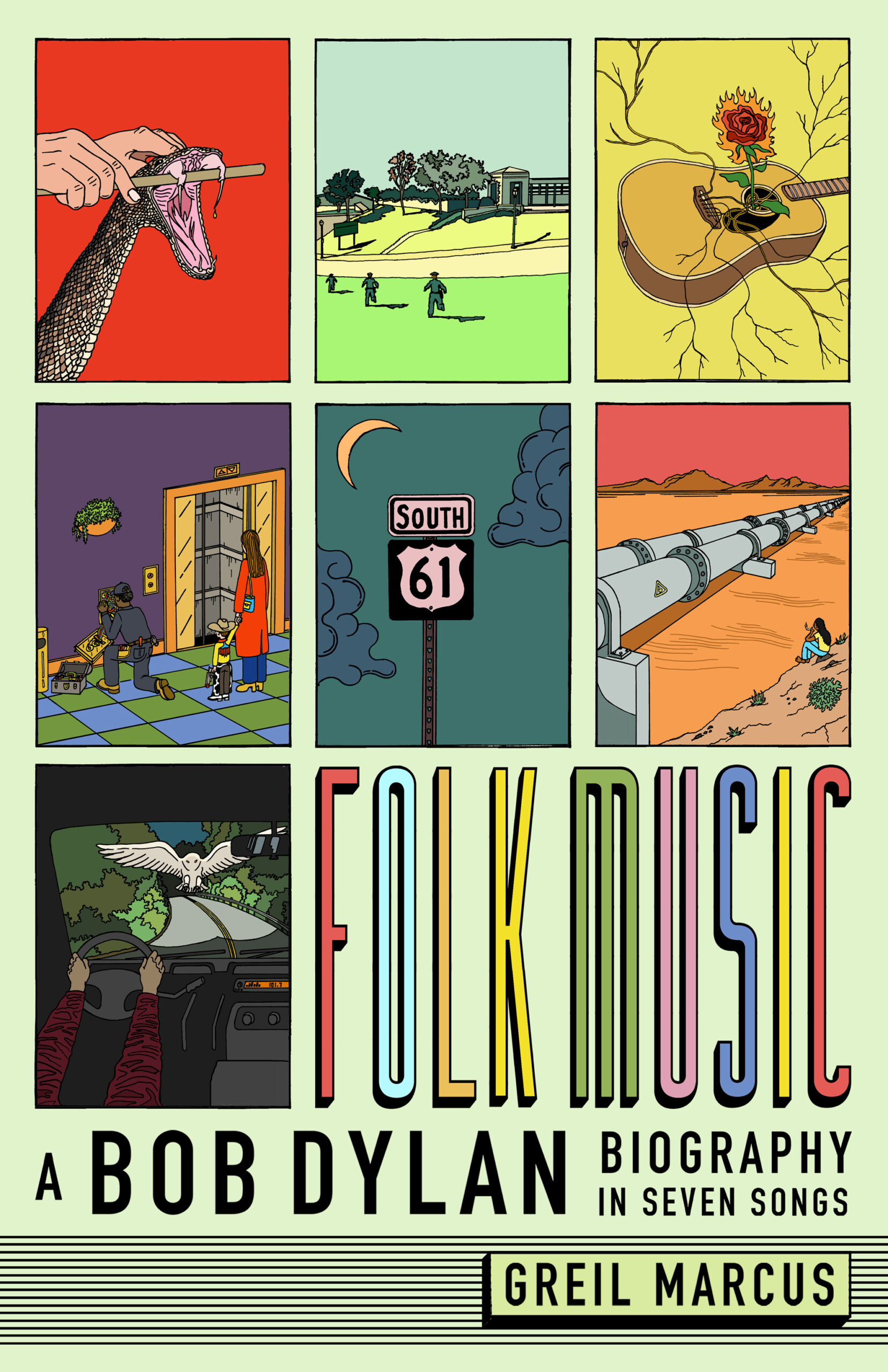
Liner Notes: Folk Music: A Bob Dylan Biography in Seven Songs by Greil Marcus

How does one write a biography of one of the most definitive, elusive, and ever-changing artists in the history of popular music? Perhaps, by abandoning any intention to include any straightforward, linear qualities that a so-called traditional biography might promise.

There have been countless books penned on the life, times, and music of Bob Dylan since he first burst onto the folk music scene of the early 1960s. There was Dylan’s own Chronicles, Volume One (2004), a seductively fascinating selected set of tales from his own life, and an arguably successful film by Todd Haynes called I’m Not There (2007), that depicted the wildly different phases of Bob Dylan’s life by casting wildly different actors for each version of Dylan—or each character inspired by him and his songs.

If any music writer and cultural critic should be well-suited to take on the task of composing a Bob Dylan biography, it would be Greil Marcus, who has in part made his name as an American critic by analyzing the work of Dylan. Marcus devoted an entire book to Bob Dylan and the Band’s Basement Tapes with Invisible Republic (1997), and this time seeks to create a Dylan biography of a kind with Folk Music: A Bob Dylan Biography in Seven Songs.

But of course, Marcus’s book is so much more than just seven songs from Dylan’s illustrious canon spanning decades and several incarnations. Much like Marcus’s The History of Rock ‘n’ Roll in Ten Songs (2014), the selected tracks are used as jumping off points to articulate a much larger cultural story about one million songs, those that came before Dylan’s existence, those that inspired his own work, and those that were inspired by his own.


Read More »

Also posted in TVD'S LINER NOTES | Leave a comment
  • SUPPORTING YOUR LOCAL INDIE SHOPS SINCE 2007


  • Alternative Text Alternative Text Alternative Text Alternative Text Alternative Text Alternative Text Alternative Text Alternative Text Alternative Text Alternative Text Alternative Text Alternative Text Alternative Text Alternative Text Alternative Text Alternative Text Alternative Text Alternative Text Alternative Text Alternative Text Alternative Text Alternative Text
  • Alternative Text Alternative Text Alternative Text Alternative Text Alternative Text Alternative Text Alternative Text Alternative Text Alternative Text Alternative Text Alternative Text Alternative Text Alternative Text Alternative Text Alternative Text Alternative Text Alternative Text Alternative Text Alternative Text Alternative Text Alternative Text Alternative Text Alternative Text Alternative Text Alternative Text