

There’s no fanfare when Destroyer takes to the stage. Indeed, bandleader Dan Bejar looks at the crowd warily before turning to his six-piece band to begin conjuring its unique sound.
Nowhere near as metal as its name might suggest, Destroyer has instead traveled intriguing roads of pop and poetry over 14 albums to create its own kind of shambling majesty. At their stop at the Black Cat in DC on a Tuesday night, they concentrated on the most recent output of their 30-year history, quite naturally emphasizing four from its latest, Dan’s Boogie. That’s another misleading title, of course, because what they come up with is no mere barroom hootchie coo.

On record, the Destroyer sound of late is sophisticated, a smartly navigated pop of strong melody and a touch of electronica, over which Bejar’s musings intersect, with a kind of observational poetry much more thought-provoking than the lush musical bed would indicate. “Your entrance was its own Red Scare,” he began, amid the grandeur of the opening, “The Same Thing as Nothing at All.” “You quote unquote the French au pair.”
Later comes the sung chorus, “The chandelier struggles to light up the night / Pride comes before the fall / to have loved and lost/is the same thing as nothing at all.” The Pet Shop Boys come to mind in some of this, in part because of Bejar’s penchant for arch and detached spoken word in his Canadian tenor. There’s a certain weariness at the center of it, belied by the buoyant melodies that often build to crashing chords.
The weariness is embodied in the front man’s delivery as well. Once a guitarist for The New Pornographers (which took its name in part from a Destroyer song), Bejar has largely left instruments to his bandmates, though he sometimes picked up a tambourine to hit it once or twice.
Nearly every time he was finished with a verse, he crouched down, ostensibly to furiously unscrew another bottle of water and gulp it (the chronically disheveled Bejar may be the most well-hydrated frontman on the road). He dips down as a way to better spotlight the band, highlighted by lead guitarist Nicolas Bragg and particularly trumpeter JP Carter, whose effective, soulful lone horn is enhanced by all manner of loops and effects.
But as Bejar continued to crouch down, he seemed to be listening, with a scowl, reconsidering the music he’d created and how it was being recreated live in the moment. Destroyer is a band that could rely much more on backing tracks in live performances than it does. Recorded electronic dance blips accompanied some songs from 2011’s Kaputt, the other album that had four songs represented. Sometimes that left drummer Joshua Wells with nothing to do.
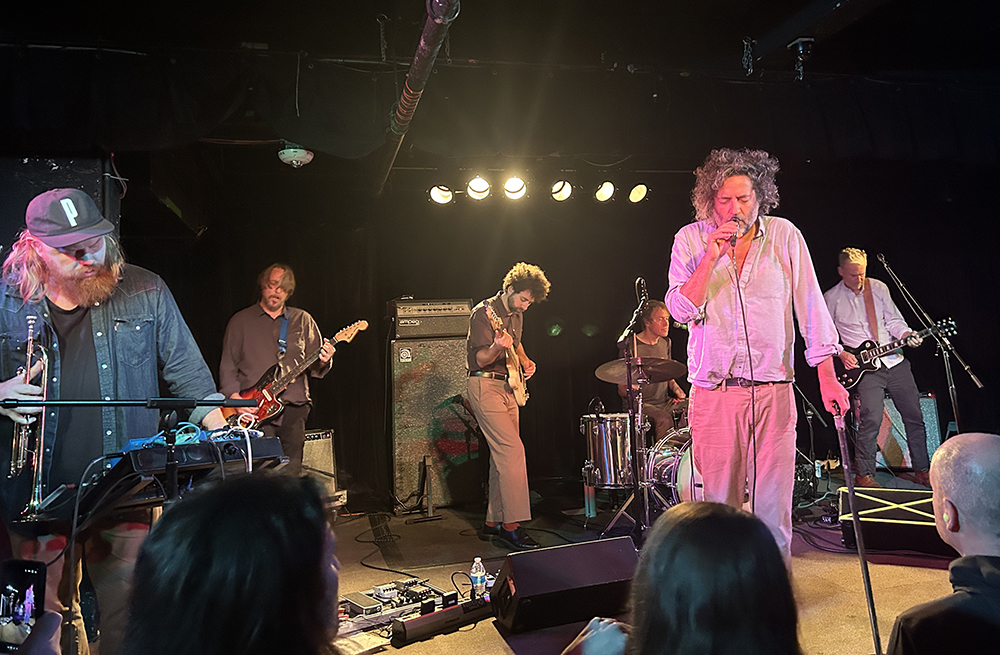
You wouldn’t say Bejar was leading the band; players would look to Wells to see when a song would end. Wells would also count off songs to start if the other guitarist, David Carswell, didn’t. Having created the songs and original arrangements and having to stand to deliver their words was enough for the bandleader. (He could have been fighting a bug, though, too; he did his share of coughing while crouching, and DC was a shorter show than most on this tour, just 14 songs overall, including one encore song instead of the usual two.)
A change of pace came when the acoustic opening act Jennifer Castle came out to duet on “Bologna,” a song from the new album that is handled there by Simone Schmidt, who performs under the name Fiver.
I can’t overstate how much the sound of Carter’s trumpet helped elevate the tunes into grooves that approached spiraled-out smooth jazz throughout the show. Before the final song of the main set, Carter got to demonstrate just how haunting a soundscape he can recreate with loops and reverb with an extended solo meditation. It led to the epic “Suicide Demo for Kara Walker,” a song whose lyrics Bejar cut up from cue cards written by the visual artist Kara Walker.
Like the unlikely juxtapositions in everything else in Destroyer, the message got across anyway, ending with “You got it all wrong, you got it all backwards…Enter through the exit and exit through the entrance.”
If Bejar barely spoke to the crowd, he did have this gracious thank-you move, grandly bowing to the applause after some songs. Like the mix of raw, poetic lyrics with gorgeous melodies, it was a way to combine the appearance of pomp with the bluntness of delivery. Nobody left unhappy.