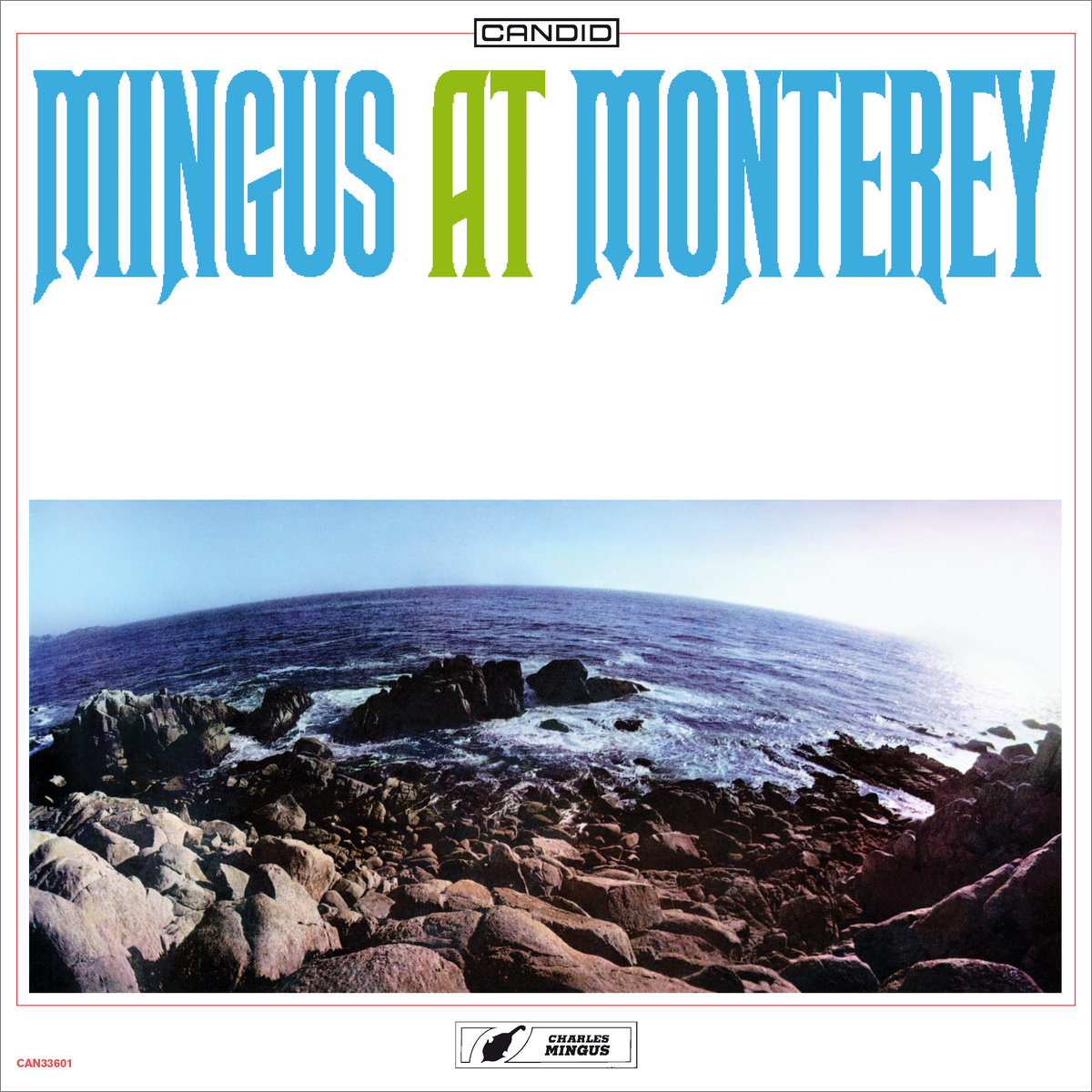
Hearing Charles Mingus and his band in performance is a reliable pleasure, and when his various aggregations were really cooking, the sounds they produced remain one of the joys of modern music. Recorded in 1964 and released the following year, Mingus at Monterey is one of the bassist-bandleader-composer’s finest live recordings. Reissued earlier in 2025 for Record Store Day, the initial 2LP set quickly sold out after hitting the album charts. Now it’s back with a fresh edition via Candid Records in partnership with Charles Mingus’ Jazz Workshop, Inc. It’s a delight from start to finish. All Mingus fans need a copy.
The live stage is where any jazz musician has to make it. It can be at Lincoln Center or in the back room of a Unitarian church, in a nightclub after midnight, or in a college auditorium before noon, in a museum’s performance space, or under the canopy at a festival: it’s where the musicians prove they have the stuff.
Charles Mingus proved it repeatedly through a long, consistently evolving life in music, but in 1962, he hit a creative low point on the stage as his ambitious performance, conceived by Mingus not as a typical concert but as a sort of recording session with audience/workshop hybrid, was a notorious debacle, although that didn’t stop United Artists from releasing a portion of the evening as Town Hall Concert in 1962.
Town Hall Concert was reissued as an expanded CD in 1994 as The Complete Town Hall Concert. The addition of bonus material clarified that the event wasn’t as disastrous as it was long assessed, but it was still a tough night by any yardstick. Take note that the 1962 Town Hall show shouldn’t be confused with the release of a 1964 live recording also titled Town Hall Concert; we’ll discuss this return engagement a bit further down.
Mingus was undefeatable, initially bouncing back in the studio with a spate of albums recorded in 1963 for the Impulse label, including the masterpieces The Black Saint and the Sinner Lady and Mingus Mingus Mingus Mingus Mingus. He also recorded a solo album, Mingus Plays Piano, briefly setting his double bass aside and exploring the 88s in a looser context.
But 1964 offered an explosion of brilliance as Mingus formed what is likely his greatest small group, a sextet, with regulars Jaki Byard on piano, Dannie Richmond on drums, and Eric Dolphy on horns and newcomers Johnny Coles on trumpet and Clifford Jordan on tenor saxophone. To hear them chronologically, starting with Cornell 1964, recorded at the school on March 18, then moving to the second Town Hall show, recorded on April 4, just ahead of a European tour that is documented on the Jazz Icons DVD Live in ’64.
By September 20, the date of the Monterey performance, that sextet was done. In fact, Dolphy tragically passed on June 29 in West Berlin after falling into a diabetic coma. A composition shared by all the sextet recordings is “So Long Eric,” a blues worked up for the group after Dolphy informed Mingus he’d be staying in Europe after the April tour.
Amongst other pieces, the sextet played “Meditations on Integration” (titled “Praying with Eric” on Town Hall Concert), the Mingus composition “Orange Was the Color of Her Dress, Then Blue Silk,” and two dives into Ellington, “Take the ‘A’ Train” and Sophisticated Lady.” These four selections carried over to the Monterey program in September. “So Long Eric” was not played in Monterey, as presumably the loss of Dolphy was still too fresh.
For Mingus at Monterey, the core band retained Byard and Richmond as Charles McPherson filled the Dolphy spot on alto, Lonnie Hillyer took over for Coles on trumpet, and John Handy for Jordan on tenor. Hillyer and Handy were returning members of the Mingus band, so there is an immediate warmth to the proceedings, even as Handy lays out for the entirety of “Orange Was the Color of Her Dress, Then Blue Silk,” as he was a last-minute replacement for the hospitalized Booker Ervin, and he didn’t know the tune.
The Monterey double album consists of three segments: an opening Ellington medley that includes “I’ve Got It Bad,” “In a Sentimental Mood,” “All Too Soon,” and “Mood Indigo,” followed by “Sophisticated Lady” and then “Take the ‘A’ Train,” which carries over onto side two. Medleys are too often duds as they signify a lack of ideas and inspiration, but Mingus’ gesture is more appropriately described as a tribute.
The medley also reinforces that nobody interpreted Ellington with the richness and pure love that are apparent in Mingus’ treatments. And hearing “Orange Was the Color of Her Dress, Then Blue Silk” directly after highlights the Ellington influence as Mingus ultimately stands in nobody’s shadow. And if the distinctiveness of Dolphy is gone, McPherson handles the alto with confidence and energy.
For “Meditations on Integration,” Mingus rounded up some consummate West Coast guys, including Buddy Collette (a Mingus vet), Red Callender, Bobby Bryant, Melvin Moore, Lou Blackburn, and Jack Nimitz. They conjure the unique spirit of Mingus’ large band recordings with a looseness that fits comfortably inside the Jazz Workshop model. Mingus at Monterey is an important recording, but it also inspires repeated plays through inventiveness and pure energy. In a second pressing in under a year, it’s clearly one to get excited about.
GRADED ON A CURVE:
A