Celebrating Bill Stevenson, born on this day in 1963. —Ed.
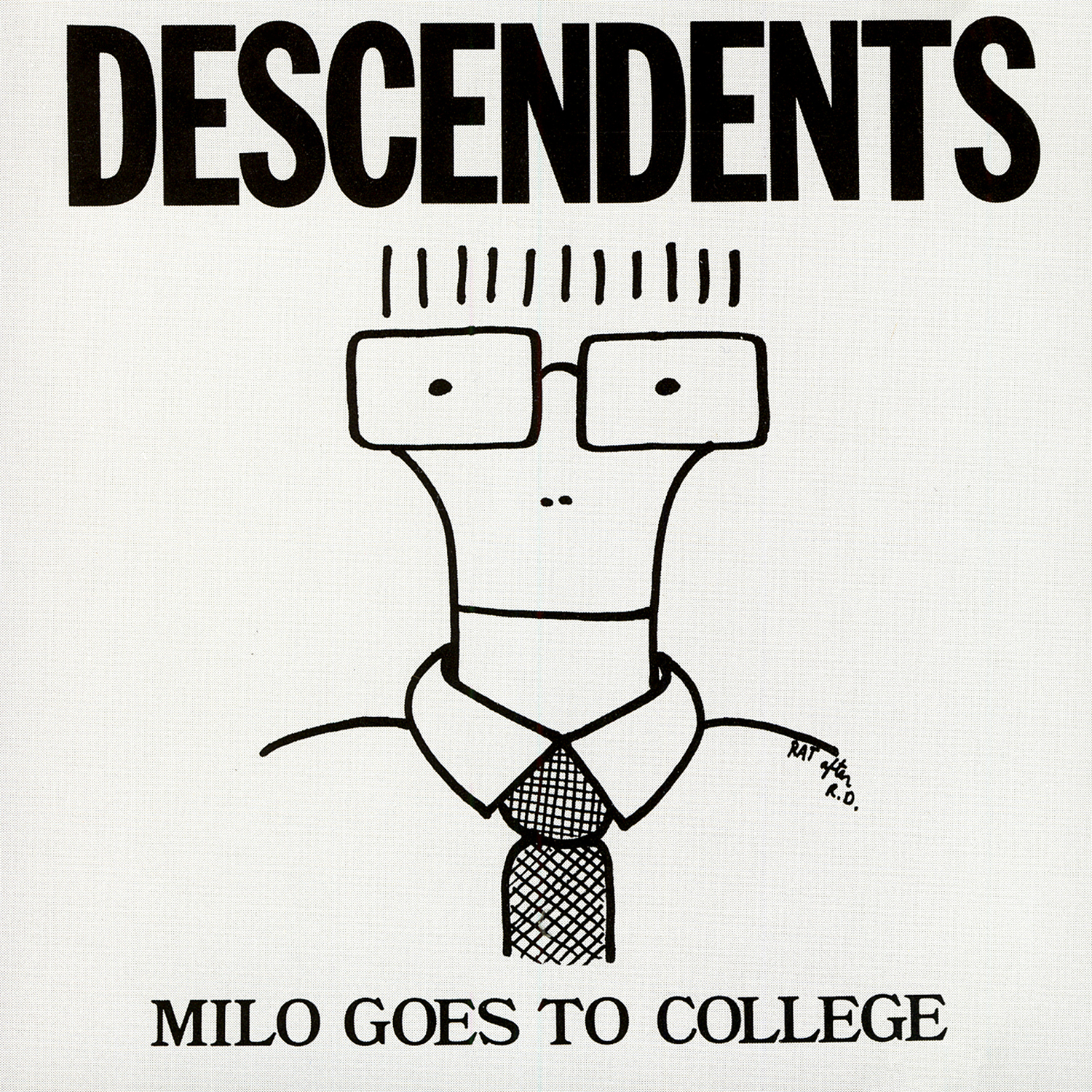
Though it seems they perennially garner fewer accolades than their Cali cohorts, Black Flag and the Minutemen, coffee-fueled Los Angeles band the Descendents’ full-length debut, Milo Goes to College, stands as one of the ’80s’ indispensable punk documents. Its grooves are teeming with furious catchiness, and what it lacks in good manners it more than makes up for in sheer gusto.
 I’ve fond memories of and considerable goodwill for the Descendents, namely the incarnations of the group that recorded up to and including the Enjoy! LP, but must say that from my viewpoint, they can be easily underrated. Or, more appropriately, they often slip through the cracks, largely due to the non-flash nature of their music and image. First and foremost, about focused energy, they wrote tunes that joined musical and lyrical concerns triumphantly seeking to shirk the concept of the punk as a metal-studded casualty with a tube of Testors stuck up his/her nostril.
Occasionally described as “nerd-core,” their songs tackled topics like fishing, hanging out in nature, the joys of junk food, loyalty to friends, bodily gases, the desire not to be a fuck-up, coffee, friction between cliques, and, quite frequently, late-adolescent struggles with the opposite sex. Many of these concerns have been addressed by other bands. Still, frankly, a few haven’t, and certainly not with the appealingly direct (again, focused) musicality and no-frills sincerity that basically stands as their enduring legacy.
They began in ’79 with a 45 of surfy, poppy guitar rock “Ride the Wild” b/w “It’s a Hectic World.” While a nice enough first effort, it’s unrepresentative of where they would head after the addition of lynchpin vocalist Milo Aukerman on 1981’s “Fat” EP. The six songs on that disc are characterized by short, sharp blasts of youthful punk action; some are melodic, others breakneck and spastic à la Hardcore, but they all still sound worthwhile as they creep up on thirty years of existence. Additionally, they serve as the template that the band would refine on their next three releases.
The next effort, ‘82’s Milo Goes to College, is for many the quintessential American pop-punk LP. I don’t think I can come up with a better example. The balance of heaviness and melodicism is ideally rendered, and it has served as a reference point for more (all lesser, to my ears) subsequent outfits than can be comfortably listed here. The strength of the interaction between the instruments remains superb, displaying a commitment to musicianship rarely found in the punk scene.
Bill Stevenson is perhaps most celebrated for his drumming on numerous Black Flag recordings, but he never sounds more fired up and yet at ease than he does with this band and on this album in particular. Tony Lombardo’s bass is as limber and reliable as anybody I’ve heard on the instrument within an exclusively punk context. And Frank Navetta’s guitar burns with sweet dexterity that mingles just right with Milo’s barking, raggedy, yet deft and disciplined vocalizing.
It’s quite a satisfying stew. Plus, there’s enough variety in the overall sound to ensure the LP stands up to repeated listens. I’ll admit that over the decades, I’ve occasionally mislaid this album. But diving back in always inspires more than just a momentary plunge into old memories; it cultivates the desire for multiple cue-ups.
Back when Milo was still a fresh discovery, I strongly felt the second-side opener “Suburban Home” was the apex of this particular release and of pop-punk in general. Yes, it’s defeatist to boil it all down to one song, particularly when The Buzzcocks are standing in the periphery with arms folded, silently asking with a collective frown and hairy eyeball if they’re chopped fooking liver. Still, at some point, anyone obsessed over music has probably engaged in the overzealous boiling down of a genre or two.
I do vividly recall heading straight for this specific track on what now feels like countless occasions to show loved ones, friends, and acquaintances that US punk rock post-1980 could be more than sweat, spit, and raging fury. It could also succeed in conjuring up accomplished and downright memorable tunes whilst getting wedded to the sonic urgency expected in the environment of its inception.
The propulsive infectiousness of this record elbows its way with pop-rock antecedents reaching all the way back to the dawn of rock ‘n’ roll, like some wonky daisy chain trying to levitate the Mabuhay Gardens. However, my current perspective on Milo Goes to College is less specifically smitten with the grandeur of “Suburban Home.”
Bluntly, the whole platter is gills-packed with cuts that nearly equal it in quality. The assured opening swagger of “Myage,” the HC-like brevity of “I Wanna Be a Bear,” “Tonyage,” and “M-16,” Milo’s gorgeous post-Darby throat shredding on “Parents,” the sing-along fist-pump oomph of “Catalina,” the explicitly ‘60s-derived chugging of “Marriage,” and the gnawing closing tunefulness of “Jean is Dead” are fast on its heels, while the achy pogo-bait of “Bikeage” actually gets so close to “Suburban Home” that I’m tempted to call it a draw. Tempted, hell! A draw it is. This isn’t sports, it’s art. Who needs winners?
Now, if you’re a significant series of yardsticks away from the tumultuous minefield that is the adolescent wasteland and have got yourself adjusted to a “healthier” mindset and environment (I’m trying to avoid the word “maturity” here, because in a nutshell, The Descendents’ prime stuff is really an extended battle with that very concept), hearing this record for the first time brings a direct possibility of finding the lyrics (quite a few of them, anyway) off-putting.
The unfortunate slang choices, in particular the insults to gays heard during “I’m Not a Loser,” and the blunt rejection/harsh criticism of females found in numerous spots (most prominently on “Catalina”) have certainly not aged well. However, the homosexual insults are really in the realm of schoolyard name-calling and not the bigger, nastier league of thought-out stupidity that H.R. of the Bad Brains sank into. It’s still not pretty, but it lacks the ugliness of ideology if you dig me.
The same goes for the hostility to gals, which honestly smacks of the conflict between flaring hormones, allegiances to friends, and expectations of self. Interestingly, the biggest Descendents fan I’ve ever known is a woman (oh, what a complex world we live in). But even at this point, they could come up with top-notch relationship songs; see “Kabuki Girl,” “Hope,” and “Marriage.” In summation, I don’t think these guys (and the above femme fan considered, much of this is “guy music” personified) were thinking in the long-term. And to digress, what great music or art really strives for longevity?
My thoughts are inclined toward the idea that most great art speaks to its time (era) and place (circumstances), and that longevity, warts and all, results from a combination of worthiness, luck, and unforeseen conditions. I’m not trying to be polemical here, though; opposing viewpoints are certainly jake. But speaking of warts, have you read Conrad’s Heart of Darkness lately?
Make no mistake; Milo Goes to College is great art made by teens, for teens, about the fucked-up reality of being teens. But like the sustained and inspired nonsense of The Chips’ “Rubber Biscuit,” the wicked simplicity of The Rats’ “The Rat’s Revenge Pt 1 & 2,” or the blazing mania of The Electric Eels’ “Cyclotron,” any random song from this record has a viselike grip on relevance. Let some of those youthful lyrical missteps bounce off your suitably thick skin, and what you’ll hear is a fantastic LP.
Ah, it’s more than that. It’s a goddamned classic.
GRADED ON A CURVE:
A+