
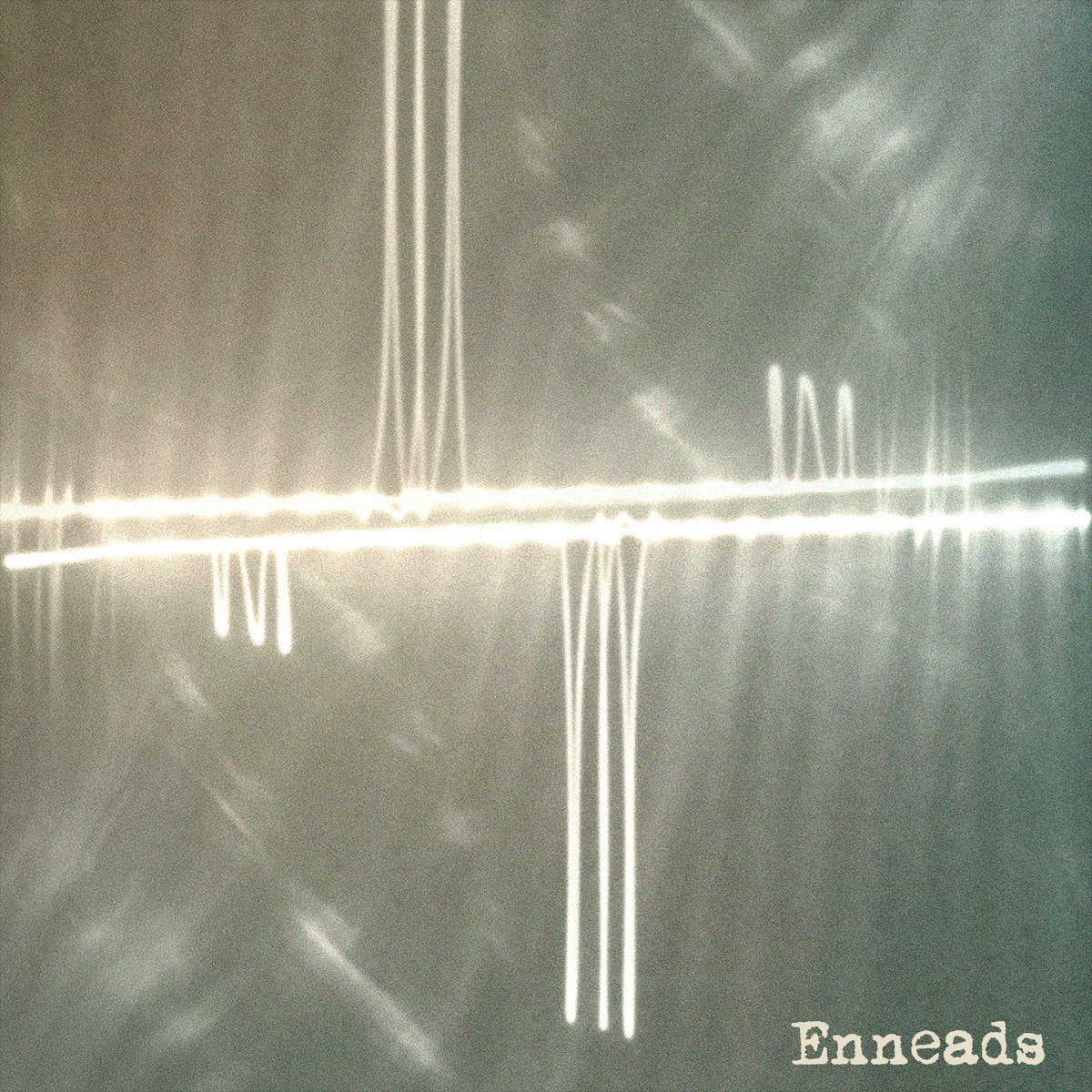
17-string bassist Zach Layton, drummer Hamir Atwal, and pianist Phyllis Chen are Enneads, a Hudson Valley-based outfit that is honing a dark and roiling slow dive into tense, occasionally abstract atmospheres that Layton has described as “doom jazz.” Their eponymous debut captures this black-clad experimentalism quite well. It’s out on vinyl, compact disc, and digital August 28 through the Birdwatcher label.
First off, this debut set was crafted by Enneads over a two-year period, a span that’s reflected in the finished work. A fair amount of experimental music leans toward inspired instantaneousness in execution, but the seven pieces that shape this album were clearly built over time.
Heaviness is a major component in the scheme, both auditory and thematically. The trio (the album) is named after the writings of Plotinus, the Greek philosopher credited with founding Neoplatonism, and a guiding improvisational principle for Enneads is the Pythagorean concept, credited to philosopher Boethius, that harmony is “number made audible.”
If the above leaves an impression of dryness, or possibly just a challenging or forbidding experience, that’s not accurate. While heavy, the pieces here aren’t designed to put the listener’s nerves through the wringer. Of course, everybody’s built differently, but the doomy quality Layton and his mates conjure isn’t stressful. To the contrary, the vibe is almost seductive.
Chen is a Guggenheim Fellow, and Atwal and Layton are educators. Chen helped to found the International Contemporary Ensemble (ICE) and is noted for her work in the UnCaged Toy Piano project. Coming out of the Bay Area, Atwal has improvised with some major figures, including Myra Melford and Kenny Wolleson. Layton has deep roots in the NYC avant-garde scene as a player and composer, but also through an extensive curatorial background.
To quote this record’s promotional text, Layton’s work “explores psychoacoustics, alternate tuning systems, brainwave and quantum sonification, multichannel spatial audio, and the physical behavior of optical sound.” In short, Layton is a serious guy, although knowledge of his predilections isn’t a prerequisite for enjoying this record. Gathering an understanding of the well-roundedness of these three creators does allow one to more ably pick up what Enneads is laying down.
In jazz terms, nothing here is anywhere close to trad. Atwal’s drums are the most recognizably jazzy element in the instrumental mix, but that’s still far from an exercise in delivering scenarios for finger snapping. The pieces do possess a graspable rhythmic thrust that keeps the sounds from tipping over into the purely abstract.
Chen plays an amplified piano, but don’t go thinking the music is sauntering up to a fusion-esque neighborhood. The closest this record gets to fusion-like tactics is a few stretches that sound like Herbie Hancock circa-Sextant getting lost on a tour of the UK and driving his rented Fiat into the living room of Cosey Fanni Tutti.
Instead of bell-like tones or liquidy organ runs, Chen dishes a bunch of thunderous low-end key plonks that sound like they could’ve been excised from the soundtrack to an early 1980s horror film shot in New York City on 8mm celluloid and screened twice in a Soho loft onto a bedsheet.
Layton’s 17-string electric bass pulls the sound together and adds considerable weight to the progressions. Recordings are slowed down, the better to tap into that doom-laden ambiance. Enneads will interest adventurous contempo jazz heads but also folks with a liking for the post-drone NYC avant-classical fringe and even an experience comparable to the Necks tripping balls in A Field in England. Perhaps not a fun record, but a very engaging one.
GRADED ON A CURVE:
A-