
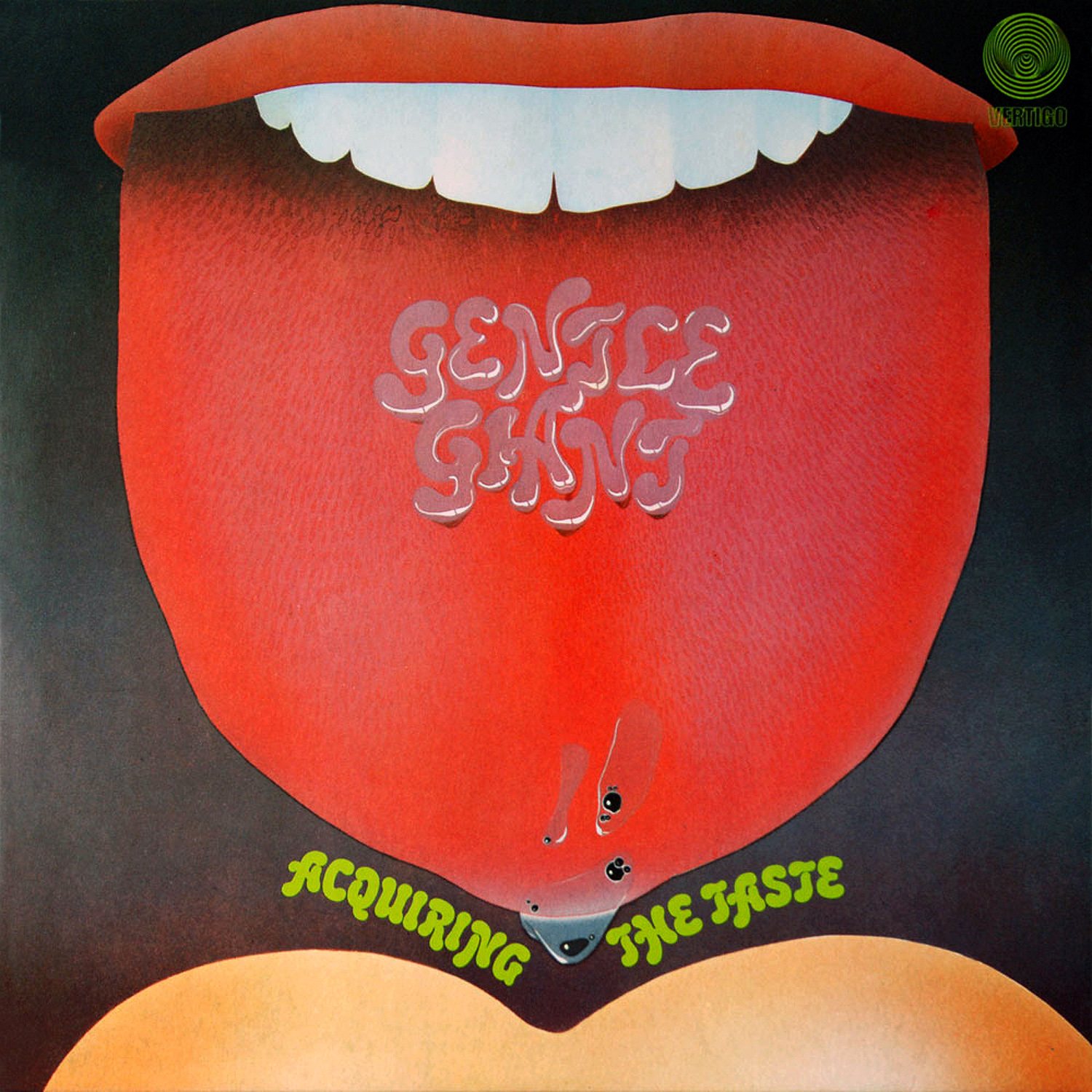
In the sleeve text of their 1971 sophomore album Acquiring the Taste, Gentle Giant made the brave claim, “It is our goal to expand the frontiers of contemporary popular music at the risk of being very unpopular.” And they succeeded beyond their wildest progressive rock dreams; during a tour opening for Black Sabbath a year or so later, they were booed off the stage—every night!
Then again, that “acquiring the taste” means exactly what it says—your average Black Sabbath fan wasn’t likely to enjoy their first taste of what Gentle Giant had to serve up, because (as they say themselves) you have to really listen to this music over and over to fall in love with it. That said, some never find Gentle Giant’s fare to their taste, and deem it unpalatable no matter how many times they attempt to swallow it. People with good taste, for example.
And speaking of good taste, or I should say its opposite, there’s that album cover, which features a tongue licking what appears to be someone’s, er, anus. Analingus is indeed an acquired taste, even if the cover’s a trick—open the gatefold, and the buttocks turn out to be a peach.
Acquiring the Taste is said to be a departure from the blues and soul on their 1970 eponymous debut. The only problem is that only a madman would characterize the pastoralisms of their debut as blues and soul. Acquiring the Taste isn’t so much a departure as a furthering, and to many, they venture too far from what they call later in their “mission statement” of sorts, “blatant commercialism.” What’s wrong with blatant commercialism? It gave us “Hang on Sloopy.” It gave us The Monkees. It’s given us just about every great rock song ever!
Acquiring the Taste is situated far, far away from the crass environs of crass commercialism—on the lost continent of Atlantis, perhaps. It has all of the hallmarks of progressive rock at its most baroque, the most annoying of which are the constant shifts in time signatures, the harmony vocals, and the constant looking back to the musical past. And the quotidian linear is anathema to Gentle Giant, making this that most dreadful of all vinyl artifacts—a musician’s album. Musicians can admire the musicianship, wannabe musicians can admire the musicianship, and the rest of us can suffer the musicianship.
They save the worst for first. “Pantagruel’s Nativity” (you know you’re in trouble with a title like that) opens with mini-Moog and the delicate vocals of Kerry Minnear, and then all boring hell breaks out. Well, the guitar of Gary Green isn’t boring, but the horns and woodwinds are, and when everything comes to a near halt, only to have Green come back in, you know what you’re in for. Madrigal vocals, just like in the Middle Ages or whenever! A vibraphone solo gratis Derek Shulman! More guitar, and thank Christ! Green, god bless him, even tosses in some heavy riffs! But then the vocals come back, a trumpet sounds from off in the distance, and on and on it goes until it all mercifully stops.
You get more sensitive vocals in “Edge of Twilight,” both singular and plural, along with some horns and drums, and then a Yes-like passage and some kettledrums and plinky xylophone and harpsichord, and there’s a gong in there too, because how could there not be a gong in there? At the edge of twilight, I always hear, far off in the distance or perhaps an inch or so from my ear, the sound of a gong. Don’t you? Pretentious is the word that comes to mind as I’m losing my mind.
“The House, the Street, the Room” opens with Derek Shulman’s vocals sounding very “rock,” but the harmony vocals that follow, in combination with the celeste or clavichord or whatever, quickly dispel that notion. Then there’s lots of dithering of the annoying variety until Green comes in on guitar and voila! Actual rock! Complete with organ and a rock ’n’ roll beat! It’s fantastic! And it goes on long enough to give you hope for these no-hopers! Until the final minute that is, when they return to futzing around, the goddamn futzers.
The title track is a blessedly short instrumental that falls into the Western classical tradition and accidentally drowns. But it has a beginning, a middle, and an end, and segues quite nicely into the semi-rocker “Wreck,” which moves in a straight line and would be more likable if it weren’t for the big vocals and the sudden shift into sensitive warbling. But this is as close as you’re going to get to a real rock track on Acquiring the Taste, that is, until producer Tony Visconti comes in playing a variety of recorders that remind me how much I hate Renaissance Faires. Who let him out of the control booth? You’ve got to lock a guy like him in! But he’s followed by a short passage that is really rather gorgeous, so of course, Gentle Giant, being the perverse bastards they are, cut it short to give the vocalists one last opportunity to keen Dark Ages style.
“The Moon Is Down” opens with horns galore, then in come more singers who sound like they belong in robes in Canterbury Cathedral, accompanied by one very irksome harpsichord until about the song’s halfway point, when the tempo picks up, Green plays some guitar, and some saxophones go Zappa on you. It’s pleasantly vapid, which is an improvement on unpleasantly annoying. Then things pick up even more until they falter to a stop, and the church singers take over again.
“Black Cat” is appropriately slinky, easy listening, kind of jazzy in a nonthreatening way, and Phil Shulman sounds very relaxed on vocals (his brother Ray ditto on backing vocals), and all’s well until things get busy at about the midway point. I think what we’re hearing is the black cat delicately making its way along, and when it’s finally over, things get jazzy again, and I have to hand it to Gentle Giant, they actually get through a song without throwing in any major roadblocks or detours.
“Plain Truth” opens with Ray Shulman sawing away on electric violin and Gary Green saying, “Tell Frank to order me…uh…two Wimpeys and a portion of chips, will ya? With onions and tomato sauce on the chips, please.” Which could well be the highlight of the album. Then Shulman saws away some more and the band commences to kind of rock, but of course they stop and then start again and once again it’s Zappa and Hot Rats that come to mind, because Shulman is really playing it up and even when the vocals come in they don’t completely abandon the rock beat, except of course they do about halfway through, slowing things down only to pick up the tempo again, and even the vocals can’t ruin things on this one. I like the piano that comes in briefly, Ray Shulman plays some great bass, and they really take it out right, which just goes to show you that had they set their minds to writing actual rock songs, they might have conquered the world!
I will never acquire the taste for Acquiring the Taste, and I’ll tell you why, besides the fact that I’d prefer to acquire a taste for analingus. “The Mighty Quinn.” It’s the perfect song, and the pikers in Gentle Giant could never have written it because they’d have considered it slumming. Worse, Gentle Giant didn’t complicate rock—they rarely condescended to rock at all. Perhaps the Brits, god bless them, are willing to follow these fine fellows down the road to folk, classical, jazz, and whatever other traditions they’re looking backwards upon. But unlike bands like Yes, Gentle Giant was one of those progressive rock bands that were always looking backwards.
Me, I’m of the opinion that if you’re going to play progressive rock, you should be looking forward. That way you don’t have your nose up somebody’s ass.
GRADED ON A CURVE:
D