
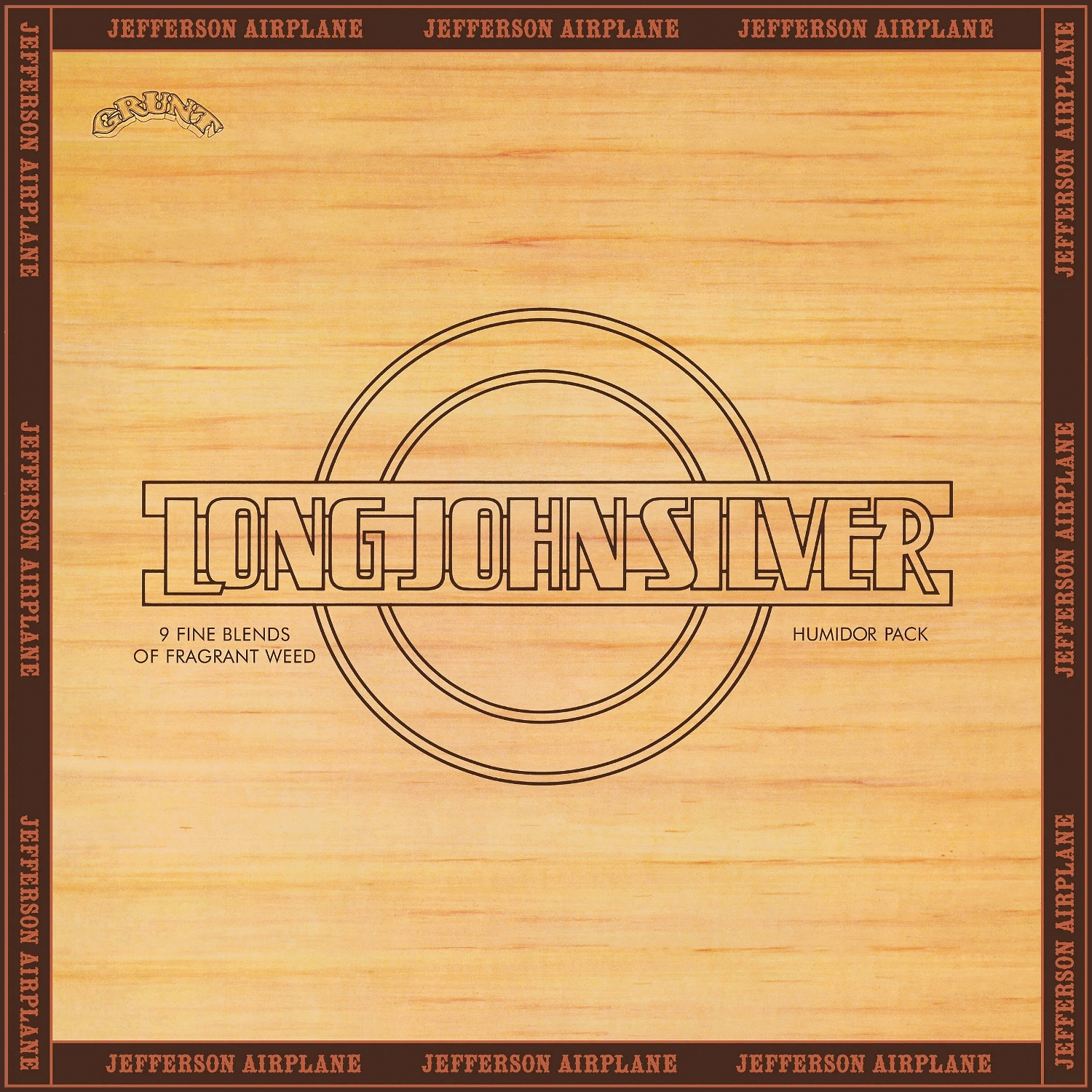
Devotees and dismissive sisters alike have long debated which is the worst Jefferson Airplane studio album. But one thing they agree on is it isn’t the obvious choice, The Worst of the Jefferson Airplane, the band’s 1970 best-of compilation. No, the two albums that always come up are the band’s last until their who-cares 1989 reunion, 1971’s Bark, and 1972’s Long John Silver.
Me, I would give the worst-of award to Bark, which is why I’m writing about Long John Silver. Not only is Bark worse than its bite, it’s worse than being gummed to death by a band of toothless hippies, not including vocalist Marty Balin, who split the band before the LP was recorded. He wouldn’t return until 1975, by which time the Airplane had become a Starship.
Long John Silver beats out Bark for two very simple reasons. First, it’s a rocker, and a hard-hitting rocker at that. And I’m not just talking about the title track and “Eat Starch Mom”—possibly the most metallic track they ever recorded. Second, it includes no obvious filler like Bark’s “Thunk” or “Never Argue with a German If You’re Tired or European Song,” and there’s nothing on it as flat-out dumb as “Rock and Roll Island.”
A quick word before we get to the review: The personnel shuffle that began with Balin’s departure continued with Long John Silver. Drummer Joey Singleton departed after recording two tracks, leaving former Turtle John Barbata (who would remain with the band) and Hot Tuna’s Sammy Piazza to play on the rest. Grace Slick, rhythm guitarist Paul Kanter, lead guitarist Jorma Kaukonen, bassist Jack Casady, and violinist Papa John Creach were all on hand.
There were no big hit singles on Long John Silver, but then again, the Jefferson Airplane hadn’t scored a hit since 1967 with “White Rabbit” and “Somebody to Love,” and would never come close again, although they topped the charts come 1975 as the Jefferson Starship with the pop-friendly LP Miracles. (The title track went to No. 3.) The singles from Long John Silver wouldn’t even chart, although the LP itself climbed to No. 20 on the Billboard Charts. Who bought it, I wonder? I’ve never met anyone who owns it. I’ve never even met anyone who could name a song off it. Where did all those copies go? Is there a used record store in Boise, Idaho, with 196,000 copies on hand?
That said, Long John Silver is a solid LP, without a real throwaway on it, and that’s saying something coming from a guy like me, who always catches the whiff of hippie bullshit when I hear the Airplane. I catch a whiff of it on Long John Silver as well, but it’s not so overwhelming that I find myself laughing at their defiant lysergic long-hair shtick. Or at least not very often.
But let’s not go overboard here. Long John Silver has its merits, but there isn’t a single song on the LP I could hum after the first, second, or even tenth time I heard it. Not only is this not true of “White Rabbit” or “Somebody to Love,” it’s even true of (and I’m bending the rules a bit here) of Starship’s execrable 1985 hit “We Built This City.” Which perversely goes to show that a stick-in-your-head melody isn’t necessarily a good thing. It can be a curse. I’ve never been able to get “Ebony and Ivory” out of my head, and I’ve seen doctors, hypnotists, psychiatrists, and tried both ECT and Ayahuasca. That song is lodged in my skull like a bullet that surgeons are afraid to remove because it could kill me.
I may not be able to hum the up-tempo title track, but it’s an impressive guitar rave-up nonetheless, especially for a band of reformed folkies—Kaukonen and Kantner rev up their chainsaws at the very start and never let up, and Kaukonen delivers on a long, lysergic solo that stands with the best of the psychedelic era. And while Slick handles the bulk of the vocal duties, Kantner harmonizes nicely. And if said band of reformed folkies rocks with authority on the title track, they go metal machine music on closer “Eat Starch Mom,” which is all stacked power chords and general meanness, over which Slick goes on about an American boy who loves his Corvette so much he feels it up. Grace also launches into a diatribe about natural foods, and while I assume she’s being sarcastic (she’s a vegetarian), it can be hard to tell with lines like:
“You say nothing’s right but natural things
Ah, you fool
Poison oak is a natural plant
Why don’t you put some in your food?
Natural food
I don’t care if there are chemicals in it
As long as my lettuce is crisp.”
And I love how she takes the song out by singing the Corvette will “move faster than you can/Vegetable lover.”
“Trial by Fire” opens on a folkie note with some nice syncopated guitar that makes me think Meat Puppets, then in comes Kantner on an apocalyptic note, singing,
“That engine just ain’t strong enough
To get you ’round the turn
Lie on your back in the middle of a field
And watch your body burn.”
Then, even darker,
“Lookin’ at me with your eyes full of fire
Like you’d rather be seein’ me dead
Lying on the floor with a hole in my face
And a ten-gauge shotgun at my head.”
From there, things open up into a psychedelic jam that is very, very groovy, and if Kantner isn’t the most expressive singer, the song’s momentum and the Neil Young “Tired Eyes”-school lyrics make the song a real keeper.
“Milk Train” is a kind of psychedelic blues, Savoy Brown on acid, with Papa John Creach’s violin soaring way up high and Grace’s voice ditto—she sounds really tough on this one, especially when she’s tossing off lines like “Don’t leave the cow juice behind, it’ll cost you nothing” and
“I don’t have to pay for your open mouth
You don’t have to buy it—I’ll give you a free milk tongue bath
It’ll cost you, cost you nothing.”
Sex and milk, milk and sex, Milk on a Train, there’s a horror movie for you. The lyrics will suck you in, even if what we’re dealing with here in the end is a loud but so-so blues.
“The Son of Jesus” is a drag, a kind of fast-paced dirge that is all harmony singing and guitar wank with Creach fiddling away. But in the end, it all adds up to nothing—you don’t even want to check the lyric sheet to find out what they’re going on about. Follow-up “Easter?” doesn’t exactly suck you in either, to the extent that every time I hear it, it’s like I’m hearing it for the first time. Grace wails, snarls, “Ah, stupid Christian, isn’t it grand? Is that your reason for this day?” then “One man of peace dies, and a hundred wars begin” while she bangs away on the piano and Kaukonen grinds away on guitar to no good end.
“Twilight Double Leader” opens with some harmony vocals by Slick and Kantner, then reveals itself to be a rocker, but it’s too light on its feet and disjointed and doesn’t cohere, and I don’t really get sucked in until Kaukonen lets rip on guitar. If you want to know what it is they’re going on about, you’ll have to check the lyric sheet, and should you consult said sheet, you’ll discover they’re going on about nothing much:
“Get down now and roll around me
Get down now and be my queen
Get down now and roll around me
Chinese dance around the queen.”
That said, the song satisfies the required hippie bullshit quotient with the lines “Have you heard about your brothers and your sisters/Livin’ in the mountains… free from the city life.” Going up the country is Grace’s call, but you’d better be damn sure Grace wouldn’t move to the mountains with her “brothers and sisters” (were people still saying that in 1972?) if San Francisco tumbled into the sea.
The lengthy “Alexander the Medium” is all vocals, featuring Papa John Creach, and if you let it just flow over you, it’s groovy, man. Kaukonen plays a really long and cool solo as Creach soars above him, and that’s about it as far as real excitement goes. Towards the end, Grace wails, then does some more wailing, and then does even more wailing, while Kaukonen and Creach weave lines around her, but I don’t know what she’s wailing about, and frankly, I don’t care. (FYI: I did consult the lyric sheet afterwards, and all I can say is I came away with a greater admiration of Patti Smith’s atrocious “poesy.”)
Which leaves us with “Aerie (Gang of Eagles).” It’s a big, portentous number, and Slick comes in sounding like a siren. There are guitars galore, Creach rides the wind, and when Kantner joins Slick singing “Aerie,” it’s really something. The lyrics are so much mumbo jumbo until the final stanza, when Slick sings.
“Well, you can’t fly, human master
No, you can’t fly – fly by yourself
You can’t fly, dying master
Without a rifle on your shelf.”
What is it with these hippies and guns? Has the Airplane decided it’s time to dump the peace and love bullshit and turn to the bullet? Too late! The revolution never happened! That said, the song’s a gorgeous thing, even if (once again) I have trouble remembering it the moment it ends.
My biggest complaint about Long John Silver is that it’s less than the sum of its parts. There’s so much excellent playing and singing, but what does it add up to? A bunch of songs, some very good, that fail to make a lasting impression. If it’s memorable melodies you’re after, look elsewhere.
All I can tell you is I enjoy most of these songs when I listen to them. I just can’t remember them. Long John Silver isn’t an album—it’s a scientifically bewildering case of induced musical amnesia.
Self-erasing songs—now there’s a concept!
GRADED ON A CURVE:
B-