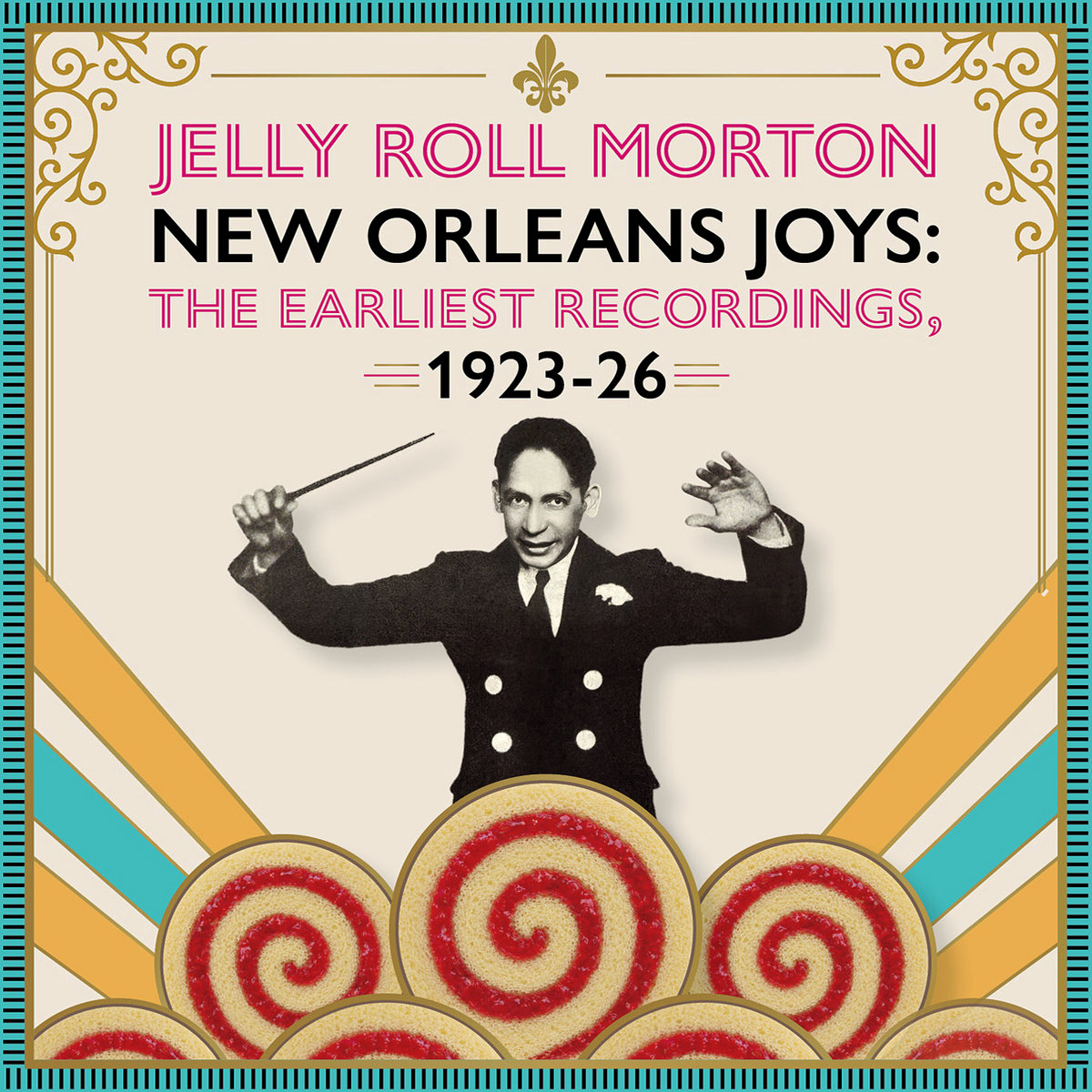
The discussion of jazz doesn’t necessarily begin with Jelly Roll Morton, but the pianist, composer, and bandleader is one of the first prominent figures to have established a major stylistic footprint in the music. With the release of the 2CD collection New Orleans Joys: The Earliest Recordings, 1923–1926 by Tompkins Square, there is now an easy way to soak up the artistic growth of a hot jazz keyboard titan in his pre-breakout days via a series of labels. The accompanying booklet is loaded with scholarship, and there’s a consistent thread of swinging verve throughout. This invaluable set is available now.
When it comes to jazz fandom, the excited novice becomes a learned aficionado by traveling a long succession of individual avenues, reaching into the past, then jumping ahead and occasionally stopping to linger upon the riches of a particular era or the fertile variations inside a niche style before darting out, forward and back and sideways as associations dictate.
Sometimes there is a step back, a deep breath, and then the decision to attempt a chronological approach. Back in the day, one way to tackle jazz in a historical, time-ordered fashion was to snag a copy of The Smithsonian Collection of Classic Jazz, originally a 6LP set available by mail order (though copies inevitably turned up in used-record shops) compiled by critic Martin Williams.
Side one of that tome begins with Scott Joplin’s “Maple Leaf Rag,” recorded in April 1916 and released by the Biograph label. Next is Jelly Roll Morton’s version of the same tune, but jumping ahead to 1938 from an extensive series of recordings made by musicologist Alan Lomax for the Library of Congress (so much for chronology) and first issued by Riverside.
Ferdinand Joseph LaMothe, later to be renowned as Jelly Roll Morton, has three more selections in the Smithsonian collection, “Grandpa’s Spells” and “Dead Man Blues” rounding out side one and “Black Bottom Stomp” opening side two; all three tracks Morton originals recorded in 1926 for RCA Victor with Morton’s famed backing band the Red Hot Peppers.
It was those RCA Victor sides that raised Morton’s profile at the time of their release and secured his placement in the history books and on 6LP anthologies. For many, this is where it begins with Morton, but New Orleans Joys offers a remarkable preamble that makes a strong case for baseline brilliance and rapid-fire development, both as a player and as a composer.
New Orleans Joys captures Morton solo, in a series of bands (Jelly Roll Morton and His Orchestra, New Orleans Rhythm Kings, Morton’s Jazz Band, Morton’s Steamboat Four, Morton’s Kings of Jazz, Morton’s Jazz Trio, the St. Louis Levee Band, Morton’s Incomparables) and in support of cornetist King Oliver, clarinetist Voltaire De Faut, and vocalist Edmonia Henderson. Throughout, Morton exudes a recognizable musical personality, which is one major component in why the guy matters a century after this stuff was recorded.
Oozing New Orleanian gusto as he hit studios in a northward migration, Morton recorded for the Paramount, Okeh, Autograph, and Vocalion labels in Chicago and the Gennett label in Richmond, Indiana. Along with reeds and brass, there are washboards, banjos, kazoos, and paper-and-comb specialists, as ties to minstrel shows and vaudeville are still evident.
But there is also Morton in solo mode, his expressiveness placed front and center. For a while in the mid-20th century, many folks disdained Morton as a braggart and worse, mainly because he wasn’t modest about his abilities as he emerged from an epoch of frequently troubling circumstances.
But spend time soaking up New Orleans Joys: The Earliest Recordings, 1923–1926, and then cue up the 1979 LP Air Lore by the great Chicago trio Air, and the connectivity of it all will flow forth mightily, as masters are in musical dialogue with masters. In 2026, the root is as sturdy as ever.
GRADED ON A CURVE:
A