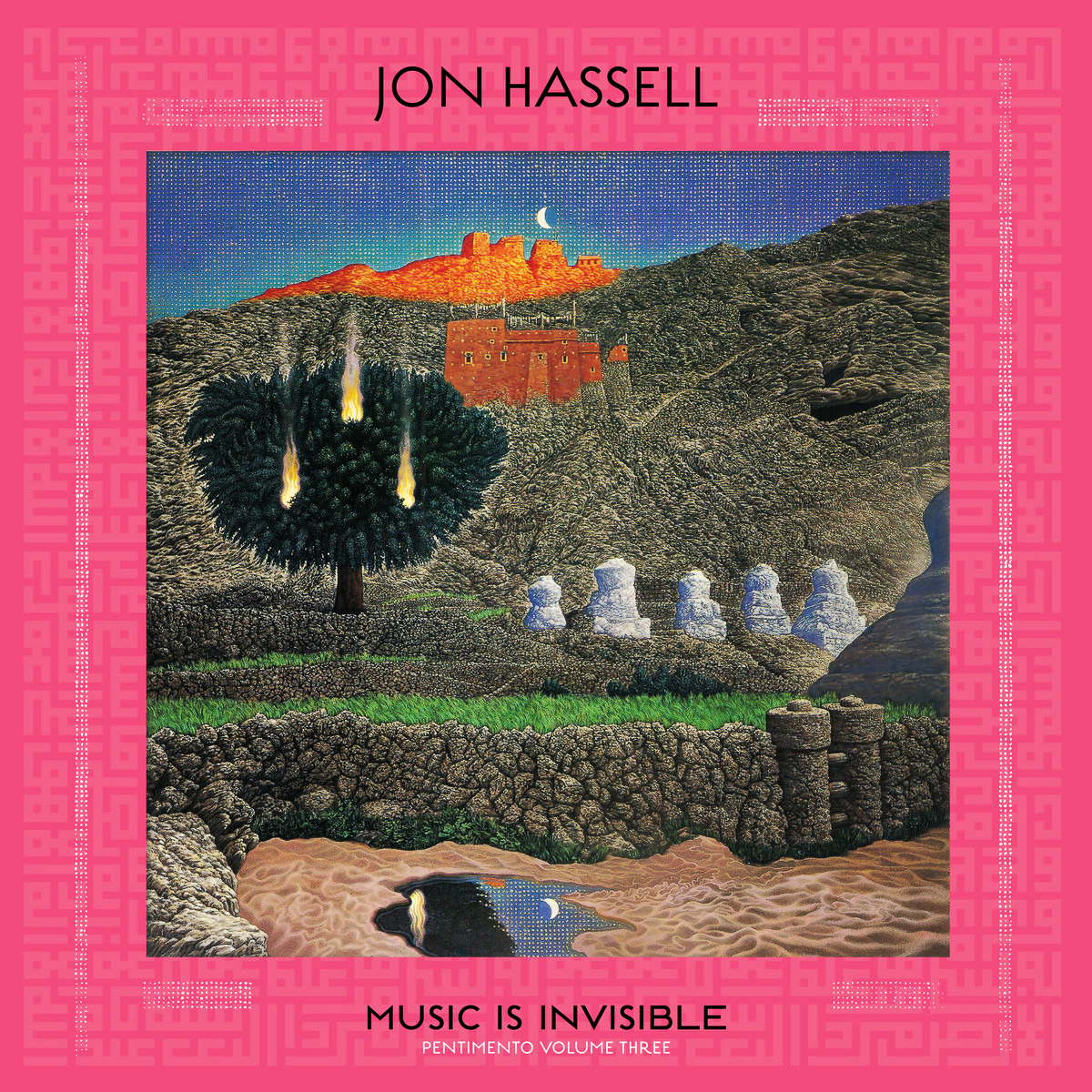
The late Jon Hassell remains one of recorded music’s great explorers. A diligent collaborator with an adventurous mind right up to the very end, Hassell’s talents are on vibrant display during Music Is Invisible (Pentimento Volume Three), which is not only his final concert recording but also the last piece in the Pentimento Trilogy (available as a CD box set). Few musicians are well served by their late works, as Hassell and his cohort blur the distinction between studio and live recordings. Music Is Invisible is out now on vinyl, compact disc, and digital through Hassell’s Ndeya label in partnership with Warp Records.
A trumpet player, composer, and a sonic architect of the highest rank, Jon Hassell debuted with the still striking Vernal Equinox in 1977 through Lovely Music, Ltd. and followed it up the next year with Earthquake Island on Tomato. But Hassell’s big splash came with his Brian Eno collaboration Fourth World, Vol. 1: Possible Musics, released in 1980 by Editions EG.
Dream Theory in Malaya: Fourth World Volume Two came out in ’81, also on Editions EG, as Hassell’s musical approach was firmly planted at the crossroads of ambient and world music. Back then (less so today), many derided these overlapping categories (and related genres such as new age, environmental-space music and neo-classical) as insubstantial and lacking in substance, but there was plenty of good stuff stocked in this corner of the record store during this era (late ’70s-late ’80s), with Hassell ranking high in mix.
That’s because there’s just so much going on in Hassell’s best stuff, and what’s going on is often wonderfully strange. It’s not background music, but there are plenty of subtleties that can give finicky attention spans the fidgets, and Hassell’s trumpet playing, while clearly influenced by jazz, and by Miles Davis in particular (and Chet Baker to a lesser extent), drifts and ripples and occasionally surges rather than rips and wails and swings.
With Last Night the Moon Came Dropping Its Clothes in the Street, his 2009 album for ECM, Hassell foreshadowed the sweet late stretch of the Pentimento Trilogy, which commenced with Listening to Pictures (Pentimento Volume One) in 2018 and continued with Seeing Through Sound (Pentimento Volume Two) in 2020.
Hassell’s passing delayed the release of the trilogy’s final installment. In 2023, Ndeya released a pair of archival albums spanning back to the late 1980s, one live, The Living City, and one studio, Psychogeography, a reworking of his earlier City: Works of Fiction album. Music Is Invisible can perhaps be considered an archival release, as it’s also a live recording dating from 2015.
To add more background, the musicians contributing to Music Is Invisible sprang forth from a musical foundation of samples, much of it from earlier Hassell performances. After the 2015 performance, frequent Hassell collaborator Jeff Rona was asked to improve portions of the set, and specifically Hassell’s own trumpet playing, that Hassell deemed subpar. The results are remarkable in maintaining organic warmth as the journey across four selections gets hazy, glitchy, swirly, and just fabulously weird.
It’s mighty impressive how Hassell and his fellow creators seem to comfortably spring from the more twisted side of the 1990s electronic music spectrum, as a few stretches of the record cozy up to post-rock from the same era. Naturally, nobody’s attempting to ape any style moves; Hassell’s trumpet is as identifiable as ever, as Rona has ironed out any of those lesser portions.
What’s left is an inspired and inventive Hassell, as Music Is Invisible never meanders and is full of surprises. The album holds up well next to the other two selections in the Pentimento Trilogy.
GRADED ON A CURVE:
A-