
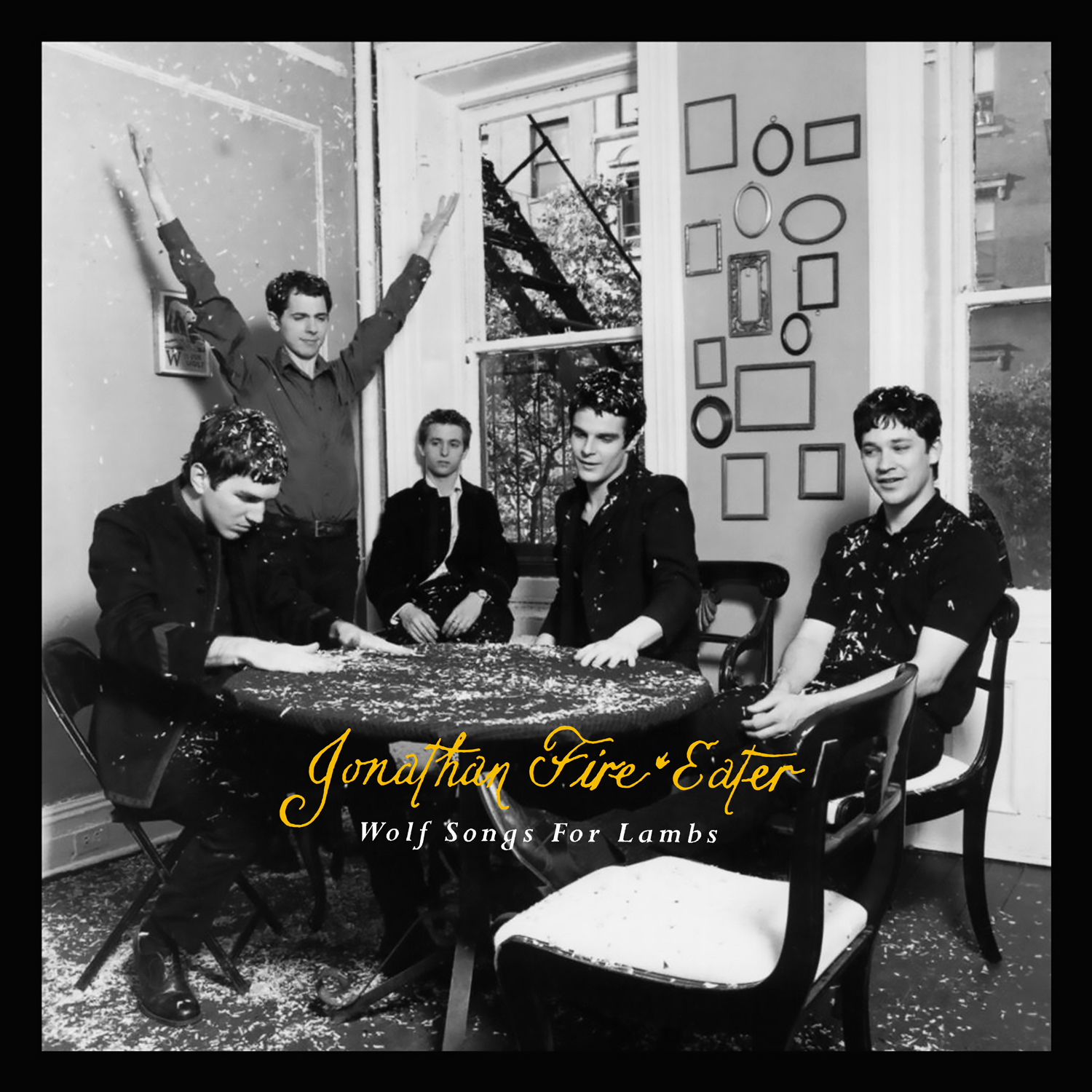
I’m trying to write something about the late Stewart Lupton, for the second time, the first time being an article for the Washington City Paper that never got published about his big comeback that never happened, and I’m finding it difficult because Stewart was this remarkably sensitive and poetic soul who radiated deep pain, and frankly writing about him—and the sad trajectory of his life—hurts.
Lupton should have been a big star with Jonathan Fire*Eater, the can’t-miss mid-nineties art-garage NYC band that combined youth, charisma, great music, good looks, impeccable fashion sense, and a whopping topping of hype. They seemed slated to become what The Strokes would become several short years later—the post-punk band that put the Big Apple back on the map.
But it all went to shit, largely because Stewart had a big bad drug habit and Jonathan Fire*Eater’s much-vaunted album for DreamWorks (who won a big-money bidding war against the likes of Seymour Stein) only sold a piddling ten thousand copies or so. The hype—which included Calvin Klein trying to corral the boys into doing some modeling—backfired on them in the end.
Too many people resented the band’s privilege (they were elite prep schoolers all), good looks, impeccable fashion sense, and arrogance (they knew they were good and weren’t inclined to false humility) and wanted them to fail, and when their DreamWorks debut (1997’s Wolf Songs for Lambs) finally hit the streets the critics turned out to be the wolf and Jonathan Fire* Eater the lamb. More importantly, nobody bought it. In the end, the band’s buzz never extended much further than Alphabet City.
Combine the album’s failure with Lupton’s increasingly erratic behavior, and that was it, show’s over, say goodbye to Calvin Klein and huge bill-topping tours and all of the rest of it. Jonathan Fire*Eater abruptly called it quits in 1998, without putting out the final two albums on their DreamWorks contract. Three of its members went on to form the Walkmen while Stewart retreated to his parents’ house in Washington, DC, where the band had gotten their start as the ska-influenced Ignobles.
After that, it was all crazy ups and downs for Lupton. He made an abortive attempt at a comeback not too long after Jonathan Fire*Eater flamed out (he told me he met Robbie Robertson during a meeting in LA, and when I asked him what Robertson was like, he said, “Orange,” which I think is one of the funniest things ever).
He then went back to college, studied poetry, and when I spent time with Stewart, things seemed to be going well; he looked healthy and was recording some truly amazing songs with his new band, The Childballads. But even then, I couldn’t escape the suspicion (and I didn’t know him that well) that he’d find a way to sabotage everything, which he did.
And Lupton knew himself well enough to have doubts, too. In a 2007 interview (which was about the same time I was spending time with him) with Phil Hebblethwaite for The Stool Pigeon, Lupton said of The Childballads, “It will probably fall apart in about three months, I bet… People expect that of me—to get my shit together for six months and then fuck it up. It makes record executives sheathe their Montblancs.” It was a great line, but sadly prophetic.
What I do know about Stewart Lupton is that never in my life have I met a person who was as obsessed with failure as I am. We were both failure junkies, and we had a great time wallowing in the utter futility of everything.
He liked to sit me down on the floor of his apartment in DC and show me ancient maps of the world, going into rhapsodies about how those cartographers had it all wrong and what a beautiful thing that was. We both subscribed to Thomas Bernhard’s dictum, “After all, there is nothing but failure.”
He was even into some arcane spiritual practice I’ve forgotten the name of, but believe me, it’s obscure. I’m sure the only reason it intrigued him was the fact that it was a loser in the great spirituality sweepstakes. It’s possible he was the only person in the world practicing it.
In the Hebblethwaite interview (I would love to consult MY notes but they disappeared into the void decades ago, leaving me with memories but no quotes) Lupton brought up a T.S. Eliot poem and how it applied to not just Jonathan Fire*Eater but to him and in the end I guess to all of us: “It’s trying to do something but you keep missing. Everybody tries and everybody just gets fucked. Everybody tries and everybody falls.” I couldn’t have said it better myself.
How old was Lupton when I spoke with him? Thirty-two, I think. This was some ten years or so after Jonathan Fire*Eater self-immolated. He was still a very good-looking man, epic self-abuse notwithstanding, and he had some eleven years left to live. And those eleven years were not kind to Stewart Lupton.
Because what I found out about Stewart Lupton during the time I spent writing my abortive feature for the Washington City Paper was that he was more than just a struggling drug addict—he had very real mental health issues, and they ended up killing him.
A quick aside that isn’t really an aside: my feature never saw print for two reasons. One, editor-in-chief at the Washington City Paper harbored a very real grudge against Lupton for reasons I could never quite figure out, and when he literally ordered me to mention a piddling shoplifting charge against Lupton in my article, and I more or less told him to fuck off, he fired me on the spot. The guy wanted a hit piece, and I liked Stewart too much to do it.
The second reason the article never saw print, anywhere, was that Stewart up and disappeared, simply vanished. Several weeks later, he began calling me from the West Coast, or to be more specific, from a train somewhere on the West Coast, and I got the idea that he’d absconded from some rehab out there.
And I’m not talking about brief phone calls—he was leaving these hours-long voice messages on my work phone, one after the other (he never called during office hours). What I had on my hands was dozens of hours of Stewart talking, talking, talking, and I’d known enough people with serious mental health issues to realize that he was in the throes of an epic manic episode. It didn’t even occur to me to try to transcribe the messages—it would have taken days, and much of what he said made little sense.
And that was it for the piece. I got fired, Stewart finally got back in touch a long time afterwards, and I had to tell him the piece was dead. I’d have felt better about things if I’d gotten the chance to finish and publish that piece—Stewart deserved some acclaim for the wonderful music he was making, even if he did indeed blow it again, although the album has seen the light of day.
And over the ensuing years, things only got worse—Lupton fell prey to bouts of paranoia and was hearing voices that told him things he didn’t want to hear. And what Lupton didn’t tell me but did tell Hebblethwaite was that his mental health issues were deadly serious even before he formed The Childballads.
They were so bad in fact, he attempted suicide, and the story he told Hebblethwaite was harrowing: “I jumped off a bridge… I don’t want to talk about the circumstances surrounding it, but it’s a miracle that I lived. It was a very tall bridge in DC known as “suicide bridge.” People don’t usually walk away from things like that. The doctor said it was a million-to-one chance of surviving that fall.”
The details are sketchy, but it seems that at age 43, Lupton would take another leap into the void, in Salt Lake City of all places, and this time he wouldn’t survive. Lupton told Hebblethwaite: “I’ve extracted a lot of life force from the natural flow of things and manipulated it for my own pleasure, and then set about planning and constructing my own downfall.”
Had his planning finally paid off? Had failure finally lost its charm? Or were the voices just too much? It doesn’t matter. I just hope I can finally write something about him that gives you some sense of what he was like.
What I want to impart to you is that Stewart Lupton was as human as they come: curious, enthusiastic, kind, arrogant, charming, and fragile, so fragile. And selfish and self-absorbed and dishonest, I’m sure—he was a junkie, after all. But he had a lot of love in him. I didn’t know him well enough to miss him, but I think I do anyway. He left an indelible impression, Stewart Lupton did, and that impression was of a man who loved life but found living to be an exquisitely painful proposition.
A friend of mine once said to me, “I’m so alive I wish I was dead.” Those are the words that come to mind when I think of Stewart Lupton.
Stewart wanted to be famous (who doesn’t, except famous people) and made no bones about it, and he made no attempt to hide his bitterness over the success of his former bandmates in The Walkmen. He says some wonderfully catty things about them in the Hebblethwaite interview, and can you blame him? The Walkmen were a very dull band, when all is said and done, and Lupton came right out and said as much.
When asked if he was jealous of their success, Lupton told Hebblethwaite, “I’m jealous of the money and nothing else. I could do what they’re doing in my sleep. I already did that. I respect their work ethic, but their music interests me about as much as the New Jersey Turnpike. It’s as bland as the New Jersey Turnpike.”
And, showing a bit of the arrogance that probably struck some people the wrong way, he added, “But I’ve already passed them artistically with this new EP [by The Childballads] so I don’t sweat too much at all. It’s not hubris, it’s just objective empirical reality.”
You have to love that “it’s just objective empirical reality.” Lupton knew his worth. He was a fine poet and the driving force behind Jonathan Fire*Eater—when he took the stage, sparks flew, and his off-stage charisma and scene-making made him as effective a PR person for the band as their real publicist. I doubt it was the other boys in the band who had Calvin Klein knocking. Lupton was always the main attraction, the one your eyes gravitated towards, the one with the 10,000-watt star power.
And speaking of Calvin Klein, Lupton was the only member of the band who wanted to do it. In yet another slam of his former bandmates, Lupton told Hebblethwaite, “These are the same people that had this pseudo-Fugazi, five-dollar X on the hand, church basement righteousness and turned down Calvin Klein, which I wanted to do and frankly I think is a little bit cooler than doing a song for the Spider-Man 3 soundtrack.”
And I get it. Lupton, who never pursued a career in any field besides music and so far as I know never held a day job, could have used the royalties from that song on the Spider-Man 3 soundtrack. He was hardly living in poverty—his apartment was quite nice, actually—but it had to grate to see his less-gifted former bandmates make nice house money.
“Are you locked into a projection booth that shows the films of your troubled youth?” Lupton once sang. It makes me think he was familiar with Delmore Schwartz’s short story “In Dreams Begin Responsibilities,” although maybe he wasn’t. The guy just wrote great lyrics. And those great lyrics are just one reason to give Wolf Songs for Lambs—and the band’s earlier EPs, 1995’s “Jonathan Fire*Eater” and 1996’s astoundingly good “Tremble Under Boom Lights” (the best record they ever put out)—a listen.
The band itself had a raw, garage-punk, organ-driven sound, almost eerie in places, but with push, because diminutive drummer Matt Barrick was this maniac who Lupton compared to Animal from The Muppets.
In Lizzy Goodman’s 2017 oral history Meet Me in the Bathroom: Rebirth and Rock and Roll in New York City, 2001-2011, which more or less begins with the Rise and Fall of Jonathan Fire*Eater, band manager Walter Durkacz says, “The truth of the matter was they were really raw but that rawness was what made people attracted to them.”
That and Lupton’s intensity on stage—–in the book Erin Norris, the band’s PR person/professional dominatrix, compared Lupton to Iggy Pop and Ian Curtis. Later, she says—and this just goes to show you that Stewart must have had a junkie’s talent for burning the people who loved him: “How is Stewie, by the way. I hate his fucking guts.”
As for Jonathan Fire*Eater’s legacy, there’s a great quote from the Strokes’ Nick Valensi: “It was always industry people who would mention, ‘Oh yeah, you guys are like what Jonathan Fire*Eater should have been five years ago,’ and we were like ‘Who the fuck is that?’ I’d never heard of them.” And journalist Jenny Eliscu was even more blunt: “It was over. People forgot they ever existed. Total implosion.”
Although that’s far from the whole truth: Karen O of the Yeah Yeah Yeahs cited them as a big influence, and Interpol’s Daniel Kessler is a big fan. And The Kills included a cover of JFE’s “The Search for Cherry Red” as a B-Side to their single “Pull A U.”
But in the real world, the world beyond the scenesters who gravitated to NYC’s Alphabet City around the time Jonathan Fire*Eater was blowing away audiences, Eliscu hits the nail on the head. Ask someone if they’re familiar with the music of Jonathan Fire*Eater, and they’re likely to say “Who?”
Oh, and before I forget. In addition to Lupton, Jonathan Fire*Eater were Tom Frank (bass), Paul Maroon (guitar and pedal steel), Matt Barrick (drums), and Walter Martin (organs, keyboards). Maroon, Barrick, and Martin went on to form the Walkmen. Frank went on to become a journalist.
Wolf Songs for Lambs is a great album in places, but it’s seriously flawed and drags at points, and with the exception of “Station Coffee,” it lacks a song as in-your-face raucous as “The Search for Cherry Red” or as crazed as “Give Me Daughters,” both from “Tremble Under Boom Lights.”
“Station Coffee” is a true garage nugget, and the most straight-up punk song Jonathan Fire*Eater ever recorded. But it’s not slick; it has a ragged, freewheeling Dylanesque feel, and ends with Lupton singing about how he’s waiting for a phone call from “Little Walter, Mr. Thomas, Matthew, Matthew and Paul”—his bandmates, in other words.
In a perfect world, opener “When the Curtain Calls for You” would have been a hit—it opens like a take on the Plugz “Reel Ten,” then in comes the smash and slam of the drums and Lupton, who has more Jagger in him than he does Iggy or Ian Curtis. The song—like most of their songs—seems to teeter on going completely off the rails, but unlike many of their songs, the organ isn’t front and center.
“The Shape of Things That Never Came” (is that the fate of Jonathan Fire*Eater or what?) is even better. It sounds deceptively ramshackle, with a kind of siren running through it while Martin hits as hard as Bonham and Lupton barks out lyrics like
“There will be no screenplay in our hands
No you can’t go home again
And there are no more lines, to be read
And it’s time
Time to begin, little darling.”
and,
“A magazine party in an old train yard
A girl had a seizure there
She was putting on the make up in a club car
There’s make up everywhere, you little princess.”
But the lines that haunt me go,
“And now we tried to be strong, and carry on
But somehow the party seemed doomed.”
A doomed party—if that isn’t the perfect summation of Jonathan Fire*Eater, I don’t know what is. One where Stewart Lupton was having so much fun it wasn’t until he woke up a year later that he realized he had no band, no money, and that everyone who’d called Jonathan Fire*Eater the next big thing had found a new next big thing to champion. In short, the world had moved on.
Unfortunately, some of the others just plain drag. “This Is My Room” sounds lazy, and not in a good way, and leads nowhere. Lines like “The cruelness of the world, it can be daunting” aren’t Lupton at his best, and the guitar solo is just so-so. “Everybody Plays the Mime” features a basic drumbeat, and Lupton sounds bored. “A Night in the Nursery” features some atmospheric guitar by Maroon but lacks a melody, and it isn’t until the three-quarter mark that Lupton seems to wake up.
“Inpatient Talent Show” is sonically interesting, but it drags, at least at the beginning. But come the second half, the organ kicks in, and Lupton delivers his lines with real urgency—he truly sounds like an inpatient in a psych ward regaling his fellow patients at a talent show.
“No Love Like That” is the closest the band came to a single—it’s fractured art garage with an off-kilter organ and staggering drums and (most importantly) real forward momentum, and Lupton sounds very, very Jagger, especially when he sings the chorus. And Maroon plays some very cool guitar.
“Bi-Polar Summer” is an organ- and drum-powered battering ram, and Lupton runs roughshod over it, dragging out a “yeeeaaaah,” shouting “Come on!” and singing “Let the bones of the wolf be gnawed by lambs/I’m think I’m beginning, man, to understand.” And then there’s
“Well they’re drinking in the aisles to the good friends they’ve lost
And the conductor with the voice so true
Says “I once had a friend who looked a lot like you”
Well I did too.”
It’s an inspired performance, and listening to it, you get a clue as to what Lupton must have sounded like live.
“These Little Monkeys” opens with some wild organ and more drum thump, and while the wheels sound in danger of falling off and there isn’t much of a melody to speak of, the song goes full tilt, the organ makes a crazy sound, and Lupton comes across like a true anti-natalist:
“And if you pull up your dress
We’ll make children that cry every time it rains
And scream at the sound of passing trains.”
Then,
“Ah these little monkeys are crawling around
These little monkeys are breeding again
These little monkeys are crawling around
These little monkeys are breeding again.”
Wolf Songs for Lambs isn’t the album Jonathan Fire*Eater could have made, indeed needed to make, and it’s unfair to place the blame for that on Lupton. What is on Lupton is that the drugs and the disappearing acts (he’d miss the occasional gig, and practices for sure) led the band to call it quits before they could set things right on the next album out. We’ll never know what Jonathan Fire*Eater was capable of, but I’m sure they were capable of better.
Stewart Lupton was a master of the art of self-sabotage, but unlike other masters of the art (Anton Newcombe of the Brian Jonestown Massacre comes to mind), Stewart could never get it together and keep it together long enough to make a mark. He simply had too many demons, and it’s a pity and a shame.
Listen to The Childballads’ “Cheekbone Hollows” if you want to know how good he could be. He should have been a star; to meet him was to know it, but time after time, he simply failed to show up. In the end, his greatest talent was for vanishing.
When I think of Stewart Lupton, and I think about him quite often, the lines that come to mind are from Neil Young’s harrowing “Tired Eyes.” “He tried to do his best, but he could not.” What a loss. What a beautiful soul. How old would he be now? What would he be doing if he hadn’t given up the ghost? I don’t blame him for giving up the ghost, mind you. Life can be too much, too painful, more than a living soul can bear.
Too much too soon too bad. What a cheap formulation. And applying it to Lupton is not just a simplification; it’s a lie. What a wonderful thing it would be if Stewart were still with us, at peace, writing poetry and making music. He tried to do his best, but he could not. He tried to do his best, and that’s all that matters. He tried to do his best, and in the end, his best was better than most. And that’s no lie.
GRADED ON A CURVE:
B