The passing of Kiss guitarist Ace Frehley on October 16, 2025, marks the perfect time to take stock of a band that was more than a band—they were a worldwide pop culture phenomenon, like Elvis or The Beatles or Wang Chung’s “Everybody Have Fun Tonight.” Yet their best album was a double live album; they recorded only a small handful of songs that the average person can name off the top of their head, and even an easy sell such as myself would not call them a great rock ’n’ roll band.
No, what made Kiss the most famous band in the world was spectacle, and in the rocket’s red glare department, humanity has never seen anything like them. In their stage make-up and outrageous outfits, they conquered the planet, thanks in equal part to a shock-rock stage show that included fire-breathing, blood-spitting, pyrotechnics, smoking guitars, shooting rockets, and a levitating drum kit. They took Glam Rock and turned it into a cartoon, and by so doing made David Bowie and Alice Cooper look like underachievers.
Why, the boys themselves told a story about how their seven-inch stack-heeled boots were so skyscraper high that one of the guitarists (I forget which) was always toppling over on stage, and how they actually had to make his falling flat on his ass part of the stage act. And the one time I saw them, it didn’t matter that their music didn’t do anything for me—I was so caught up in the blood and the explosions and the rest of the extravaganza, the music was an afterthought.
The costume pageantry and make-up were catnip for the (mostly kids) who volunteered for the “Kiss Army”; muz-crit Chuck Eddy once quipped of the band’s iconic painted faces, “Several sleazy harlots in my high school’s Designated Cigarette Area did the same, which perhaps indicates that the group will be extremely popular someday.” He wrote that in 1991. Nobody at my school went that far, but you couldn’t drive down my hometown’s sad excuse for a main drag without hearing their 1975 double-live landmark Alive! coming out of somebody’s car stereo. And if it wasn’t Alive! it was Frampton Comes Alive! There must have been something in the air in the mid-Seventies, radiation perhaps, because rockers were coming alive left and right.
Unless you’re a diehard Kiss fan there is really one album you need own, namely Alive!, the slab o’vinyl they’ll be chiefly remembered for, and this despite the fact that over the course of their career of very high highs and very low lows (let’s take off our make-up!) the NYC quartet recorded thirty (30!) gold records, more than anybody else in the so-called Land of the Free. Who bought all of those records, I wonder? Why, even the abominable 1981 concept album Music from “The Elder” went gold! It’s one of life’s great mysteries. Could it have been Eddie Van Halen, who, in a paroxysm of dumb, actually wanted to replace Frehley when he defected from the band in the early eighties? (Ace would return in time for the band’s “reunion” in 1996.)
Had Eddie ACTUALLY joined the band, we’d have never had Van Halen’s 1984! Life would be unendurable! I’d have been denied the pleasure of watching the “Jump” video 18,467 times, and counting! And David Lee Roth would have never quipped, “I don’t feel tardy!”
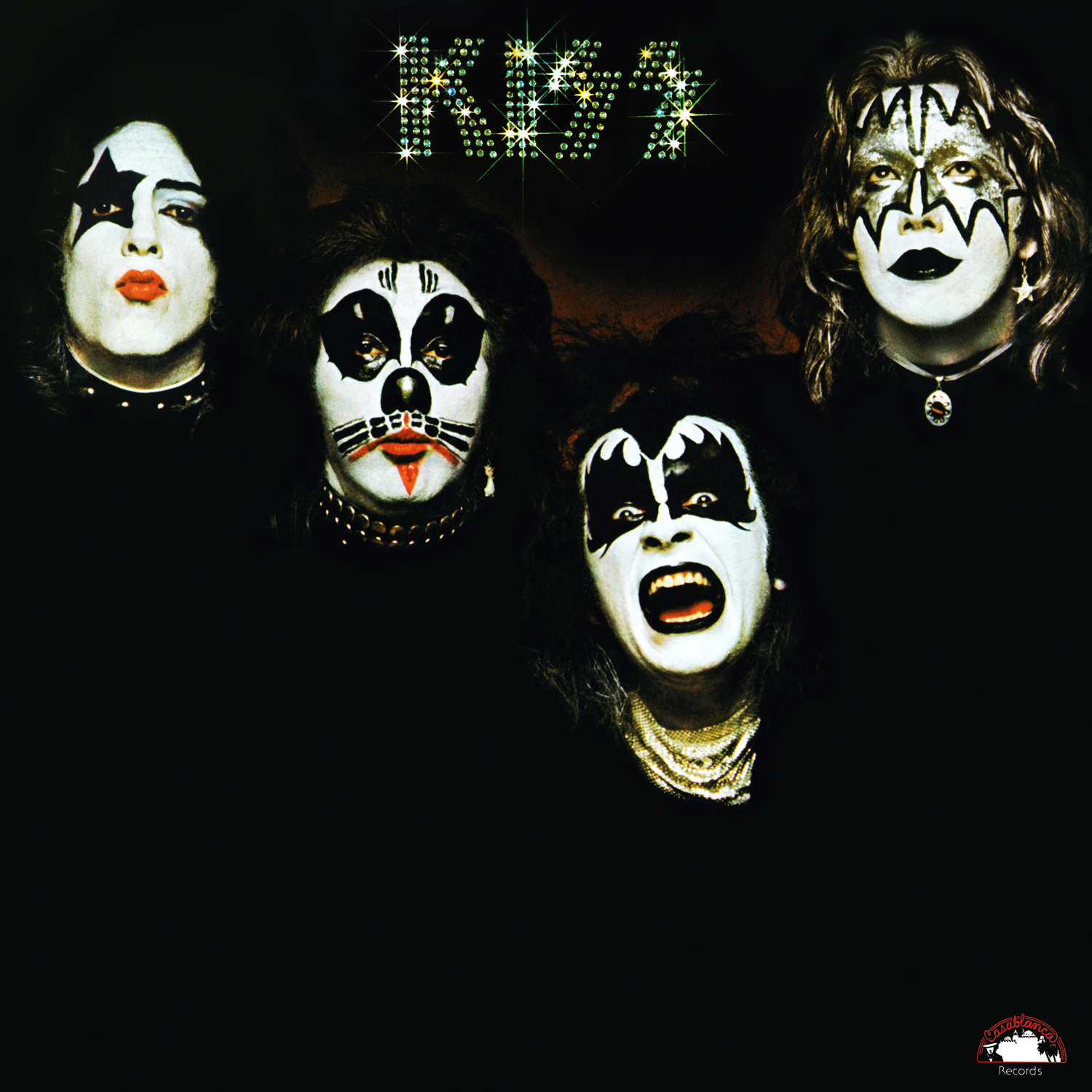
That said, if you’re sane and you’re looking for a second Kiss album worth owning, my money (not that I actually spent any) is on their eponymous 1974 debut. Like the Dictators and the New York Dolls and Television and Patti Smith and so many other rock acts to come out of New York City in the seventies, Kiss saved their best (studio) album for first, which probably tells you something about the corrosive aspects of life in the Rotten Apple. I can think of exceptions, but most of them are folk acts like Simon & Garfunkel and the Beastie Boys.
I hate to quote Chuck Eddy again, but I think he nailed it when he said of the album, “Mostly it’s dumb, mostly that’s the point, mostly the ‘point’ doesn’t make it any better than it already is, mostly it’s pretty good despite the point.” But then again, that goes (or at least that “dumb” does) for every album Kiss ever recorded, and for many, dumb is the reason they love Kiss—there’s something to be said for throwing intellect and class out the window and wallowing in the lowest common denominator for a change. I love Black Oak Arkansas for a reason.
Some will argue that 1976’s Bob Ezrin-produced Destroyer (which includes the undeniable “Detroit Rock City” and the deniable “Beth”) is a better album, or that 1977’s Alive! II (which included five studio tracks) beats out Kiss. Why, there are even some evil mothers (thanks, Lou) who will tell you that 1982’s Ace-free and very metallic Creatures of the Night is a better album. But cut for cut, Kiss is their studio best—it includes “Strutter” and “Deuce” as well as the flawed but still great “Black Diamond,” to say nothing of other lesser-known (to the casual fan) winners like “Nothin’ to Lose,” “Cold Gin,” and “Let Me Know.” Hell, even the Bobby Rydell cover “Kissin’ Time” has its merits.
Even as a dumb teenager, I knew Kiss were dumb, and I was right—what I missed was that dumb has its advantages. Then again, sometimes dumb is just plain stupid, as Kiss proves on the hilariously inept instrumental “Love Theme from Kiss,” which sounds like bad Southern rock, the Allman Brothers in an irreversible coma. And the same goes for “100,000 Years,” which seems to last about that long and includes a drum solo and some truly uninspired jamming. And while some claim “Firehouse” is a Kiss classic, to my ears it just plods. And who needs a firehouse when the whole song is a false alarm?
Otherwise, Kiss prove themselves to be the idiot children of the New York Dolls, barely competent but fully capable of producing stick-figure simple songs that you only need to hear once to remember forever. “Strutter” is pure dumb simple, but its brute power is undeniable, its melody is unforgettable, and the song doesn’t just move, it struts. And the guitar work of both Ace “Space Ace” Frehley (on lead) and Paul Stanley (on rhythm) is lean and mean.
Semi-sleeper “Nothin’ to Lose” is about Gene Simmons trying to talk his partner into trying anal sex (“Before I had a baby/I didn’t care anyway/I thought about the back door, etc.”) and works mainly on humongous power chords, a melody that is sweeter than it has any right to be, Gene Simmon’s seven-inch stacked platform pipes, and the nifty backing vocals, which date the whole way back to the Golden Age of Rock’n’Roll.
Kiss was pressured into recording a cover of Rydell’s 1962 rocker “Kissin’ Time” (get it?) by Casablanca Records’ head honcho, Neil Bogart, who was desperate for a hit. Needless to say, Kiss rolls over the original like a panzer tank, but behind all the metallic clamor, what you have is a very Beach Boys shout-out to Detroit Rock City, Cleveland, and every other city you can dream up, complete with group vocals. The cover may have flopped, but it has Sha Na Na power.
The Ace Frehley-penned “Cold Gin” is a blunt force object, a mid-tempo hard rocker that features on just about everybody’s list of great drinking songs. It’s no “Six Pack” (Black Flag) or “I Got Loaded” (Los Lobos), but it’s as heavy as Kiss ever got, and Gene Simmons sings it like he’s trying to deafen the folks in the cheap seats and practically chokes on the words in the process. And the long-tongued one is a teetotaler! Which is kind of like Ian MacKaye singing Gang Green’s “Alcohol”!
As for “Deuce,” Simmons conceded he copped the bassline from The Rolling Stones’ “Bitch” and played it more or less backwards! And Paul Stanley conceded his opening riff was inspired by the Raspberries’ “Go All the Way.” Which when you put the two together, how could the song not be great? So great, in fact, that Redd Kross covered it, and Redd Kross have impeccable taste! All Kiss had to do was add metal, some great Simmons bellow, and lots of unimpeachable guitar work by Frehley, and presto, a classic!
“Black Diamond” opens with some frankly risible acoustic guitar and crooning by Stanley, then in come the guitars and the vox of drummer Peter Criss, who does a damn good Gene Simmons imitation. By Kiss standards, “Black Diamond” is progressive rock, and to be honest, I wish they’d kept it simpler—the long drag of an instrumental mid-section almost ruins it for me. You get this slowed-down, Black Sabbath-murky, dinosaur-making-mournful-sounds-as-it-sinks-in-a-tar-pit guitar slobber that goes on and on, and while I’m sure it worked live (Gene was probably lighting his farts on fire while it was going on), on record it’s worse than anything I’ve ever heard by Grand Funk, and that’s saying something. But strip it down and it’s a great song. They should have let me edit it.
Ace Frehley’s death touched friends who I didn’t even know were Kiss fans, which goes to show you the Kiss Army is larger probably than Liechtenstein’s, although that’s a trick because Liechtenstein doesn’t have an army! But seriously, Kiss were huge, are huge, and will always be huge, and there never was and never will be anything like them. I wouldn’t call them a great rock and roll band, but one hundred million records sold probably proves me wrong. Go to the remotest part of the Amazon, and the indigenous people there are probably wearing Kiss t-shirts. Ask them to name the members of The Beatles, and they’d probably say “Who?” And the same goes, probably, for many of the younger Kiss fans out there.
Ace Frehley once said, “I’m just a kid from the Bronx who got lucky.” No, Ace, we all got lucky.
Ladies and gentlemen, I give you the greatest rock and roll band in the History of the World!
GRADED ON A CURVE:
A-