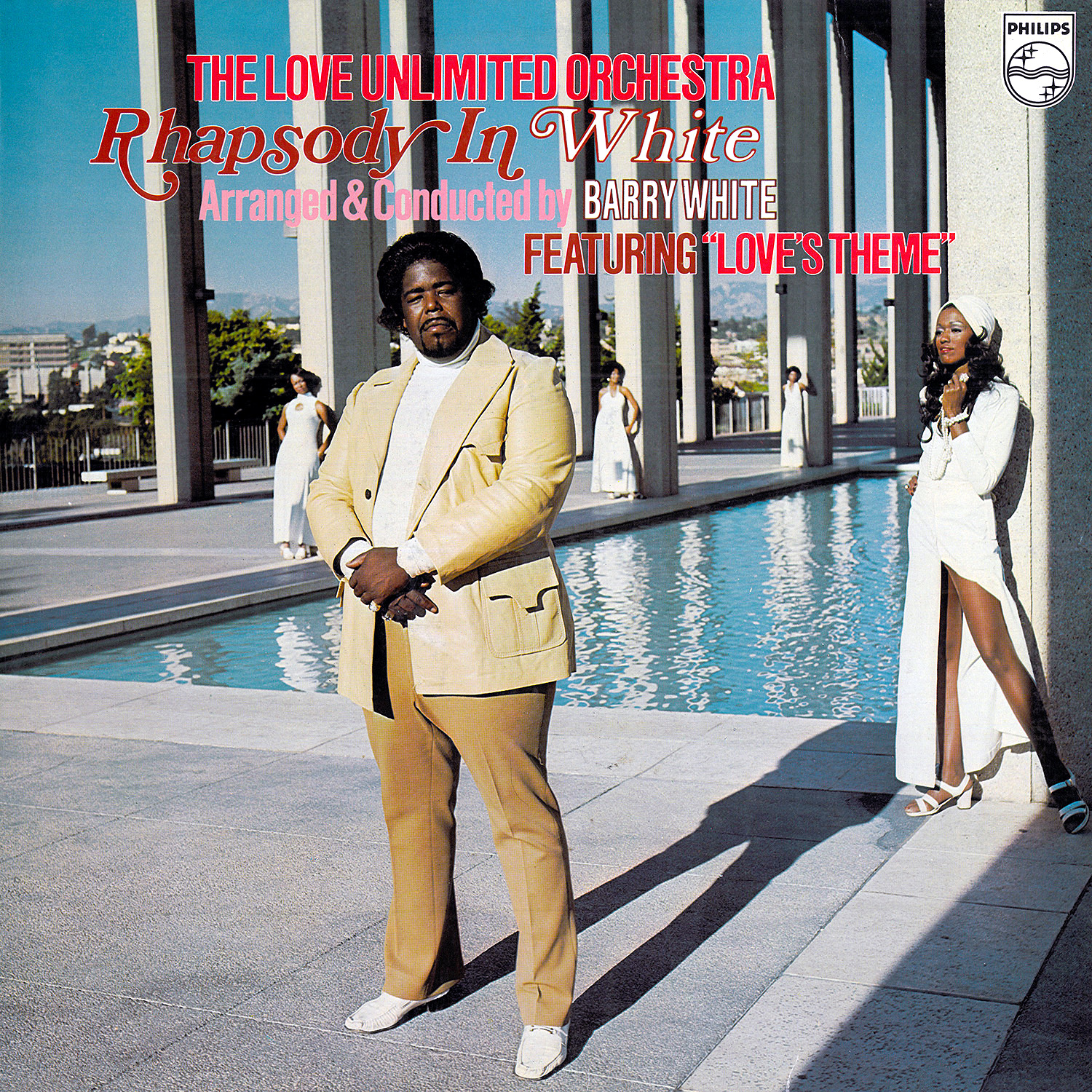
Robert Christgau was cruel and unjust when he dismissed Love Unlimited Orchestra as Barry White’s “Jackie Gleason Tribute Band.” As a musical extension of the rotund soul sex-peddler with the positively lubricious bass voice, Love Unlimited Orchestra shared most of Barry’s strengths and shortcomings, and at their best they served up some great proto-disco and pretty steamy soul.
At their worst they were Barry’s Jackie Gleason Tribute Band.
But first, a word on Barry White himself. Barry was not just another R&B soul man. He was the Grand Dragon of the Golden Order of the Beast with Two Backs and the undisputed King of Music to Fuck By, and his records probably hold some kind of world record for the sheer number of human beings who have orgasmed while they were playing. Statistics like that are hard to come by.
Smell a Barry White record sometime. It will smell like sex. Seriously. That is the hot and funky musk of sexual congress in session you are smelling. I am not kidding. Try it. You’ll want to wash your hands afterwards.
As I said above, the Love Unlimited Orchestra was a musical extension of Barry’s positively colonial empire of fornication, and quite the extension it was–a 40-piece, heavy-on-the-strings musical conglomerate that over the course of its existence counted amongst it members, in addition to guitarists Wah Wah Watson, David T. Walker, and Lee Ritenour, the likes of Ray “Ghostbusters” Parker, Jr., Kenny G, Ernie Watts, Wilton Felder and god knows how many nameless strings musicians. Conducted and arranged by the rotund Emperor or the Erotic himself, the Love Unlimited Orchestra was the strings-plushy cushion in the pushin’ of Barry’s panties-free paeans to let’s get it on.
The Love Unlimited Orchestra stepped out on it own on numerous occasions, but TLUO’s best and most successful outing was its debut, 1974’s Rhapsody in White. Which doubtlessly owed much of its success to the inclusion of the 1973 hit single, “Love’s Theme,” which I loved as kid because as a kid I loved everything, including Neil Diamond’s “Song Sung Blue.” Kids who grow up in the sticks are suckers.
I have never made love to a Barry White or Love Unlimited Orchestra album, and when I went on Facebook to ask if anyone ever had the comments I got back ran along the lines of “How ‘bout the Star Wars theme in a drive-in movie?” (how awful) and “Yes—but I was home alone.” Which would almost be enough to make me think the White-Fornication Komplex was a myth if I hadn’t heard two guys in a bar one night talking at length about how Barry’s music was without equal in the setting the mood department, how his voice could get your girl wet in the panties without you even touching her, and how White’s music was catnip for the ladies and only a damned fool would play anything else while under, on top of or anywhere in the general vicinity of the sheets, including the tacky linoleum floor in the kitchen.
That the Love Unlimited Orchestra is a 100 percent Barry White proposition is demonstrated by the fact that Barry’s on the cover of Rhapsody in White, along with the words “Arranged & Conducted by Barry White.” And while I was expecting the album to be a completely orchestral undertaking Barry actually lends his vocals to several songs. They’re not his best songs, by any means. But I found it surprising none the less that the album isn’t credited to Barry White and the Love Unlimited Orchestra.
The album is isn’t what you’d expect if you’ve ever heard the sweeping and surprisingly funky “Love’s Theme,” which topped the pop charts in 1973. It’s all street-sweeping strings, chukka-chukka guitar, and flute-powered proto-disco propulsion. I dare you to not get sucked into its moveable orchestral shlock. I dare you! And the title track is more of the same, albeit with a smooth jazz veneer—that laid-back guitar guarantees it. Actually there are several guitars in there, but the main point to be made is that “Rhapsody in White” also has propulsion to spare.
What I didn’t expect from the Love Unlimited Orchestra was get-down power, but that’s exactly what you get in the disco funk opener “Barry’s Theme,” which is all staccato guitar, piano and strings, picking up speed as they go along until you get to this the percussion breakdown, after which the Orchestra go full throttle. Even funkier is “What a Groove,” which is some deep-dish shit with percussion galore and has real kick. The strings are there but not over-the-top, there’s this brilliant guitar solo playing over a huge bottom, and the horns are a perfect topper. And that guitar never stops, never. Why it’s still there as the song fades out. Who expected to be funk-punched by a Love Unlimited Orchestra song? Not me.
White is featured on the remaining four tracks, but in a very limited way—he treats us to a bit of his love philosophy at the beginning of each song, then retires into the background and lets the Love Unlimited Orchestra take over. Most of White’s amorous “deep throat” intros aren’t his most inspired—you’ll find no “I don’t want to see no panties” here—although as it turns out the baby blues in the slow groove that is “Baby Blues” are a pair of panties, and Barry likee. “Baby Blues” opens with some strings doing the shower scene in Psycho thing in slow motion, then in comes Barry teasing us by saying (he does no singing on the album) “Certain things turn me on” before saying some boring and totally G-rated stuff but just as you’re giving up he comes out with,
“Now you really, really, really, look good to me, baby
In your baby blue panties, yes love, you look good to me right now
In your baby blues, them baby blues and you.”
The poor woman never stood a chance. As for the song it has this sultry late-night groove that is pure R&B with a strings overlay. But the strings aren’t overpowering, and you get a very sexy sax solo and a long and very laid-back guitar solo that is the aural equivalent of foreplay. Listening to it I finally understand where Lambchop got their chops. “Baby Blues” isn’t as good as Pulp’s “Underwear,” but what is? And while “Baby Blues” isn’t the dirtiest of dirty lowdown by any means, it isn’t easy listening by a long shot.
“Don’t Take It Away From Me” isn’t as effective a song, mainly because Barry’s opening baby please don’t go followed by a cascading champagne waterfall-of-strings ala Lawrence Welk slice of pureed easy listening. It lacks the go-all-the-way drive of “Love’s Theme,” and doesn’t have enough ersatz grit in it to give it R&B appeal.
“Midnight and You” is all cool get down “the night time is the right time” right down to White’s “Right on… right on.” There’s a whole lotta chukka-chukka guitar, but whoever’s playing that guitar does more—he makes noises with that ax that are downright supernatural. And while he’s performing uncanny feats the strings are doing all kinds of things, depending on which direction the rhythm section—which is surprisingly formidable—is steering the song at the time. And come to think of it there’s another guitar, sounding more George Benson smooth, and the percussion is tres Latin and tres cool, and goddamn this one is sweet.
“I Feel Love Coming On” has a hokey melody but I was hopeful when Barry opens things with the love-burp, “You know what I feel like doing to you right now?” Unfortunately, nothing that follows is R-, much less X-rated, and Barry barely manages to salvage his reputation at the end with a lewd but big-hearted laugh. As for the song, it has a movie soundtrack feel and makes me think of waltzes, and songs that make me think of waltzes are no damn good. The strings “play lead,” and that’s not to the good either. You get some guitar in there, but it’s nothing special, and the occasional funk breaks don’t last long enough to save the song from being second-string Viennese disco cannon fodder. It’s also the longest song on the album by far, and the extra minutes don’t make you like it more.
Barry White was an unlikely sex god, but by god he pulled it off with silk sheet bravado and that one-in-the-universe bass seduction vox of his, which changed overnight (as White told Conan O’Brien, “I woke up one morning when I was 14. I spoke to my mother, and I scared both of us”) and ended up changing the world. White never challenged the hard-core funksters or R&B dudes—he opted for brilliant shlock instead, and ended up the King of the Sack.
To quote R. Christgau again, White “always had the integrity to remain utterly lowbrow—street, as they say. Of course, the main thing White heard in the ‘hood was the brandy-spiked whipped cream in his head…” Christgau goes on, but that “brandy-spiked whipped cream in his head” says it all. Barry White’s mind, body, soul and songs never left the boudoir, and Rhapsody in White is shockingly satisfying proof that Barry could talk you out of your baby blues without singing a single word.
If you think you know what the Love Unlimited Orchestra was all about because you’ve heard “Love’s Theme,” Rhapsody in White will be a small revelation. The Love Unlimited Orchestra could do more than create cotton candy strings confections that walked the line of pure camp. They had some funk up their collective sleeve. I expected Rhapsody in White to be a very bad album. Shows what I know.
Barry White is the God of Love!
GRADED ON A CURVE:
B