For decades, Lynyrd Skynyrd fans had to make do with only one live album—1976’s adequate but flawed One More from the Road. I’m a Skynyrd fan to the bone, but I never felt the need to own it. Did I really want to hear covers of the tired “Crossroads” or Jimmie Rodgers’ blues yodel “T for Texas”?
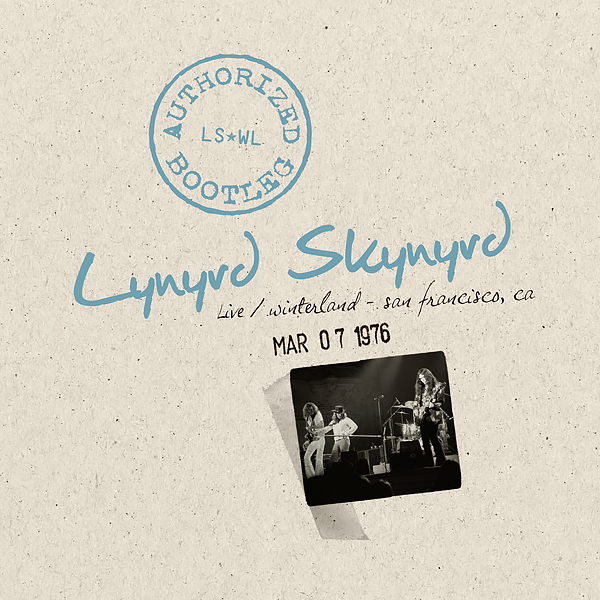
Or a bunch of other songs that sounded EXACTLY (frontman Ronnie Vant was a real stickler on this point) how they sounded on record? Only not as good? Then came 2009, when Geffen Records released a pair of live shows from 1975 (Live at the Cardiff Capitol Theatre) and 1976 Authorized Bootleg: Live in Winterland, San Francisco, CA, 3/07/76. It was cause for rejoicing, right?
Well, yes and no. What I love about Authorized Bootleg: Live in Winterland, San Francisco, CA, 3/07/76 is its raw power. What I don’t like so much about Authorized Bootleg: Live in Winterland, San Francisco, CA, 3/07/76 is its raw power. Let me explain. The songs on the LP are wonderfully rough around the edges, and don’t sound like replications of the studio versions for one simple reason—Lynyrd Skynyrd’s much vaunted “three guitar army” had been reduced to a two-guitar army.
Why? Because the album was recorded during the interim between the departure of Ed King (who’d finally had enough of Van Zant’s alcohol-fueled violence) and the addition of Steve Gaines, who would only play on One from the Road and 1977’s great Street Survivors before dying in the October 20 plane crash that also took the lives of Van Zant and Gaines’ sister Cassie Gaines.
The result is an album that puts a very different Lynyrd Skynyrd on display. They sound like they’re playing catch-up, and what you get is ragged glory. They make me think of a professional football player out to prove he can shine despite a knee injury. He has to adjust the way he plays the game, but damn if he doesn’t win by a nose despite it all. It’s just not very pretty at times.
I have my caveats–the Honkettes, Skynyrd’s trio of backing vocalists, are too high in the mix, especially on “Sweet Home Alabama.” Their vocals overwhelm—or perhaps I should say drown out—the band, and it’s not just distracting. It’s downright annoying. And there’s simply no beating Ed King’s iconic solo from the studio version.
And there are moments that make clear why Lynyrd Skynyrd was dead set on finding a third guitar slinger. That injured football player can make some interesting adjustments, but he’s always going to play better in a healthy state.
Still, I dig it. The LP features only one cover, of J.J. Cale’s 1971 gallivanting “Call Me the Breeze,” which the band felt so strongly about they included a version on 1974’s Second Helping. Here it comes, attached to ear-destroyer “Gimme Three Steps,” on which bar brawler Van Zant plays the barroom coward to great comedic effect (“Show me the back door, man,” he ad-libs, sounding very desperate indeed).
And if Van Zant runs on “Gimme Three Steps,” he keeps running on the Tulsa-sanctified “Call Me the Breeze,” although he has no particular reason to run—as he makes plain, nobody is chasing him. The band doesn’t just nail the two songs together; it nails them, period, with the latter number showcasing the jaw-dropping piano skills of fleet-fingered keyboardist Billy Powell.
I have no clue why they open the show with the mid-tempo “Cry for the Bad Man,” which isn’t one of their best songs. Positive: Gary Rossington’s guitar work, which includes one Yankee-slaying guitar solo. Negative: the songwriting was a team effort, and it sounds like it. It appeared on 1976’s disappointing Gimme Back My Bullets, and it’s one of the reasons why Gimme Back My Bullets isn’t one of Skynyrd’s better LPs.
Speaking of bullets, “Saturday Night Special” is lean, mean, and boasts one belligerent riff—my only problem is the synthesizer (blasphemy!) that makes some farting noises. And if you think the anti-gun “Saturday Night Special” is a hard rock shot to the gut, “Searching” ups the ante—it’s a positive street brawl, with Rossington and Allen Collins trading lead guitar lines. At the same time, the sly Van Zant’s threatening vocal delivery is the equivalent of his off-stage bellicosity.
You can literally hear the guy who once punched Collins in the head—while Collins was driving up Interstate 75 at eighty miles per hour. And that was one of his saner antics.
Skynyrd’s cover of J.J. Cale’s “(I Got the) Same Old Blues” isn’t a thriller, but the guitar work is something to behold, as is Powell’s piano solo. And Van Zant is in great voice. The belligerent “Gimme Back My Bullets” is a triumph and boasts one of the coolest riffs Skynyrd ever came up with. Van Zant isn’t asking for his bullets—he’s demanding them, and his threat against pencil-pushing music critics (“better get out of my way”) makes me glad I wasn’t a member of the eraser-chewing fraternity at the time.
The positively-symphonic-by-Skynyrd-standards “Tuesday’s Gone” holds up remarkably well in a live setting—my only caveat is the Honkettes, who once again are too high in the mix, and every bit as distracting as they are in “Sweet Home Alabama.” But the band pulls it off, and then some, with two guitars, and between Van Zant’s mournful vocals and Powell’s organ and pretty piano solo it’s every bit the victory as the studio version.
“The Needle and the Spoon” isn’t just a hard drug cautionary tale a la “That Smell”—it’s hard rock boogie with a take-no-prisoners pair of incendiary guitar solos by Collins. “If you can’t smoke it or drink it, to hell with it,” Van Zant tells the audience at the end.
Skynyrd close with “Free Bird,” and I would love to know if they ever closed with anything else. The version here is rather ragged, but I love it for that. Van Zant tells the audience they’re playing it for Duane Allman, Powell’s piano is appropriately elegiac, and if it takes Allen Collins a short while to get going, his guitar outro remains a marvel. In the studio, he doubled all the lead guitar lines. He doesn’t have that luxury here, but he proves he doesn’t need it.
Sick of the damn song? Join the club. But I’m not a member of that club. And neither is Artimus Pyle, whose drumming adds a brutal touch to the goings-on.
Lynyrd Skynyrd aren’t just the greatest Southern Rock band of ‘em all—they may just be the greatest American rock band of ‘em all, period. Scoff if you want, but Ronnie Van Zant was one of the most elegant songwriters of his or any time, and the band left us with a body of great songs that stand up against those of Creedence Clearwater Revival, The Band, or their pal Neil Young.
Once upon a time an airplane skimmed the trees of a Mississippi swamp before slamming into the ground, and that was that. There was no fire, just an eerie silence followed by cries for help. The sun was going down, and then the sun went down on a band that had just proven with Street Survivors (which had only been released three days before) that they had plenty of great songs left in them.
Cry for the bad man. Then turn it up.
GRADED ON A CURVE:
A-