Marvin Gaye went from strength to strength throughout most of his career. His early Tamla/Motown singles became big hits, and he had some of those hits as a duo, primarily with Tammi Terrell.
His album What’s Goin’ On, released in 1971, was a breakthrough that demonstrated he was a serious artist writing about the issues of the day and expanding his musical palette by incorporating sophisticated musical arrangements, lush orchestrations, and new musical sounds into a conceptual masterpiece that has withstood the test of time. Lyrically, the album is as relevant as ever. Only two years after that album was made, one of the most purely amatory albums ever recorded was released, and he hit the charts yet again with Let’s Get It On.
Even with all this success, behind the scenes, Gaye was, to riff on the title song from the soundtrack album he released in 1972, a troubled man. Drugs, personal demons, record company hassles, and an unraveling marriage would eventually lead him to drop out of the music business and leave Motown. The album that would in many ways be his last real Motown effort of note (even though there would be two more released) is I Want You. While not met with as much critical praise as Let’s Get It On, it did hit number one on the R&B album charts, and the title song was a number one hit there also.
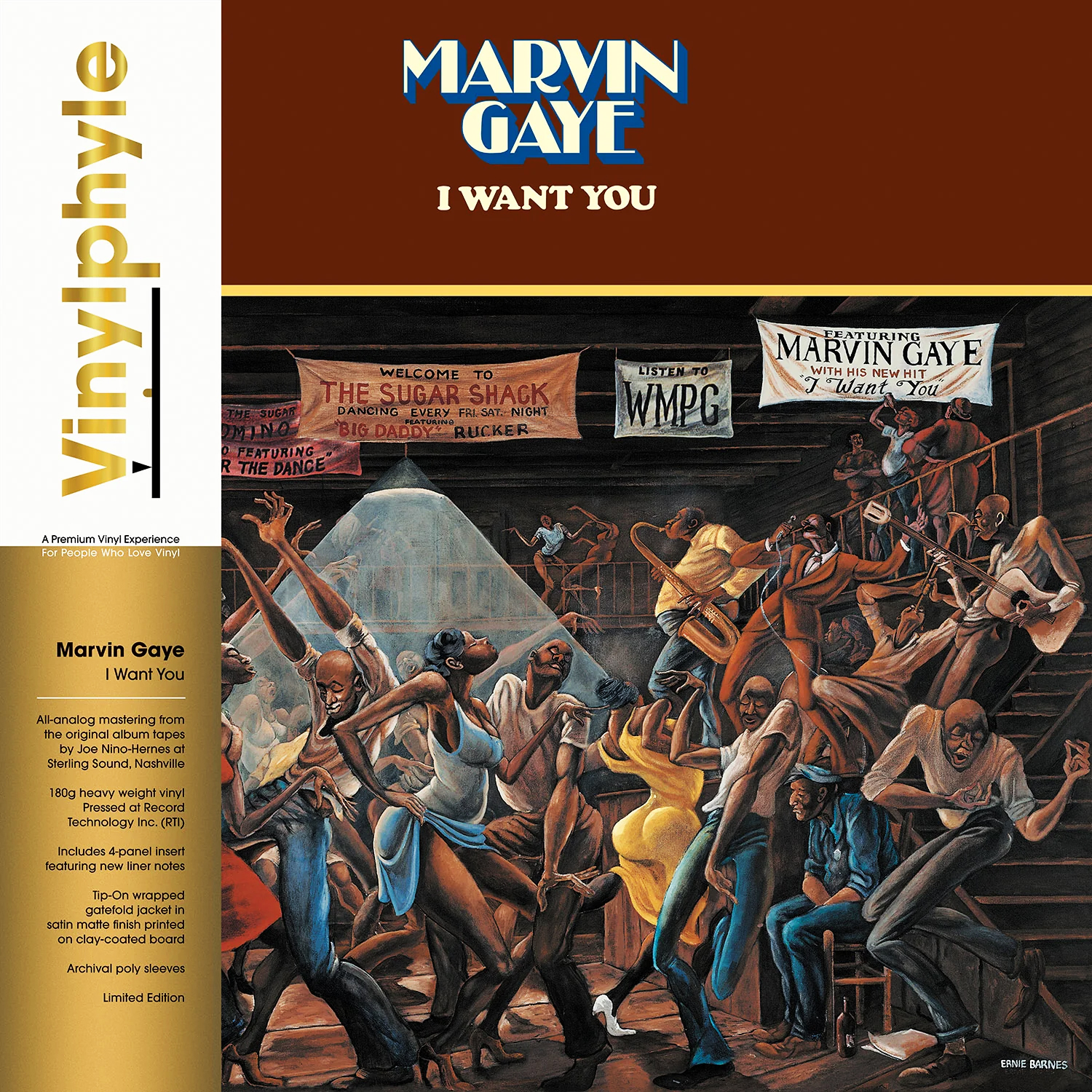
Over the years, the album has gone through a re-appraisal, and in fact, in retrospect, it has become a highly influential work. It’s fitting that the album is now receiving an audiophile release to mark its 50th anniversary. The album, the first recorded at Gaye’s own Marvin’s Room studio, has superb sound, and this is easily one of the best-sounding Vinylphyle releases.
Rather than snappy R&B, bold funk, or sophisticated soul, the album has a subtle late-night chill vibe that gave a preview of the brief quiet storm genre to come many years later. A close listen reveals an album that almost sounds like the blueprint Sade used to launch her critically and commercially successful career six short years later.
This album is all groove, yet for the most part it is upbeat (particularly in expressing Gaye’s feelings about his then-newfound love, Janis) and lively, though there are some spacey moments. There’s some stellar studio musician support from the likes of Chuck Rainey, Wilton Felder, Jay Gradon, and even Ray Parker Jr. Leon Ware’s production is glossy without being sterile, and two songs (“After the Dance” and the title cut, which has two different instrumental versions) are presented with both vocal and instrumental takes.
This is one of those kinds of albums that the more you listen to it, the more you get into it. It may be one of Gaye’s most underrated albums. The key is to enjoy it for what it is and leave aside the high expectations of transcendence that often are reached listening to Gaye’s music or the baggage that comes with his addictions and relationships with women.
Like previous Vinylphyle releases we have covered, this is a limited-edition, 180-gram, heavyweight vinyl release from the original analog tapes, pressed at RTI. It comes in an archival sleeve and gatefold package (featuring the iconic Ernie Barnes cover art), with an OBI strip, a plastic outer bag, and a four-page insert featuring tape-box photos from the original reel-to-reels and new liner notes, including an interview with Harry Weinger and SaLaAMReMi.
GRADED ON A CURVE:
B+