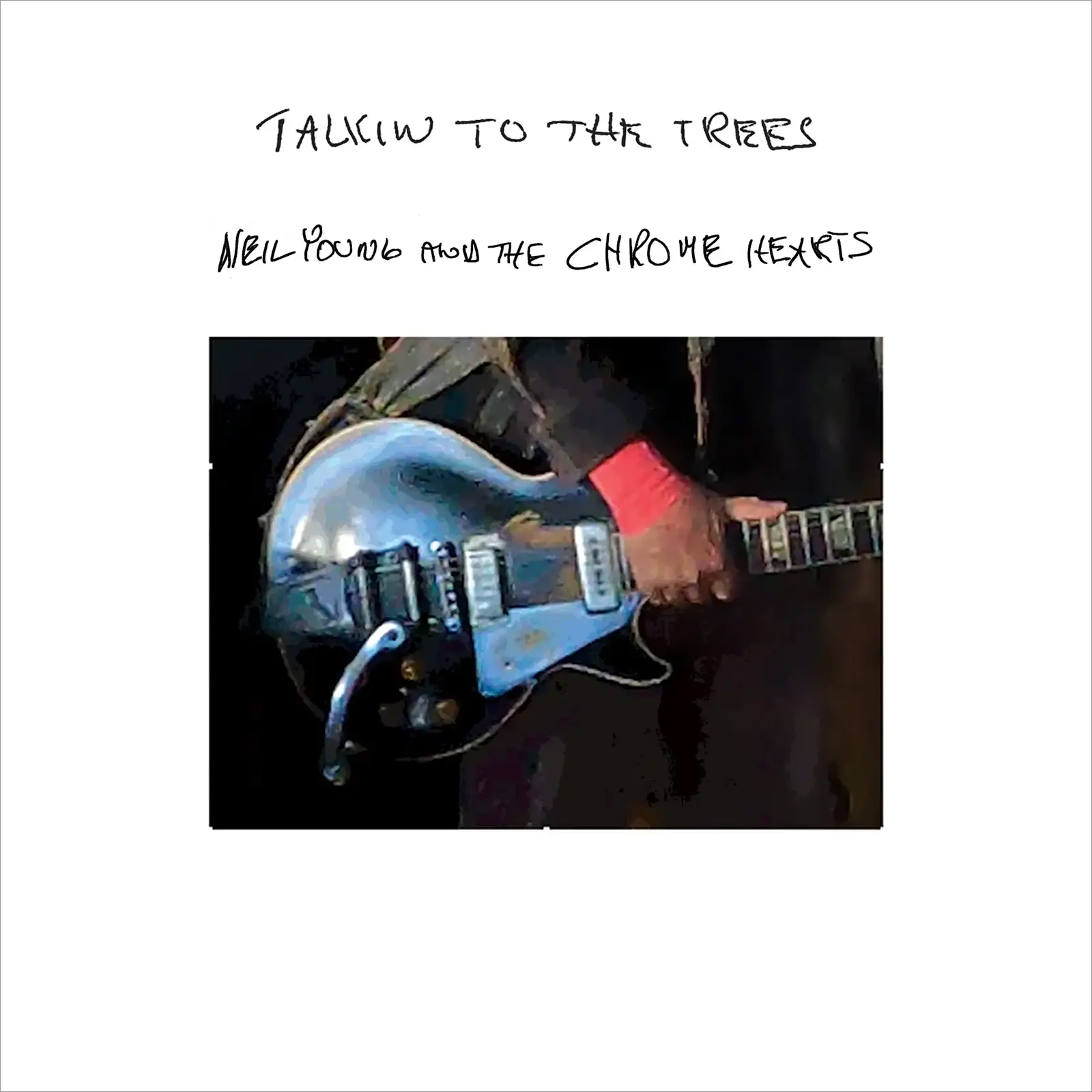
Neil Young remains one of the most consistently prolific artists in music. He turns 80 on November 12, and his latest album is a self-reflective work that is heartfelt, honest, and occasionally angry, but ultimately uplifting.
Young’s output is staggering. Every year, he puts out unreleased music from his vast archives, reissues of previous works, and often albums of all-new recordings. It’s the variety, quality, and approach of these new recordings that spotlight his continued relevance. Young does not rest on his laurels, he favors making gritty, organic music with songs that are deeply personal and is not creating product for the marketplace or pandering to popular tastes.
The new album features many of the musicians Young has been recording and touring with since 2015. They are musicians who play with Young as Promise of the Real (Lukas Nelson, Anthony LoGerfo, Tato Melgar, Corey McCormick, Logan Metz) and in the case of this album, the Chrome Hearts (Micah Nelson, Spooner Oldham, Corey McCormick, Anthony LoGerfo). Lukas and Micah are Willie Nelson’s sons.
Oldham is one of the true legends of American music, stretching back to his unparalleled work as a lynchpin of the history-making Muscle Shoals sessions, including the key Atlantic Recordings of Aretha Franklin. He is a member of Young’s current touring band and has collaborated with him on a total of nine albums, dating back to 1978. His contributions to Young’s albums and music in general cannot be overstated. He was inducted into the Rock n Roll Hall of Fame in 2009 as a sideman with Bill Black and D.J. Fontana.
Young has played with many others in the last ten years and released six albums in collaboration with Crazy Horse, three of which are from Young’s vault, with recordings dating from as far back as 1969 and 1974–1977, and as recently as 2001 and last year. Examining all the releases from the previous 10 years, one can see the method behind Young’s sometimes perceived madness.
First, the non-Crazy Horse bands have some of that free-range grit and simplicity that is the hallmark of Young’s approach to playing with Crazy Horse. These are all musicians in tune with Young’s intuitive gut approach to making new music and are adept at finding that sweet spot where rock, country, folk, and improvisation meet. This is music about feel, not about perfection.
The other person contributing to this album is co-producer Lou Adler. Adler worked with Young on Before and After, a live album from 2023. Adler is a legend in pop music history, most notable for producing the Mamas and the Papas and Carole King’s Tapestry album, among many other singles and albums, and for launching Dunhill Records. However, he hasn’t produced in years.
He was a key figure in pop music and film, with his work on the Monterey Pop Festival film and concert, The Rocky Horror Picture Show, and Ladies and Gentlemen, The Fabulous Stains, as well as producing such non-music films as Up In Smoke and Brewster McCloud. He is also Young’s brother-in-law, as he is married to Young’s wife, Daryl Hannah’s sister Page. Adler probably helped smooth out some of the ragged edges of these recordings without taming the fuzzy glory.
Again, Young makes music that feels like it was from his salad days but has something new and sparky. Young wrote like a wise old man in his early 20s, but now has the road-tested wisdom of actual experience. The album’s opening track, “Family Life,” actually sounds like it could have been the last recorded, as his voice has never sounded so weathered, rough, raw, and vulnerable. It’s a song all about old age, being a grandpa, and savoring every last minute.
There are hints of Comes A Time and Harvest Moon, but the music here is stark and fragile. There’s more about aging on “Dark Mirage,” which recalls Dylan’s Time Out of Mind period but is not as atmospheric or produced. “First Fire of Winter” is of a pair with “Family Life” musically and again recalls Dylan, but this time in the vein of “Knockin’ On Heaven’s Door.” It also has some echoes of Young’s “Helpless” from Déjà vu. Sliding into Woody Guthrie territory, “This Land Is Your Land” in particular, on “Silver Eagle,” Young then ends the side with the most overtly political song on the album, “Let’s Roll Again.”
Side two starts off with the heavy blues of “Big Change,” which also has some political lyrics. The title cut again recalls the Comes A Time-era Young, but is not as polished. “Moon Ahead” has some of the same heavy blues as “Big Change.” “Bottle of Love” has some surprising jazzy chord changes and is heartfelt and something entirely new for Young. On the final track again, there are echoes of Harvest Moon.
The vinyl version of this new release, which is the best way to listen to this album, was mastered from the original analog tapes. It’s a shame so many musicians don’t release the vinyl album versions of their latest works in this fashion.
This is yet another miraculous chapter in the long run of Neil Young albums, whether solo or with various groups, that now date back nearly 60 years. While the album finds Young clearly eyeing old age, the music here mostly doesn’t sound like the music of an old man. While in his mind, time seems to be fading away, for Neil Young, there actually seem to be many more rich musical harvests ahead.
GRADED ON A CURVE:
B+