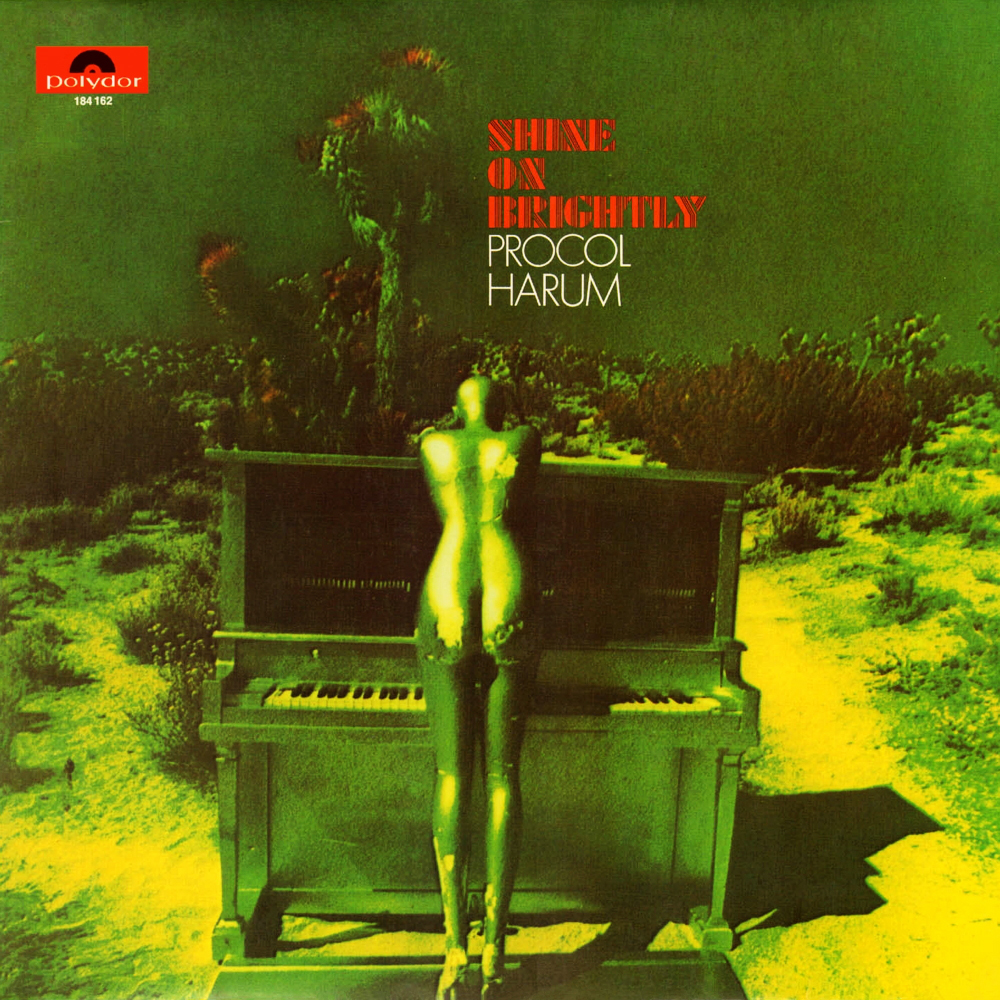
Bookended by the band’s excellent eponymous 1967 debut and 1969’s brilliant A Salty Dog, Procol Harum’s 1968 LP Shine on Brightly is a half-assed example of the sophomore slump. Side one is no disgrace, but the progressive rockers lose the thread on side two, which sinks beneath the weight of the acid-addled balderdash of the unconscionably long (and quite frequently inadvertently hilarious) song suite “In Held Twas in I.”
Shot themselves right in the dick with the song, they did. But all might have been forgiven had Procol Harum tricked up another song as magic and majestic as “A Whiter Shade of Pale,” which was THE song of 1967 and inspired none other than Beatle John himself to say, “You play it when you take some acid and … whoooooooo.’”
But Shine On Brightly’s only single, “Quite Rightly So,” inspired nary a “whoooooooo,” and only climbed to the half-century spot on the UK charts. A paler shade of “A Whiter Shade of Pale” it was, and as things panned out, the LP itself didn’t even chart in England’s Green and Pleasant Land. Perhaps if Keith Reid had included more Chaucer references, your literary Brits would have eaten them right up.
Procol Harum had a winning formula—a great singer in Gary Brooker, even if The Village Voice’s Robert Christgau once wrote that Brooker “learned his oft-praised blues mannerisms from the constipated guy in the next toilet stall.” Matthew Fisher’s organ gave them a rich sound, and was ideal when it came to copping odds and sods from classical compositions, which was what got them labeled a progressive rock band in the first place. And Robin Trower was a blues rock guitarist with mad skills who kept their compositions from floating away on the clouds of neo-classical pomposity.
And what made them the most accessible (and least annoying) progressive rock band of their era (or any era, for that matter) was their down-to-earth approach to song craft. They were more comfortable with the blues than free-form songs that flitted from complex time signature to complex time signature, wisely avoided (except, fatally, in the case of “In Held Twas in I”) long and complex songs, and never sounded like technical virtuosos showing off. They may have nicked the occasional classical snippet, but they didn’t make aping the classics their bread and butter the way Emerson, Lake & Palmer did. Procol Harum had scruples.
Which is what makes Shine on Brightly so disappointing. Procol Harum succumbed to progressive rock disease with an almost side-long, five-part Frankenstein of a song that miraculously manages to highlight all of their weaknesses (with a special award of merit going to band “lyricist” Keith Reid) and none of their strengths. It’s incoherent and doesn’t cohere, risible in parts and simply mediocre in others. And the other song on side two is almost as bad.
Side one really had to work hard to keep the album from being a complete embarrassment. Opener “Quite Rightly So” is an organ-drenched and mid-tempo number with a fetching melody on which Brooker shines on vocals and Trower throws in some truly awesome guitar. Unfortunately, it doesn’t pick you up and carry you along in an otherworldly swell the way “A Whiter Shade of Pale” does. Is it a good song? Quite rightly so. Is it a great song? Not quite.
“Shine on Brightly” is the album highlight, and I will never understand why IT wasn’t the single. The song is ecstasy-inducing thanks to Robin Trower’s chiming and uplifting guitar riff, which hits you in the face from note one, and an organ riff and piano line that both provide great assistance. In fact, the organ solo in the song’s middle is every bit as captivating as “A Whiter Shade of Pale.” And always suspect “lyricist in residence” Keith Reid throws in plenty of the absurdist details that made “A Whiter Shade of Pale” such a hoot—Prussian blue electric clocks, a Ferris wheel and a chandelier, and the suspiciously incoherent refrain, “And even my befuddled brain/Is shining brightly, quite insane.”
“Skip Softly (My Moonbeams)” is a side one low: half annoying music hall whimsy and half scorching Robert Trower guitar solo, and what’s even more annoying is that the opening music hall whimsy (which is all piano, oompah and quirky backing vocals) simply isn’t worth listening to for the guitar solo that follows. Procol Harum was always a surprisingly heavy band, and whimsical hijinks are not their forte. A disappointment.
“Wish Me Well” is a mid-tempo swinger with Brooker and Trower singing in tandem while Brooker pounds on the piano and Trower wails, and it brings to mind none other than Joe Cocker. And Traffic. It’s a low-key keeper, and gets better with every listen—on first hearing, I thought it rather a bore.
“Rambling On” had to be one of the oddest songs of 1968. The song itself is slow and ‘eavy, with Trower following every musical phrase with a fuzzed-out riff, and I like it. What throws you is the lyrics; Keith Reid has really outdone himself in the bizarro department. Here’s the synopsis: guy goes to Batman movie, decides if Batman can fly so can he, gets himself a pair of wings and climbs a wall when a guy says what are you an idiot you can’t fly, and what ensues is a very confusing interlude with a crowd gathering and Brooker trying to decide should he or shouldn’t he when a gust of wind comes along and—off he goes!
The lyrics are so distracting they verge on ruining the song, but it’s saved when Trower’s guitar comes roaring in and Brooker shouts “Here I go!” Why it’s bona fide cathartic, that “Here I go!”, which is followed by this ascending chord progression (we’re soaring too!) with the organ joining in. We then rejoin Brooker, who’s sailing merrily along until a bird rips into one of his wings and down he goes at the speed of sound, but luckily, he only tears his underpants! And all the while Trower is ripping it up and tearing it up on his ax until Brooker sings, “I’m rambling on and on and on!” and he sure is!
And all along you’re thinking, “Since when can Batman fly?”
Side two opens with the disappointingly slight and lyrically incomprehensible “Magdalene (My Regal Zonophone).” I originally thought that “Regal Zonophone” was absurdist whimsy until I learned it was the name of their record label, but that’s neither here nor there; what sinks the song (beside the military rat-a-tat-tat of B.J. Wilson’s drums and the slight melody) are the words coming out of Brooker’s mouth.
You simply can’t take your eyes off them! First he leaves you wondering with the lines, “And with one foot on the seashore and the other in the sand” (huh?), which he follows with “I will stand here plaiting daisies whilst you play the piano-grand,” before finally destroying your faith in the intelligence of mankind with the lines, “And for once I stood quite naked. Unashamed, I wept the tears/Which I tried to hide inside myself from me, I mean from you.”
God wept! He also blows cobwebs from his ears, which good luck figuring that one out, but the point I’m trying to make is you simply can’t ignore the lousy ass lyrics and are truly grateful when Brooker shuts up, some kind of mock-bugle comes in, and he sings, his vocal distorted, the title of the song over and over again as the whole sorry enterprise thankfully fades out.
But if the lyrics of “Magdalene (My Regal Zonophone)” are bad, the lyrics of the first installment in the song suite “In Held Twas in I” are hilariously bad and should put to rest once and for all the absurd idea that Keith Reid was a poet. “Glimpses of Nirvana” is the song’s title, and Brooker talks his way through it over some mock transcendental meditation humming, and I don’t have the words to describe just how bad the lyrics are, so I’ll reprint some of his acid-addled jibber-jabber here:
“At a time like this, which exists maybe only for me
But is nonetheless real, if I can communicate
And in the telling and the bearing of my soul
Anything is gained, even though the words
Which I use are pretentious and make you cringe
With embarrassment, let me remind you of the pilgrim
Who asked for an audience with the Dalai Lama… ”
Yes, I am cringing with embarrassment. I’m human, and as for the story about the Dalai Lama that follows, it ends with His Holiness saying the meaning of life is “Beanstalk,” which totally cracked me up, as did the series of ascending chords that make you feel as if you’re actually CLIMBING said beanstalk. Then you get this balalaika that sounds like a sitar to let you know you’re in Lotus Land and the acid has kicked in, and it’s accompanied by some piano and lots of hushed vocal nonsense, then Brooker sighs and tosses off some more bozo philosophical folderol l which isn’t worth quoting.
Part B, “Twas Teatime at the Circus,” is a very Beatlesque number, very jolly and annoying with circus organ and lots of vocals and whistling and applause, and by God, it’s horrid—Procol Harum are riding the clown car and you’re trapped with them! The repeated refrain is “But while the crowd applauded desperately, they do not see the joke.” I see the joke. And it’s on us.
Part C, “In the Autumn of My Madness,” is an improvement. Matthew Fisher’s vocals give the song a Moody Blues feel. Fisher’s organ is majestic and very “A Whiter Shade of Pale.” Trower plays some big power chords. And the sound effects add rather than distract/detract. This is the only song in the suite that I wouldn’t keep locked in the suite to prevent it from perturbing the general public, and it makes me sad that it’s saddled with such squalid company.
Part D, “Look to Your Soul,” starts promisingly with a very Jethro Tull guitar riff and some cool organ drone before proceeding to plod in a very dull way, like a bored stegosaurus pacing back and forth in a very small room. After some two minutes of bored stegosaurus, the song slows to a crawl as if the stegosaurus is thinking, “Is there any way out of this room, which is actually a terrible song, and how did I get trapped here in the first place? I don’t even know Procol Harum!”
Finally Brooker commences to spout some errant nonsense (accompanied by one very earnest harpsichord, to let you know he’s not joking) about how he’s condemned to spend his “life amongst the dead who spend their lives in fear/Of a death that they’re not sure of, of a life they can’t control,” but you have to wonder WHY he’s doing so because in the very next line he says, “But it’s all so simple really if you just look to your soul.”
But on the plus side, by this point in time, a nice melody has wandered along, and the stegosaurus is gone, which makes the whole thing a bit more bearable—although not so bearable that you’ll ever be tempted to listen to the song again—even if Robin Trower does take it out with a truly gonzo (and sadly squandered) solo.
“In Held Twas in I” culminates, appropriately and pompously enough, with “Grande Finale,” and grand with an “e” it is. It opens with some portentous bass and piano, kind of marching along as if in a procession by some threadbare and forgotten king, then this choir comes in ooohing ersatz majestically and it’s all rather pretentious and second rate and dull until Trower barges in and launches into a guitar solo that gives you a taste of the guitar god Bridge of Sighs-era Trower to come. Then the choir comes back even bigger, but it all adds up to nothing. What we have are five slapdash songs superglued haphazardly together in defiance of logic and reason, even if Pete Townshend was a big fan of the thing, although his reasoning is worth repeating because it’s hilarious:
“I think that their musical thing now is far more basically strong,” he told an interviewer. “I know it had its roots in such a vague era of music, that’s why. Days of cantatas and God knows what, was a very very boring one, and there was only about 4 or 5 pieces of music which lifted their heads above the rest in that era, and so that’s all Procol Harum have got to draw on.”
Would you like to rephrase that, Pete? Because if I had been a member of Procol Harum I’d have had a hard time finding a compliment in there.
Shine on Brightly is a spotty affair, and perhaps the best that can be said for it is that Procol Harum didn’t repeat its mistakes on A Salty Dog. Which isn’t to say that the LP isn’t worth a listen. Side one is definitely worth a listen. And had side two been half as good as side one, Shine on Brightly would have shone. But side two isn’t just bad, it’s a downright menace.
In summation, three observations.
1. A real poet, Delmore Schwartz by name, once quipped, “A horse divided cannot stand.”
2. Shine on Brightly is a horse divided.
3. Thankfully, this horse divided includes some music I CAN stand. Enjoy even. And I think you’ll enjoy it too. Just steer clear of side two.
GRADED ON A CURVE:
C+