
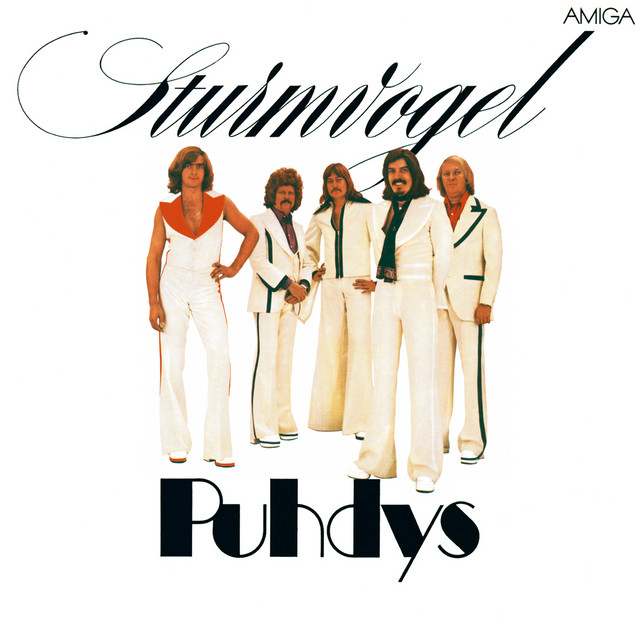
Being a rock ’n’ roller in a repressive police state like East Germany, where the Stasi (the state’s secret police) was the nation’s largest employer and one in every 6.5 citizens was a Stasi informant (that figure is hotly debated) was a dicey business.
Just ask the Klaus Renft Combo. Long-haired people who pushed the envelope, in 1975, they were called before the Stasi and informed that their lyrics “had absolutely nothing to do with Socialist reality. The working class is insulted and the State and Defence Organisations defamed.” They were also informed that they no longer existed. Period. They would never play another gig, and their albums were promptly deleted from the catalogue of state-owned Amiga Records, East Germany’s only music label.
The Pudhys had it better—in fact the Puhdys had it so good they became the most successful of all Ostrock bands. But they had to jump hoop after hoop to get there. Rehearsals were monitored by party loyalists to ensure the musicians were developing into healthy “socialist personalities.” Lyrics had to be submitted to the government and scrutinized for subversive content.
And bands had to audition for flunkies at the Ministry of Culture before being granted the Auftrittserserlaubnis, which gave them the right to perform in public. And even then, most venues were regulated by the government, and god help the band if they didn’t play the songs on their setlist or if things got out of hand. And there was always the chance that your drummer was a Stasi informant, so you had to be careful what you said before, during, and after shows.
It’s almost impossible to imagine what life was like in a poor country where the Stasi literally collected and stored jarred cotton samples of suspect individuals‘ body odors, for use in tracking them. My ex-wife was East German (and eleven when the Wall fell), and what she remembers is a country where chocolate ice cream might appear in the markets once a year. The same went for watermelons. She dropped the annual watermelon once on her way home from the store, and it was her most traumatic childhood memory, aside from undergoing a root canal without anesthesia.
And the state car, the Trabant, was so shabby you could tear pieces off it with your bare hands. My ex‘s parents owned one, and what my ex recalls is having to keep the windows open in the dead of winter lest you die of carbon monoxide poisoning. Her father showed me the first aid kit from his old Trabant, and there was nothing in it but bandages marked “Wehrmacht 1940.” I laughed, but he informed me that the bandages came in quite handy for securing parts that would occasionally fall out of the engine.
But I digress. The Pudhys were so popular and adept at adhering to the government line that they were actually allowed to play the West (including West Germany), and such good boys they didn’t even defect! Their first album was a great success, but I’m a bigger fan of their third LP, 1976’s Sturmvogel (Stormbird) because it rocks in the way most German albums of the time rocked, which is to say you listen to it and immediately realize that Germans (at least of the non-Krautrock variety) had no idea how to rock but were doing their Teutonic best. They wanted to sound like their Western idols, but invariably fell back on Germanic folk music elements that sound kitschy to non-Germanic ears.
That said, there are songs on Sturmvogel that pass muster as rockers, and once you grow accustomed to the Volkisch influences the album actually sucks you in. I laughed the first time I heard some of the songs on Sturmvogel, but I’ve grown to like the LP. It requires some ear adjustments, but listen to it enough and you’ll be hooked.
Take the title track. It’s a kick-ass Deep Purple/Uriah Heep-influenced hard rocker with a mean guitar riff and Moody Blues-school vocals on top, and it trucks. And things get all spacy about two-thirds of the way in before that bodacious guitar riff comes back in, the vocalists go all angelic on you, and the band gets back to the business of rocking you like a communist-bloc hurricane. Follow-up “Lebenszeit” is fast-paced, folksy, and acoustic, and reminds me of Billy Bragg. If Billy Bragg were a Kraut, that is. It has a lovely melody, guitarists Dieter “Maschine” Birr and Dieter Hertrampf swap vocals, and while you’ll never mistake it for anything but a Germanic song, it’s quite addictive.
And that goes double for “Als Ich Mir Wünschte, Ein Kind Zu Sein,” a lovely ballad with some fancy acoustic guitar work and some nice harpsichord (I think) by keyboardist/saxophonist Peter “Eingehängt” Meyer. There are moments when you could be listening to Kansas, or even “Hotel California,” but the heartfelt vocals could only be German and take some getting used to. It’s all very melodramatic, and in your mind’s eye, you can see the audience swaying and singing along.
“Untermiete” is, well, I’m not quite sure what it is. Commie rockabilly? Whatever it is, you won’t hear its likes in America or England or anywhere else, for that matter. The singer kicks it off with some nonsense syllables that are the German equivalent of “be bop a lula,” then a frantic guitar and piano come in. The vocalist is quite excitable, the drummer batters the drums like he’s out to send them to the Krankenhaus, the piano player goes berserk, and by the end, the singer has gone barking mad. I can’t imagine the Stasi liked it much.
“Schlafe Ein Und Fang Die Träume” is a cover of a song by the Polish band 2 plus 1, who were so popular they performed in the United States and Canada in 1974, which tells me that Polish rock bands enjoyed a freedom unthinkable to their East German counterparts. The song is a supersized power ballad with a big Mott the Hoople guitar riff, oh so sensitive vocals that go big and possess more pathos than six movies where the dog dies at the end. In other words, this one has star power, and it’s no wonder it won 2 Plus 1 third place at Poland’s Sopot International Song Festival. If you ask me, it should have won!
“Reise Zum Mittelpunkt Der Erde” is bombastic space rock and translates as “Journey to the Center of the Earth,” which makes the Puhdys the Rick Wakeman of the Eastern Bloc! And it’s a really cool song! It’s got this great hard rock riff that dissolves into synthesized intergalactic paradiddle, with swooping space winds that will blow your hair around, before the vocalist comes in all portentous like a junior league Ozzy Osbourne. The bass throbs, other vocalists go all astral plane on you, and this great hard rock guitar comes in and out. Then it goes full intergalactic on you and it’s great, before things slow down and you get this momentary Southern Rock vibe. This is progressive rock, folks, with the guitar and vocalists going back and forth before they go back into pure sweeping grandiosity that will make you forget all about Styx. I mean to tell you this song is the shit, and belongs on Uriah Heep’s Greatest Hits except it’s better than anything Uriah Heep ever did with the possible exception of “Easy Livin’.”
“Lachen und Schweigen” is a hard rocker with one very ‘eavy guitar riff and harmony vocals that are surprisingly light given their setting, which gives the song a power pop feel, especially when they deliver on some great “Ooo Ooo Ooo’s!” It’s groovy. “Eisamkeit” is a lovely symphonic number with acoustic guitar and some gritty vocals, and features some positively transcendental female backing vocalists. It’s a truly wonderful song, and I doubt there was a dry-eyed Stasi official in the house when they auditioned it. It even includes a brief flute solo, and I’d be remiss if I didn’t give a shoutout to Harry Jeske for his fluid bass playing.
Closer “Auf dem Wege” is a galloping (and quite likeable) progressive rock number with happening guitars and these sudden halts where the vocalists come in, but the amazing thing is the abrupt stops and starts barely halt the song’s inexorable forward motion. And there’s this really cool guitar break on which drummer Gunther Wosylus shines, although he shines throughout. Very happening.
The Puhdys are enough to make you wonder if art can only flourish in a police state. Like most German bands, excluding, of course, such Krautrock faves as Can, Neu!, and Kraftwerk, the Pudhys have too many Volkisch elements to ever win over many Americanized ears, but given the many hurdles they had to jump to make music at all, the Pudhys have done well. It’s not easy, being a rocker in a state where you could be erased from history in an instant and where government functionaries, in a panic over the obscene gyrations of Elvis Presley and the polymorphous perversity of the Twist, created an anything but lascivious state-sanctioned dance called the Lipsi. You can check it out on YouTube.
Final words: Check out the Pudhys. Be careful what you say to the neighbors, because there’s a good chance they’re Stasi informants. And don’t drop your watermelon on the way home. You’ll have to wait a full year for another one.
GRADED ON A CURVE:
B+