Remembering Rahsaan Roland Kirk, born on this date in 1935. —Ed.
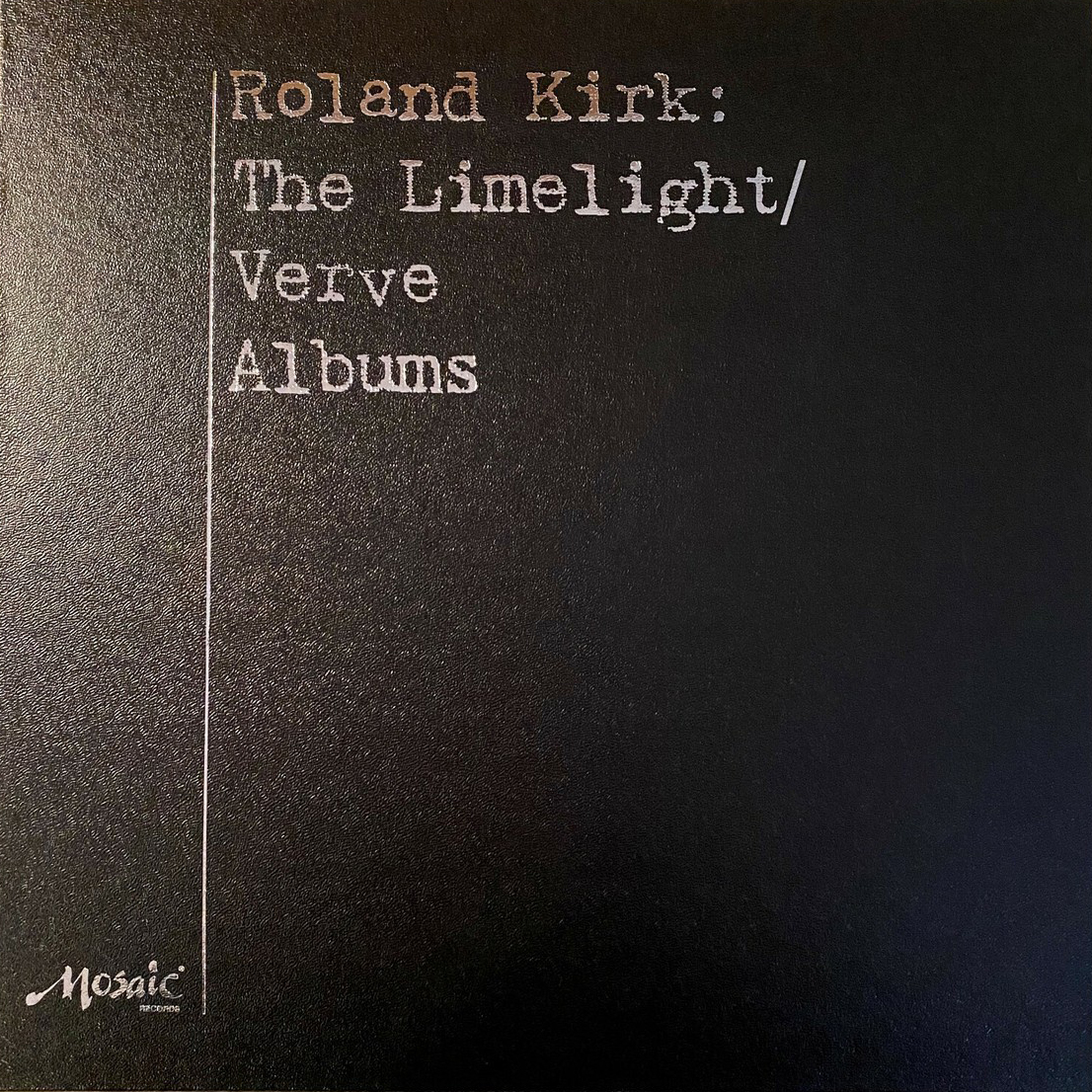
If one endeavored to compile the names of the last half century’s most enduringly popular jazz figures, multi-instrumentalist Rahsaan Roland Kirk would land on that list with ease. In converting new listeners to his chosen musical field the bandleader’s right up there with Miles, Coltrane, Mingus and Monk. As Mosaic Records’ 4LP box set The Limelight/Verve Albums illustrates, Kirk’s achievement was sustained through a rare combination of pure skill, purposeful showmanship, uncommon range, sincere eccentricity and ceaseless ambition. And don’t forget the blues.
 It was during the tail end of the 1980s that I made my initial attempts at diving headfirst into the immense landscape of jazz history. And I stress attempts, for while the music’s long narrative was easy enough to absorb through the numerous books on the subject, securing the all important listening material often proved quite tricky.
Certain crucial recordings, and indeed the prime works of many key players, were languishing out of print, and all but the most righteously stubborn of shops were choosing to whittle down shelf-space for non-pop/rock-related product to a relative sliver. Of course, an economic upsurge and ensuing compact disc boom was just around the corner, but in 1989 those trying to explore jazzdom (outside of major urban areas, anyway) often felt like they were navigating an enormous block of Swiss cheese.
A big exception was Roland Kirk. In my town, his platters could be found in both the Mom & Pop shop and the chain store at the mall, occasionally in the local used bins and on reliable loan from the area libraries, and the reason for this ease of availability related directly to his magnetic blend of the idiosyncratic and the accessible. However, he was also deft at communicating the glories of tradition in visionary terms, and with enough soul grease, blues grit and/or gutbucket funk to potentially send jazz novice’s reeling with personal epiphanies.
Kirk, who died way too young of a stroke on December 5, 1977 was said to disdain sideman work, instead preferring to lead his own bands down all sorts of intriguing sonic paths. He wasn’t completely averse to the backup role though; for one example, his contribution is instantly recognizable on the Roy Haynes Quartet’s magnificent 1962 Impulse album Out of the Afternoon. But by far Kirk’s most illuminating non-leadership gig was delivered under Charles Mingus, in particular the bassist’s ’62 masterpiece Oh Yeah.
In terms of sheer breadth, Mingus and Kirk, and for that matter their associate, the great pianist Jaki Byard, all held complementary personal styles. For one thing, none had been entirely seduced by the allure of bebop, and for Kirk this resulted in an unusual introduction to the recording studio. His first LP Triple Threat (aka Third Dimension as later rereleased by Bethlehem) was issued in ’56 by the King imprint, Syd Nathan’s now legendary Cincinnati-based fount of R&B, country, and gospel.
The debut’s title referred to Kirk’s ability to play three horns simultaneously; along with saxophones, flutes, and clarinet he brandished (and swung) on the left field sax-variants manzello and stritch and he even built a few of his own. If this practice clearly set him apart from the post-bop crowd it also paid no immediate dividends; he didn’t record again until ’60, this time for the Chess Brothers’ Argo label with the album Introducing Roland Kirk. Like Triple Threat, it’s a worthwhile document, but for Kirk it took the third time to really bring the charm.
In July of ’61 he touched down in Hackensack, NJ for the first of several productive visits to Van Gelder studios. Issued by the Prestige organization, the result was the very enjoyable Kirk’s Work, an early soul-jazz outing featuring a quartet holding drummer Art Taylor and notable organist Brother Jack McDuff. From there it was gravy; a month later he commenced a fruitful association with Mercury through sessions for the oft-brilliant breakthrough LP We Free Kings.
Kirk landed at Mercury through the auspices of label vice-prez (and frequent subsequent collaborator) Quincy Jones, and many consider his output for the company, which the abovementioned CD boom saw compiled onto the at-once splendiferous and intimidating 11-disc behemoth Rahsaan: The Complete Mercury Recordings of Roland Kirk, to be his very finest period.
And that’s an easily understandable notion. Under Jones’ supervision, Limelight sprang to life in 1964 as a subsidiary of Mercury, with three of the four dates comprising The Limelight/Verve Albums also included in the Rahsaan box. Mosaic’s limited-to-2500 vinyl-only coupling of the never particularly difficult to hear Limelight stuff with his sole ’67 effort for Verve is certainly geared to a fairly specific type of collector, as it’s presented on four 180gm slabs waxed-up at Chad Kassem’s highly regarded Quality Record Pressings.
But the grouping is also an enlightening one, as it spotlights a fascinating moment in his artistic growth, one overlapping the Mercury era and a long stay with the Ertegün Brothers at Atlantic, a prolific and constantly evolving run that lasted until the end of his life (the relationship began in ’65 with the smoking live recording Here Comes the Whistleman).
The Limelight LPs offer very diverse scenarios, and over the decades each has cultivated a large base of fan support, though the level of quality across the three is strong enough that no consensus critical favorite has ever really risen to the surface. For instance, fans of the esoteric warmth found in Kirk’s flute playing surely dig the first one I Talk with the Spirits, though the record also does a superb job of harnessing a major portion of Kirk’s broad creative spectrum.
It opens with the very engaging “Serenade to a Cuckoo,” which folks nuts over Jethro Tull no doubt know from that band’s ’68 debut Time Was, but it additionally features a rack of Kirk originals including the positively groove-busting harbinger of live flute showstoppers to come “The Business Ain’t Nothin’ but the Blues.” It furthermore shows off his adeptness with chestnuts via the Ira Gershwin/Kurt Weill composition “My Ship,” and highlights his appreciation for the songwriting skills of his fellow jazzmen by offering a reading of pianist John Lewis’ “Django.”
To my ear the most revealing track on the record is the medley of a then 20-year-old pop tune “We’ll Be Together Again” and the contemporaneous smash (as sung by Barbara Streisand from the musical Funny Girl) “People.” Kirk tackles both with a nonchalance that incorporates stabs of humor and occasional wobbliness but avoids irreverence as it heads for the outskirts of off-kilter sincerity.
I Talk with the Spirits possesses enough edginess to endear it to fans of the then happening New Thing, but for avant-garde firepower Rip, Rig and Panic is the real deal. And if the prior LP found Kirk in cahoots with such valuable players as pianist Horace Parlan, vibraphonist Bobby Moses, and drummer Walter Perkins, the band assembled for the follow-up is one for the ages: bassist Richard Davis, drummer Elvin Jones, and pianist Byard join the horn-man on what is arguably (of course) his finest studio work.
While truly invested in pushing the boundaries (“Slippery, Hippery, Flippery” contains musique concrète, with Kirk citing modernist classical composer Edgard Varèse as an influence) Rip, Rig and Panic is just as immersed in jazz tradition; the title of “No Tonic Pres” references tenor saxophonist Lester Young, “Once in a While” is inspired by Clifford Brown (the trumpeter is also name checked on I Talk with the Spirits), and the subjects “From Bechet, Byas, and Fats” celebrate are obvious.
Rip, Rig and Panic is often “out” but it’s never difficult, and if the edge is apparent the whole goes down surprisingly easy. Not as easily as Slightly Latin, though. Which shouldn’t infer that the final Limelight LP is not an oddball treat; the thick and woozy multi-horn opening run-through of Bacharach and David’s “Walk On By,” with Garnett Brown’s serrated and see-sawing trombone added in, immediately takes the proceedings far beyond any standard Latin jazz crossover.
Courtesy of the Coleridge Perkinson choir there are tracks recalling Esquivel (“Raouf”) paired up with strange exotica (“Safari”), Eastern-tinged moments (“Ebrauqs”), swinging arrangements for large band (“Juarez”), some burning soloing (“Nothing But the Truth”), and a cut that sounds a tad bit like Kirk teaming up with Ramsey Lewis (though the pianist is again Horace Parlan) to cover The Beatles (“And I Love Her”).
Not everything on Slightly Latin works equally well, but that’s not a surprise since Kirk’s hefty aspirations generally kept him from making perfect albums (Kirk in Copenhagen from ’64 being a notable exception). It does stand as a remarkably cohesive listen from start to finish, and it sets the table for the groove-feast that is Now Please Don’t You Cry, Beautiful Edith.
Much of the Verve LP recalls the gorgeous thrust of his abundant live recordings, with the circular breathing on clarinet offered through opener “Blues Rol” reminding me of the blues-heavy performances captured on the 1990 compilation The Man Who Cried Fire. And his band here, if not quite as massive as the Rip, Rig and Panic group, isn’t far behind: piano by Lonnie Liston Smith, noted Sun Ra bassist Ronnie Boykins and the in-demand and wide-ranging drummer Grady Tate.
But on what’s essentially a blowing date Kirk gets in all sorts of varied action; there’s “Alfie” one year after Sonny Rollins immortalized it, a bunch of swank originals including the Smith showcases “Silverlization” (a likely tribute to the piano artistry of Blue Note mainstay Horace Silver) and the cooking, mildly Lewis-esque “Fallout,” the smoldering ballad title-track, and some multi-horn goodness with “Stompin’ Grounds.”
These four sessions derive from an extended period where Rahsaan Roland Kirk was not only firing on all creative cylinders but was also still formulating his soon to be renowned persona. Lots of hot blowing, a series of concept albums, and eventual canonization were all on the horizon, but from ’64-’67 Kirk was extremely trim and yet bursting with ideas, with his trajectory travelling upward.
Any minor flaws in execution found on these eight LP sides are considerably diminished through this inspired grouping, and while only 2,500 customers will be taking home a copy of this set, every jazz fan should make the necessary arrangements to investigate the music.
GRADED ON A CURVE:
A