
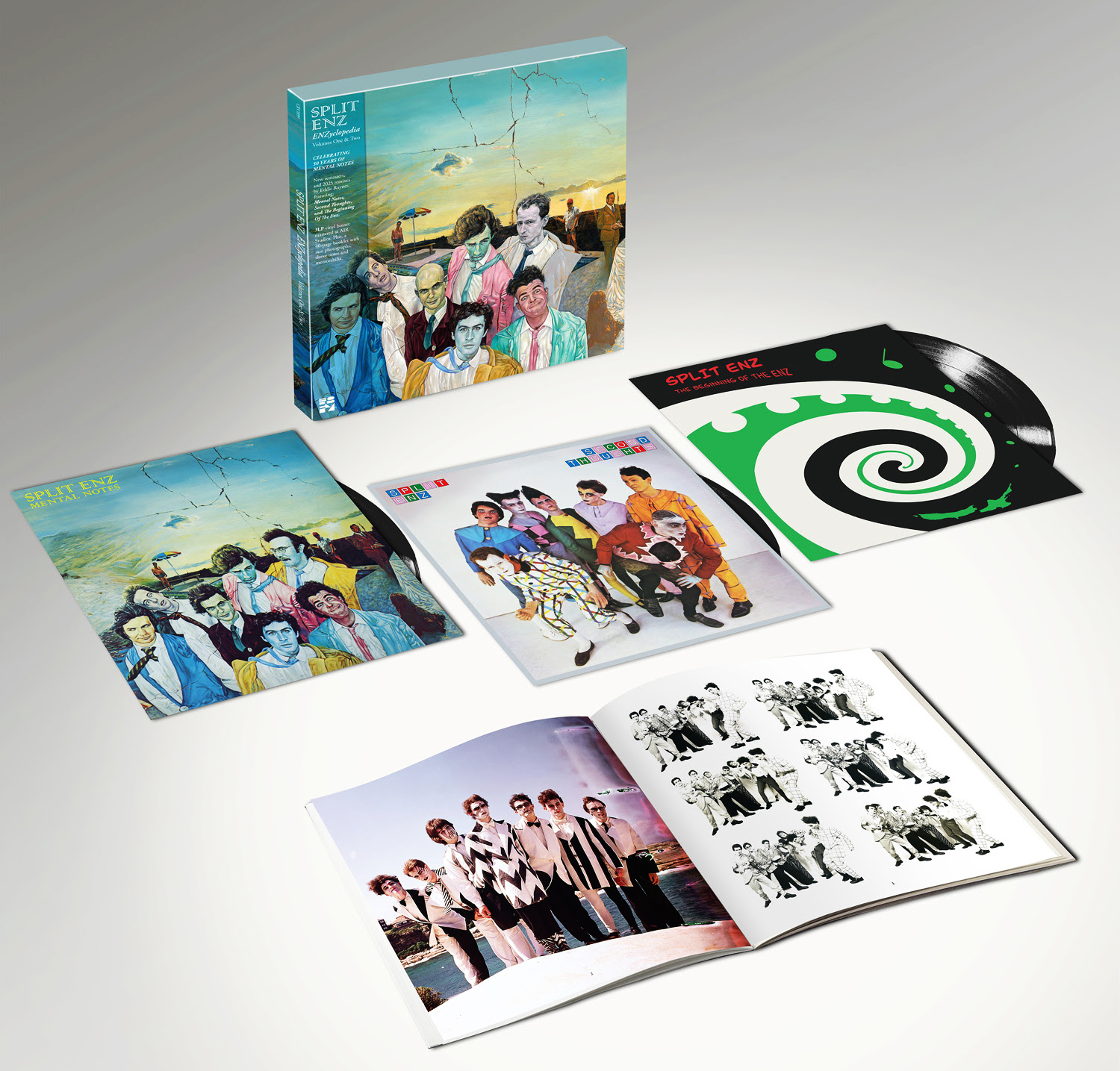
Globally, New Zealand’s Split Enz is often categorized as a New Wave act, based on a string of albums and singles that charted in the UK/US circa the early 1980s. However, the band was formed in 1972, initially as a folk-tinged combo sans drummer before integrating a kit and leaning into a progressive rock sound (of sorts) for a stretch that solidified Split Enz’s reputation in Australasia. Chrysalis Records’ 3LP/5CD set Enzyclopedia (Volumes One & Two) sheds vibrant illumination on this era. Those who only know the group as breakout Kiwi wavers will likely be surprised by the sounds herein.
To put the New Wave association aside, Split Enz are also noted as the melodically inclined precursor to the even more pop-oriented Crowded House. Taken together, they comprise New Zealand’s biggest musical export, with the exception of the contemporary electropop singer-songwriter Lorde.
Split Enz was formed in 1972 in Auckland by the songwriting partnership of vocalist Tim Finn and guitarist-vocalist Phil Judd, with bassist Mike Chunn, violinist Miles Golding, and flutist Mike Howard filling out the lineup. After securing live gigs, they debuted on record with the “For You” b/w “Split Ends” (the B-side, the original spelling of their name) on the Vertigo label; the single was distributed only in New Zealand.
The 45 is very much a ’60s hippie-era holdover in terms of atmosphere; its songs were later compiled on the 1979 album The Beginning of the Enz, which is included (with a different, preferably non-chronological sequence) on Enzyclopedia as LP 3 and CD 4. Altogether, this selection of recordings, made prior to their debut LP, Mental Notes, in 1975, delivers an enlightening and largely pleasant listen.
The Beginning of the Enz covers stylistic territory beyond the early, folky stuff. Once drums and electric guitar entered the scenario, Split Enz became a considerably more rocking affair. The demo version of “Spellbound” that opens the comp has a grand, almost ELO-like urgency, “Sweet Talking Spoon Song” heads in a Music Hall-ish direction with horns that bring a hint of Thunderclap Newman to mind, and “129” is appealingly symphonic with touches of theatricality that foretell what was to come.
Mental Notes, recorded in Australia with a purportedly unsympathetic producer, illuminated an increasingly confident and, indeed, occasionally theatrical band that had taken its sound in a decidedly pop-prog direction. It’s a recipe for excess (Mervyn Peake’s Gormenghast series of novels was a stated influence), but Split Enz largely managed to avoid going overboard, having kept the songs catchy and mostly succinct.
The addition of drummer Emlyn Crowther and electric guitarist Wally Wilkinson further honed the rock edge, apparent right away in opener “Walking Down a Road,” and Eddie Rayner deepened the prog side of the equation, adding various keyboards, including organ and clavinet, mellotron, and synthesizer. Numerous moments on Mental Notes can be described as dated, but hardly anything drifts into the embarrassing.
Released in 1976 (January 1977 in the US), Second Thoughts was recorded in London with Roxy Music’s Phil Manzanera producing, and half the tracks are new versions of songs from Mental Notes. Indeed, in Europe and the US, the LP was originally titled Mental Notes, as it served as their debut outside Australasia.
The original stereo mix of Second Thoughts is exclusive to the CD edition of Enzyclopedia. A 2025 remix of the album by Rayner adds a disc to the CD edition and is how the album is represented on the vinyl set. Second Thoughts is essentially an extension of (if slightly better than) their debut and sounds fine in both mixes.
For interested parties who are leaning toward the vinyl, the Rayner refreshening of Second Thoughts is a perfectly adequate choice. The (mostly live) material included on the fifth CD (titled Wide Angle Enz) is quite enjoyable but not necessarily strong enough to justify passing over the wax. It’s all worth hearing, however.
To return to Split Enz in the 1980s, the band’s successful recalibration of their sound toward pop was fairly unusual. When old(er) dogs attempted to learn new (wave) tricks, they usually stumbled. It’s fair to say that Split Enz (with brother Neil Finn having joined) saved their best stuff for the homestretch. But the music corralled on Enzyclopedia (Volumes One & Two) is far from negligible. Rather, it’s crucial to an understanding of what Split Enz was all about.
GRADED ON A CURVE:
Mental Notes
B
Second Thoughts (both versions)
B+
The Beginning of the Enz
B+
Wide Angle Enz
B+
Enzyclopedia (Volumes One & Two)
B+