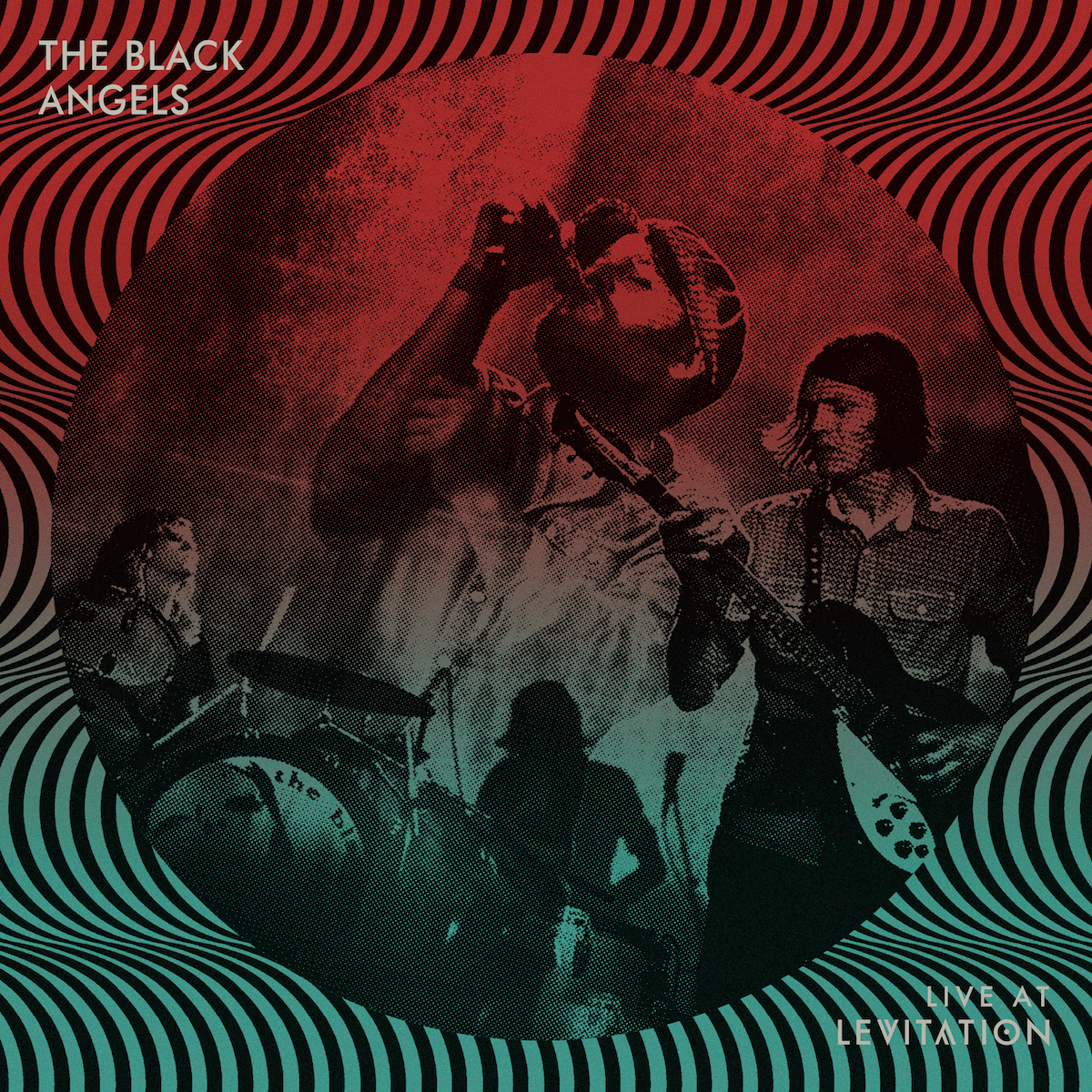
The Black Angels have exuded menace via drone, squalls of guitar feedback, and dark subject matter since they first blew me away with the War Is Hell tracks “The First Vietnamese War” and “Young Men Dead” and the doom-laden “The Sniper at the Gates of Heaven” way back in (has it really been that long?) 2006.
They swiped their name from the Velvet Underground’s “The Black Angel’s Death Song,” and it’s appropriate. Theirs is not your hippie uncle’s idea of psychedelic music.
Over the course of six full-length LPs from 2006 to 2022, The Black Angels have transmogrified dread into ecstasy, utilizing the sitar in a manner that would not get Ravi Shankar’s Seal of Spiritual Approval and in general recording music that is all Altamont and no Woodstock.
I’m talking dark, darker, darkest, and when that massive drone kicks in, you won’t relax, but you’ll float downstream, straight into the Heart of Darkness.
The Black Angels hail from Austin, Texas, and have played festival after festival with such kindred spirits as the Brian Jonestown Massacre, Japan’s Acid Mothers Temple, the Flaming Lips, Spiritualized, Black Rebel Motorcycle Club, the Dandy Warhols—even The Zombies! And they did a several-day stint as Roky Erickson’s backing band.
The liner notes of their 2006 debut LP Passover included a quote from Edvard Munch: “Illness, insanity, and death are the black angels that kept watch over my cradle and accompanied me all my life.” Very appropriate, that.
Because unlike most of the bands above, The Black Angels, whose core (and founding) members include Alex Maas (lead vocals, bass, organ, guitar, percussion, flute, Mellotron) Christian Bland (guitars, bass, keys, vocals, occasional drums, organ, harmonium, autoharp, electric piano, celeste, Mellotron), and Stephanie Bailey (drums, percussion, occasional bass) have spent their career on the dark side.
Bland has said The Black Angels are at their best live, but the band hasn’t exactly gone out of its way to document its shows on vinyl. So we’re lucky to have Live at Levitation, which was released in 2023 by the Reverberation Appreciation Society and captures live performances at the annual Austin Psych Fest (which The Black Angels dreamt up in a tour van in 2007 and has since been renamed Levitation) between 2010 and 2012.
Multi-instrumentalists Kyle Hunt and Nate Ryan appear on the album but are no longer with the band, and three songs feature Rashi Dhir from Toronto band Elephant Stone on sitar.
The fact that the album’s makers only culled six songs from the band’s shows over several years tells me they were going only for the best. And they did a stellar job, because Live at Levitation stunningly documents the band’s mesmeric stage act.
The Black Angels have appeared at several subsequent Psych Fests, which makes me hope we can look forward to a second Live at Levitation LP. Live at Levitation includes songs only from the band’s first two LPs. It would be wonderful to hear them play songs from later albums live.
Dhir’s sitar and Bland’s reverb-heavy guitar (underpinned by some truly titanic drumming by Bailey) dominate opener “Manipulation.” Both the melody and Maas’ vocals make me think Joy Division, and I can’t figure out why no one else has ever made the comparison. Perhaps the sitar and omniscient drone are camouflage enough. But the song is all propulsive gloom, and is undoubtedly making the shade of Ian Curtis a mite happier.
I hate to get ahead of myself, but the relatively restrained by Black Angels’ standards “Empire” makes me think of another band no one ever compares The Black Angels to—The Doors. You get the same sense of echo-laden and people-are-strange dread, which is amazing given all you’re hearing is Bailey’s drum pound, guitars doing a psychedelic ghost dance, and Maas’ doom-laden vocals. This is the End indeed, and not since the days of Jim Morrison has the end sounded so Book of Revelations scary.
Maas is high in the mix in the bluesy “Better Off Alone,” which is all reverb guitar and steady-as-she-goes drumming, and things don’t really kick into gear until he sings, “I’m better off alone,” and Bland launches into an Apocalypse Now guitar solo that will make you sorry you ever got off the boat. This one’s uncharacteristically subdued by Black Angels’ standards, but it makes comparisons to The Jesus and Mary Chain sound silly.
Firstly, The Black Angels would never coat a sugary melody in noise. And what do The Jesus and Mary Chain know about the blues? Let them try to produce a demented blues like Passover’s “Bloodhounds on My Trail,” which draws a line from the Velvet Underground to Robert Johnson and can give you tinnitus while it’s doing it.
Less restrained than “Better Off Alone” is the King Hell drone on “You on the Run,” an album highlight on which Maas cuts loose, serving up some “Oof”s and in general acting excitable while Bland goes positively barbaric on the guitar. It’s all feedback and chaos, with Bailey laying into the cymbals, and things really get capital “P” psychedelic as the song goes on before being snuffed out by universal consent.
Can’t say I’m sure what the song’s about, mind you; the lines “Now you on the run son/Since 1981/You went and did some things/And spoiled the fun” make me think late-stage revolutionary on the lam, but the business about the senator’s wife just leaves me befuddled.
“Surf City” has a zero Beach Boys quotient—it opens with Bland brutalizing his guitar while Maas proclaims surf’s up and prepare to die:
“Grab your boards, it’s time to get away
Wax them down, waitin’ for the tidal wave
Vampire boys proclaim that Jesus saves
The pretty girls, waitin’ at the hideaway
Surf City, here we come.”
Organ and guitar produce a roar, Bland tears a guitar solo to bits and burns the pieces, and the vampire boys can’t be right; as Maas howls and Bland follows suit on the six-string, Our Lord and Savior is nowhere to be found. After that, it’s all mayhem—California is finally sinking into the sea, and Bland produces a storm of feedback suitable to the occasion.
Closer “Young Men Dead” is The Black Angels practicing the dark art of injecting the black ink of pure dread into a crowd that wants more, more, more. It opens with an as-beguiling-as-it-is-threatening reverb-drenched guitar figure, then the band explodes and all you can do is ride the monster drone while Maas sings, “Fire from the hills, pick up speed and let’s go/Fire for real, yeah, shoot to kill with no aim/Head for the hills, yes, eyes on the camp fire glow” before going mystical menacing with the lines,
“And out of the black a figure forms
A soldier in the sky
With a drop of love
Trying to set you free.”
Bland plays solo after solo through the drum pound and the barbaric din, but things never descend into total chaos as Maas sings “Run for the hills, pick up your feet and let’s go” before taking the song out with the lines, “Fire at the breeze that blows these thoughts through our minds/Hire only thieves to steal the thoughts from our heads, oh.”
War, death, death, and more death—The Black Angels are a band for our times, and for this time in particular, when young men and young women and young people in general are dying here, there, and everywhere. Old people, too.
We’re engaged in a forever war against decency and human kindness, and no one alive or dead could produce a drone dreadful enough to capture the unending horror of it all. But The Black Angels try.
It’s terrible out there. And staying frosty will not save a single one of us.
GRADED ON A CURVE:
A