Want to know exactly how many times I’ve heard the Fall played on American radio, AM, FM, for-profit, not-for-profit, college, high school, guy down the block who sticks his speakers out his windows and considers himself a radio station because he shouts “The next song is by Oingo Boingo!” etc? Zero. And do you want to know how many American Fall fans I know? Don’t even get me started. I know more HENRY COW fans, and Henry Cow are art prog shit!
All of which is to say, from my personal experience, that The Fall are a distinctly un-American proposition. In Great Britain and other places around the world they’re considered sacred, the only band that matters, and they regularly made the pop charts. You can walk into any pub in England and find rabid Fall fans hitting other rabid Fall fans over the head with pint glasses because they had the temerity to suggest, I don’t know, that the Brix Smith-era Fall is far superior to the Live from the Witch Trials-era Fall. Here in America the legendary curmudgeon and band resident genius Mark E. Smith could (if he weren’t deceased) win the Masked Singer and people would say “Mark E. Who?”
It’s undeniable that the music of The Fall can be both challenging and, and, at least upon first listen, off-putting. The band sounds amateurish, the songs are as often not repetitive grooves, and Mark E. Smith declaims obscurantist (to me anyway, people keep telling me he’s actually making sense) “poetry” in a voice that veers in an instant from rant to sneer to falsetto squeal. He sounds like the strange geezer at the far end of the bar muttering to himself. And you may almost think he’s saying something of momentous import until he stops you dead with a word like “infaskunkstructure.” He’s anything but the Iowa Writer’s Workshop type.
And I think that’s the gist of it. Americans simply can’t wrap their minds around Mark E. Smith. He’s a crank and uniquely English species of iconoclast, a type as exotic to the American sensibility as spotted dick or deliberately driving on the wrong side of the road. Smith is always driving on the wrong side of the road, and as often as he not he’s pissed in both the British and American meanings of the world. It’s an aside, but one of my personal Mark E. Smith anecdotes goes as follows:
“We were playing a festival in Dublin the other week. There was this other group, like, warming up in the next sort of chalet, and they were terrible. I said, ‘Shut them cunts up!’ And they were still warming up, so I threw a bottle at them. The bands said, ‘That’s the Sons of Mumford’ or something. ‘They’re number five in charts!’ I just thought they were a load of retarded Irish folk singers.”
But I’m not here to explain; I’m here to convert. I want you to listen to The Fall and I want you to fall in love with The Fall because I feel so goddamn alone. There are lots of places you could start. The smart money would be on albums from the era when Brix Smith (Smith’s ex) was doing the seemingly impossible—almost (and that’s a very relative term) making The Fall accessible to a wider audience. 1984’s sublime The Wonderful and Frightening World Of… would be the popular choice.
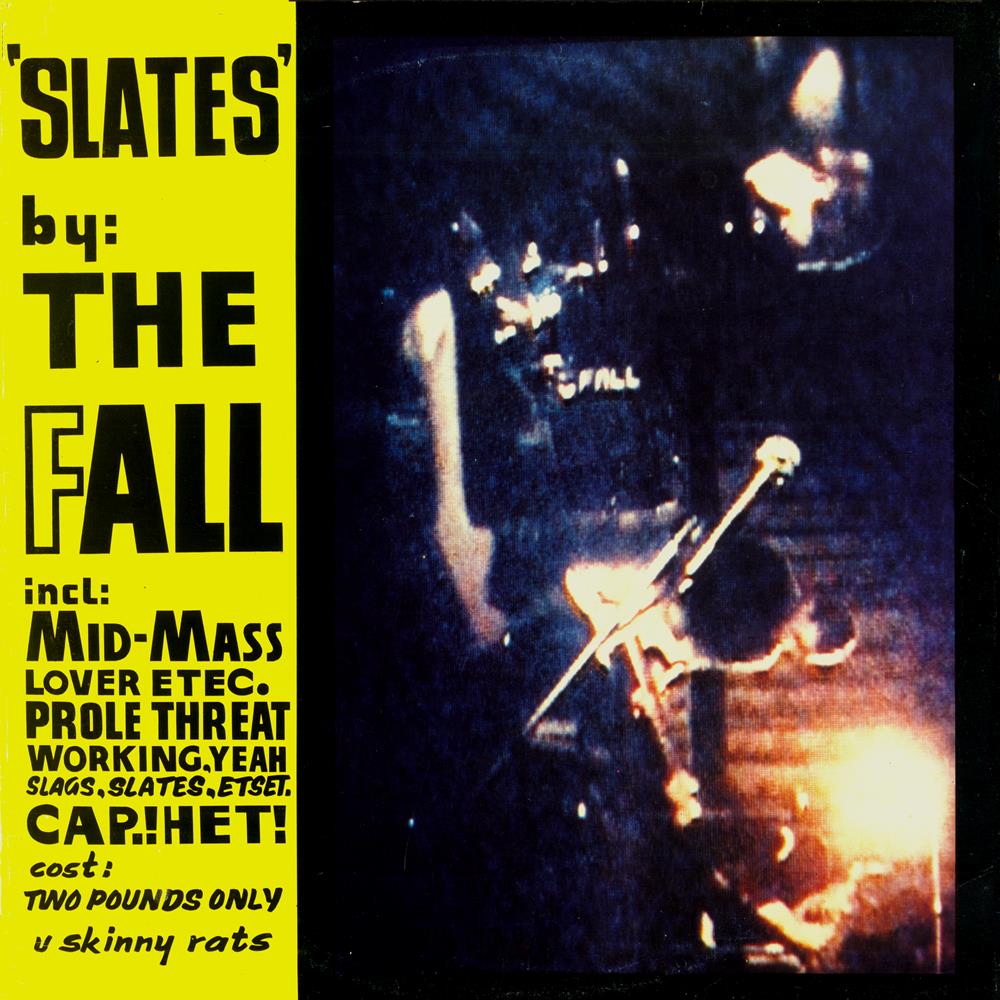
But I think there’s a better introduction, and that’s 1981’s “Slates” EP, The Fall’s fourth studio recording. It’s a short but not sweet demonstration of The Fall at their powerful and shambolic best, digestible in a less than 24-minute sitting but as close to a flawless Fall record as you’re ever likely to hear. And while this too isn’t pertinent, an exasperated Smith received so much flak from Rough Trade, his label, about certain aspects of the record (the word “slags” offended some) that he finally told a higher up, “Just sell the fuckin’ record you fuckin’ hippy.”
Smith is probably the most willfully perverse pop singer and band leader to ever walk onto a stage; his musical philosophy (“If you’re going to play it out of tune, then play it out of tune properly”) is as idiosyncratic as his lyrics, which read like broadsheets written in a cryptic shorthand that only Smith truly understands. So it makes sense that he would open “Slates” with its least mesmerizing cut and then slowly turn up the temperature until the incendiary “Leave the Capitol.” Although others (Dave Thompson, author of 2003’s A User’s Guide to the Fall, for instance) think just the opposite, which helps to explain the frequent pub brawls.
“Middle Mass” is a rambling, relatively slow-motion number just slightly sweetened by a repetitive and moderately melodic guitar figure over which Smith strews cryptic comments galore. I’ve been told it’s both a commentary on the middle class (“The evil is not in extremes/It’s in the aftermath/The middle mass/After the fact/Vulturous in the aftermath”) and a dig at band mate guitarist Marc Riley, but parsing the lyrics what I glean is a wonderful mess with cryptic lines (“Because cripple states a holy state”) and sudden repetitions that sound good but hardly illuminate:
“The Werhmacht never got in here
The Werhmacht never got in here
The Werhmacht never got in here
The Werhmacht never got in here
Thought it took us six years
The Werhmacht never got in here”
But it doesn’t matter! That’s the brilliance of Mark E. Smith! His words are indispensable to the music and vice versa, and if he keeps you constantly off-kilter with his lyrics, the music does the same. And never once did he stoop to writing a love song or a political anthem the left could rally round because his politics were every bit as erratically contrarian and complicated as he was.
“An Older Lover Etc.” is a clear cut as Smith ever gets. Basic message: you should take an older lover or on second thought a younger lover (you’ll “soon tire” of the older one cuz she’ll “shag you out on the table”) but if you go with the younger one you’ll end up missing the older one because “Her love was like your mother’s/With added attractions.” Musically you get this skinny guitar line, a menacing bass, and some drum patter, which more or less goes on for the length of the song, but the best part is Smith, who goes from a falsetto squeal to his regular speaking voice to a murmur to a hiss to some spiteful raving when he repeats “Doctor Annabel lies!” exactly four times, and no I don’t have the faintest idea who this Dr. Annabel is.
“Prole Art Threat” is all clamor and rant—Smith opens things with a shout of “Pink press threat!” at which point the guitar comes in with these three-note bursts while the drummer plays a kind of spavined gallop and the guitar bleeds noise and distortion all over it. It’s enough to give you whiplash, this one, and Smith has a fit the whole way through, sounding a bit like Paul Revere warning the public about what exactly? This was the one that broke Rough Trade’s back; they said it sounded fascist to them. Me, I don’t hear it. All I can make out is lots of talk about safehouses and the “pink press threat file” and the “wet lib file” with the occasional “stage direction” and “narrator” thrown in which makes you think play and wouldn’t you know it this is how the song started life, as a play, and man what I’d give to read said play if it ever got written which I doubt. Smith claimed the whole thing was a joke.
“Fit and Working Again” is a jaunty gallop and vamp with a guitar line riding over lots of percussion and skinny piano plink. Smith is in fine fettle, never felt better, feels in fact like English boxing champion Alan Minter after taking eighteen tabs of blotter paper (which Smith follows with, in typical absurdist fashion), “And I tripped out on the Alka Seltzer”). This one carries you along like a train, and at one point you actually are on a train with “a freak” and Smith is singing “Analysis is academic/Some thoughts can get nauseous” but that doesn’t change the fact that Smith sounds like he’s ready to go eighteen rounds—maybe he’s taken up weight lifting?
The Fall save the best two tracks for last. “Slags, Slates Etc.” is a hard-driving rant (you can tell because Smith opens the song with the declaration “Here’s the definitive rant/Slates drive me bats”). Over lots of battering percussion, a booming bass and a ferocious guitar that occasionally descends into squealing feedback, Smith proceeds to name check the various types of people who drive him nuts (“academic male slags,” “dead publisher’s sons”) growing more agitated by the nonce.
Lines jump out at you (“Break your balls, suck your thoughts/Rip off bands/With stuck up hair and new shitty pants”) before Mark E. goes right over the top, screaming “a wah wah wah wah!” and descending into gibberish while the occasional other voice comes in to add a bit of local color to the chaos (“Dog bites the dicks that feeds it”). One of their finest performances in my opinion—primitive, powerful, inexorable. As for that “Don’t start improvising for Christ’s sake” towards the end, it’s directed toward the band. No one had a lower opinion of musicians than Smith; “I can’t stick musicians,” he once said, especially the ones who could think.
Closer “Leave the Capitol” is a hate song to London, a city Smith never cottoned to being a Mancunian from the North where life was drearier, the pace of life slower, and the pace of drinking much accelerated. And the song’s pace is appropriately fast, with a bona fide likeable melody and lots of odd touches (Smith bleats away on the harmonica, an instrument he seems unacquainted with, and slips in and out of a hilarious falsetto) but what’s really fetching is the way Smith keeps exploding “LEAVE THE CAPITOL!/EXIT THIS ROMAN SHELL!” The beds are too clean for his liking, and the hotel maids smile in unison which for some reason he finds sinister, but he’s not about to tolerate such horrors. “It will not drag me down/I will leave this ten times town/I will leave this fucking dump.” It would be easy to say Smith is best in bile mode, but then bile is his mode, so let’s just call this one of his bilious best.
The irascible Mark E. Smith and a constantly changing line-up (which often worked to the band’s detriment) didn’t just make uncompromising music. They made uncompromising music for decades, and I’m talking lots and lots of music—The Fall discography can only be described as epic. Smith made no concessions, often took the piss but took no prisoners, and all of this has somehow made him a lovable character, at least in his native land. But it’s the music that counts, and if you haven’t listened to it already “Slates” is a swell place to start. That, or if you’re more adventurous and looking for a more well-rounded starting point, 2004’s 39-track compilation 50,000 Fall Fans Can’t Be Wrong.
How many bands out there are truly sui generis? No one sounded like The Fall and no one ever will. Which wouldn’t mean much if didn’t take rock ’n’ roll and savage it in unforgettable song after unforgettable song. I’m reminded of the opening lines of “Sparta F.C”: “Come on I will show you how I will change,” sings the Hip Priest, “When you give me something to slaughter.” I guess you could call his mission statement.
GRADED ON A CURVE:
A