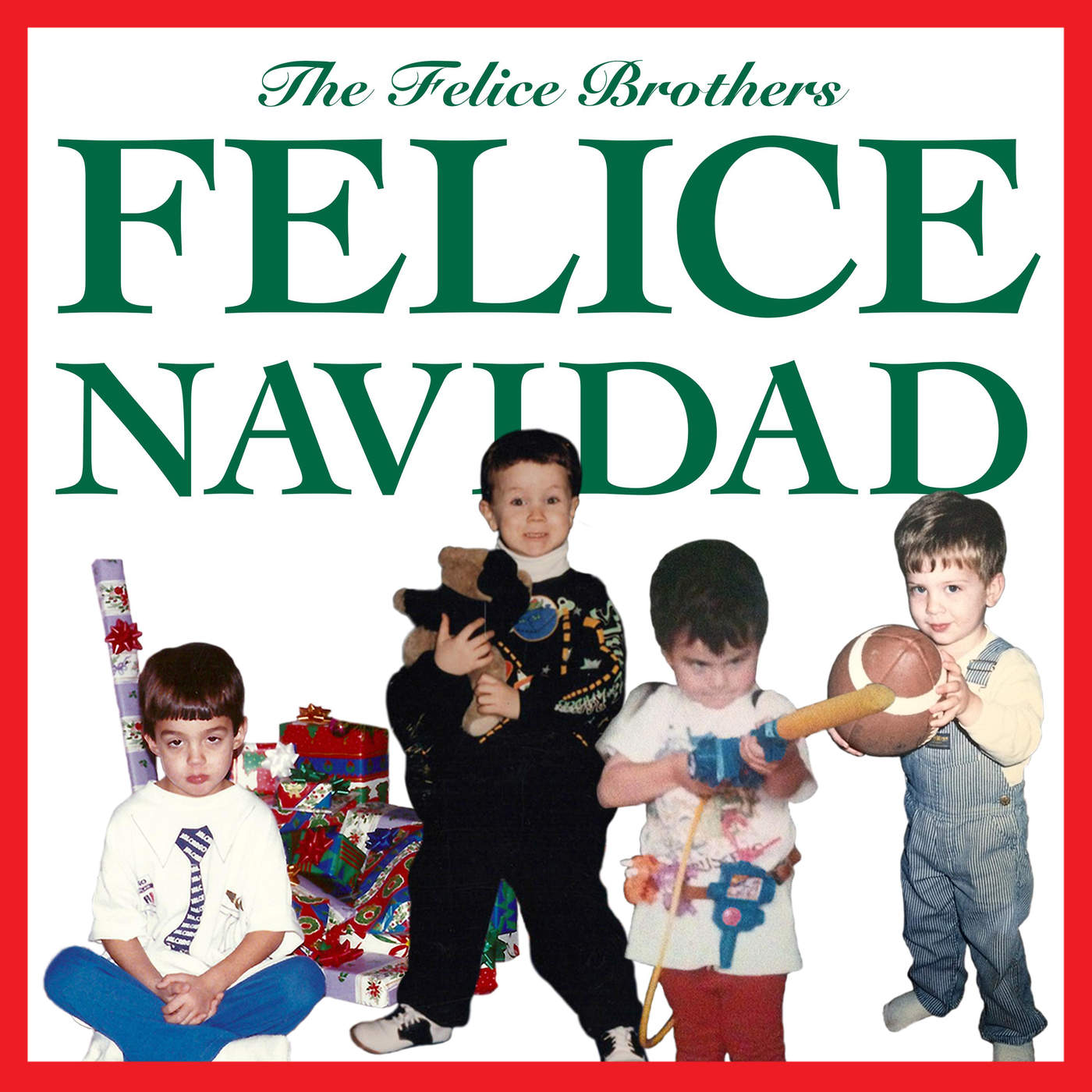
I don’t write about holiday albums much, Merry Christmas being depressing words to me because of a terrible tragedy that befell my family on Christmas Eve many years ago, but I’m making an exception for The Felice Brothers’ self-released 2015 EP “Felice Navidad” because Ian Felice is one of the best songwriters in the world, period, an authentic goddamn Great American Poet with heart to spare and a bittersweet view of life that means he isn’t going to sugarcoat the Holidays—he knows they can rip your heart right out of your chest and eat it.
Thing is my family drove off a sheer thousand-foot cliff on a foggy Christmas Eve, me in the backseat with my siblings, and I’ll tell you more after I tell you that the music of The Felice Brothers is the absolute best thing to come out of the Catskill Mountains since Bob Dylan and the Band produced the greatest music ever made in the basement of the house they dubbed Big Pink at 6 Parnassus Lane, West Saugerties, New York.
I first saw The Felice Brothers in Woodstock, after making a pilgrimage to Big Pink, and while I’d never heard their music before in my life (my ex- and I had gone to see Bobby’s son’s band The Wallflowers) I knew a connection had been made, that The Felice Brothers had that same divine spark in them that produced The Basement Tapes. It was a glorious night.
Ian Felice is a songwriter with an incredible range. The rawbones raucous “Frankie’s Gun,” the spiritually powerful “We Shall Live Again,” and the flat-out amazing “Take This Bread” prove he can keep things folk simple. More complex and sophisticated songs like “Fire at the Pageant,” “Back in the Dancehalls,” and “Jazz on the Autobahn” have a more cutting-edge bent, while numbers like “Money Talks” take the band in a direction so surreal no one could have anticipated it.
On “Felice Navidad,” The Felice Brothers keep things simple, mining that vein of stripped-down folk rock and country that was their bread and butter when I saw them way back in the day in Woodstock. This is the sound of the band that recorded perhaps their best-known song, “Frankie’s Gun!” in a chicken coop. “People seem to think that’s weird,” said Ian Felice, “but it was normal to us. It was like a little tiny dirty house.”
This is also the sound of the band that got its start busking in the subway stations of the Big Apple. No frills, no funny stuff, just songs that sound like they were written impromptu in front of a crackling fire in a snowed-in cabin high in the Adirondacks.
But back to the Christmas Eve tragedy that has even soured me on the soundtrack to A Charlie Brown Christmas, the best Yuletide music ever! Like I say, we’d driven over this thousand-foot cliff, and we were all screaming bloody murder until my father said, “Damn. We’re going to run out of gas before we hit bottom.” Well, this sobered us all up, but back to “Felice Navidad.”
Five songs, opening with “Carriage,” a mid-tempo number with acoustic guitar and electric piano that finds Ian Felice come Christmas Day with no one for company but his old dog, seeing as how his gal broke her promise to take him to town “in that old carriage hearse you found.” And he’s long in the mouth to say the least:
“And the tinsel hangs in the window
Candy canes strung on a tree
Well, it’s Christmas, the snow’s falling down
On this shit eating country town.”
And just to make things worse—and you’ll see the theme repeated in “Dollar Store”—times are tough all over:
“Well, it’s getting hard to pretend
That the new Great Depression will end
Or I’ll save up more than a buck
But I truly don’t give a fuck.”
But hey, what are you going to do but raise a toast to Grandpa Felice,
“And all of the others deceased
To the blizzard flickering the light
And turning their graves to white.”
And just like that, the anger has turned to sadness, to eternal things, and Ian turns things around at the end, although you can’t help but wonder if there isn’t a little sarcasm in the lines:
“See the ghostly reindeer dashing
With their bells in the perilous night
Well, it’s Christmas, and the power is down
In this beautiful country town.”
“Dollar Store” finds James Felice behind the microphone, buried snowbank-deep in the mix, and features some gorgeously ethereal and haunting choral singing before James, the prodigal drunk, comes home for Christmas, sings about trying to find presents for the kids in the family. His doleful accordion and some lovely piano provide accompaniment as he sings,
“Oh, it’s Christmas day
I forgot, I suppose
I walked this entire way
And the dollar store is closed.”
Such sad and faltering vocals, such a mournful and lonely and lovely thing, you can feel the pain and self-hatred until he closes things down with some lines that sum up families and the ne’er-do-wells who bring them nothing but pain, but who they can’t refuse to let through the door as much as they’d like to. “Let there be light,” sings James, then:
“Oh, it’s Christmas day
Whether you like it or not
You can’t turn this drunk away
You’re all this drunk has got.”
“Country Ham” is a more cheerful affair and a love song of sorts. Ian Felice accompanies himself on acoustic guitar as he tries to find the words to express his love. A lovely electric piano comes in, and Ian sings,
“You’re smoking a corn cob pipe
Know that you’re just my type
Your legs are thin and long
Your eggnog’s really strong
Your oranges are ripe.”
After that, it’s pure poetry:
“Drummer boy ain’t dumb
He plays a rum-pum-pom
He marches around the trees
A joyous jubilee
Until his hands are numb
An old man by the tree
He said as he waved at me
“I bet the first Noel
Back in Israel
Was a sight to see.”
It’s a joyous song, this one, from the very beginning when he sings,
“I love candied yam
Hooray for the country ham
Hear the sleigh bells ring
Hear Bing Crosby sing
A Winter Wonderland.”
“Clarence” is a whimsical visit to the angels in Heaven. It opens with sleighbells, then a piano comes in with acoustic guitar, and Ian can hardly suppress a chuckle because the angels in Heaven are exactly like us. “If you make her down to hell,” sings Ian, “grab me some Pall Malls/Been laughing at all the shit Mozart writes on the bathroom stall.” But the song’s also mournful, with Felice singing
“It’s Christmas Eve, and even angels get a little misty-eyed
Thinking of their families’ faces on the day they died.”
And he closes with a line that breaks my heart:
“It’s Christmas Eve, and even angels get a little misty-eyed
Thinking ’bout how frail it felt to ever be alive.”
And what follows that is an impossibly lovely instrumental coda featuring Greg Farley (who is no longer with the band) on fiddle.
And it’s Farley’s fiddle that fuels the breakneck hoedown of a closer that is “Breaking Up Christmas.” It’s a real romp in the snow, or the chicken house, this one, and I don’t know who’s singing or what they’re singing (whatever’s happening is happening “way over yonder,” I can tell you that much) but there’s some great vocal swapping with guys butting in to toss in lines and this barn-burner reminds me of the Christmas Eve I jumped out of the hayloft in the barn at my pal Billy Harrison’s pig farm outside Littlestown, PA and spent the rest of Christmas Eve in the ER with a busted ankle. Better than the drunk tank, I guess, but more painful.
But back to the reason why I hate Christmas and Christmas songs. As I said before, the whole family and I were plummeting off that high cliff with an empty gas tank when, lo and behold, a Christmas miracle occurred. We saw a gas station! Dad pulled into that filling station and filled up the tank so we’d have enough gas to get to the bottom, but while he was doing that I was in the gas station toilet and I’ll be damned if my parents and siblings didn’t even notice I wasn’t in the car when they pulled out of that filling station and proceeded to plunge to their deaths in a fiery explosion.
Afterwards, I stood inconsolable in the filling station, an orphan newborn, snow falling outside the window, and Burl Ives singing “A Holly Jolly Christmas” on the cheap transistor radio on a shelf behind the counter. “This is the worst Christmas ever,” I said to the filling station attendant, who had the name Clarence emblazoned on the shirt of his Esso uniform. He just grinned and handed me a Pall Mall. I was twelve years old.
“Kid,” said Clarence, who was scrawny and had bad teeth and even worse tattoos on his hands, “I’ve seen every variety of fucked there is in this world, and you just got fucked good. But it’s midnight, and that makes this Christmas Day. So what say you and I make the best of it.” And with that, he handed me a beer and said, “It’s a wonderful life.”
“Like hell it is,” I said.
“Just my luck, a hard case,” said Clarence, with an otherworldly gleam in his eye. He put his grease-stained finger to his weak chin and thought for a moment. Then he said, “What say you we head on over to Pottersville and get you a hooker? There’s an angel round here in need of a pair of wings.”
And he was right! It’s a wonderful life!
GRADED ON A CURVE:
A