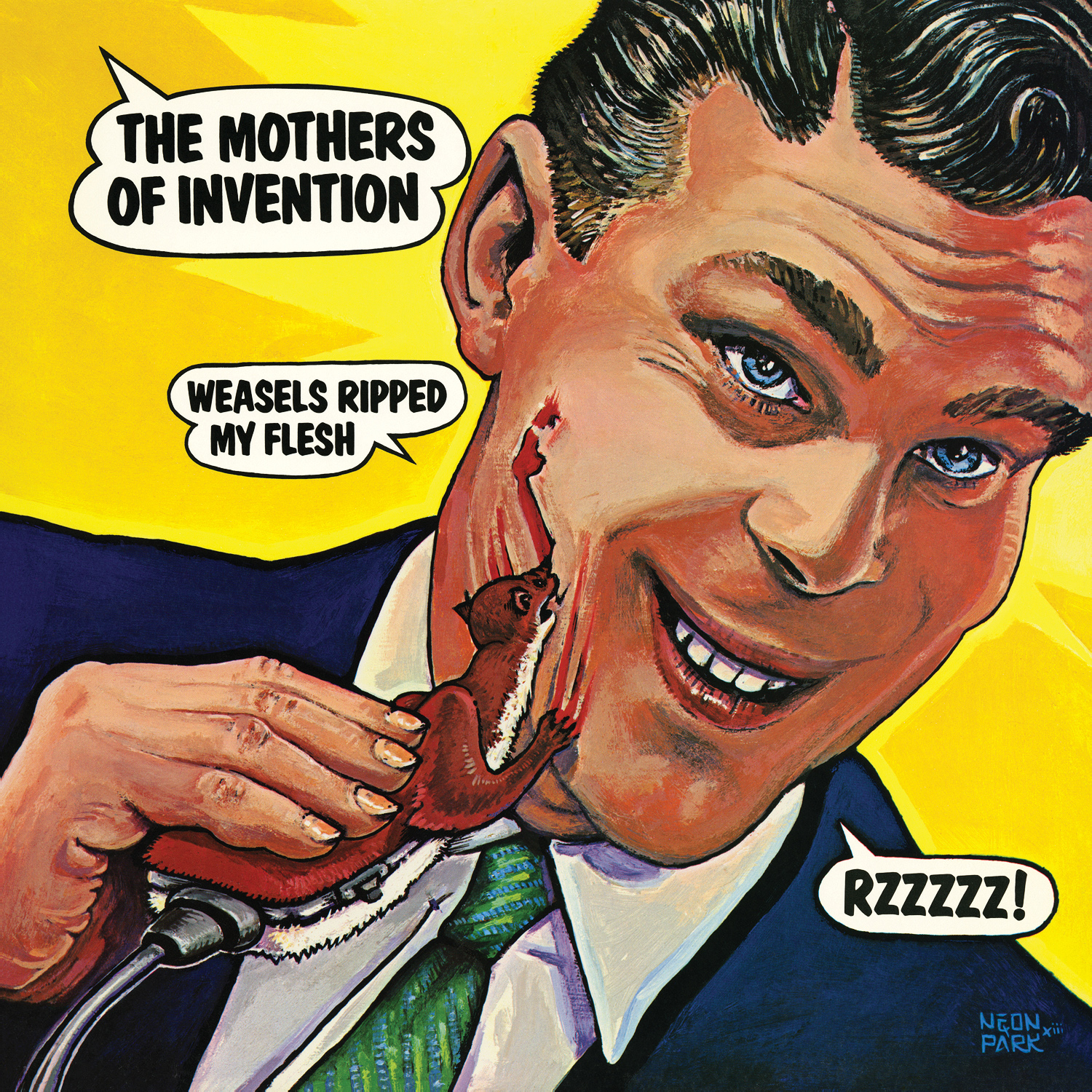
Let’s pretend, for a moment, that I’m somebody else. Somebody who doesn’t think Frank Zappa was a smug, supercilious, smirking jerk, who sneered at his betters (The Monkees come to mind) and whose belief in his own musical and moral superiority wasn’t completely undercut by the fact that he catered to the kinds of giggling juveniles who think “Don’t Eat the Yellow Snow” is the Huskies’ urine.
And who will best be remembered by the general public for the trite novelty tunes “Dancin’ Fool” and “Valley Girl.”
Oh, forget it. I can’t be somebody else—I love myself too much. But it’s easier for me to keep an open mind when it comes to Zappa’s earlier work, when he had yet to tailor his music to the pre-pubes crowd.
I can actually listen to 1969’s Hot Rats, mainly because Zappa never opens his sarcastic trap, and there are numerous good things to be said about 1970’s Weasels Ripped My Flesh, a combination live/studio disc that Zappa assembled from material recorded before the Mothers of Invention sadly went tits up.
Weasels Ripped My Flesh is a mixed bag with some very good songs, and it might have been a triumph had Frank Zappa had a little less Frank Zappa in him. By which I mean Frank Zappa never met a rock song he couldn’t ruin by over-complicating it, basically because he believed that mere rock music was beneath his staggering genius.
As a result, Weasels Ripped My Flesh includes some coulda-been-very-good songs that are only very good in parts, and what good are songs that are only very good in parts? But it also includes a few of the best songs Zappa ever recorded.
“My Guitar Wants to Kill Your Mama” is one of a small handful of Zaptunes I listen to for pleasure; far too many Zappa songs make me wish America’s Champion in the War Against Musical Censorship HAD been censored—“Dancin’ Fool” may not be obscene, but it’s guilty of lowering the collective IQ of the American listening public.
And there are other tracks on Weasels Ripped My Flesh that pass the smell test. The problem is that Zappa could be (and generally was) a pretentious avant-garde manque, and Zappa the pretentious avant-garde manque is all over Weasels Ripped My Flesh. Fortunately, we also get the Zappa capable of reining in the Edgar Varese and producing a straightforward song that is strong from beginning to end.
Opener “Didya Get Any Onya?” (which was recorded live at the Philadelphia Arena in 1969) is not such a song. It’s an annoyance. It opens at a fast clip and is all machine gun saxophone and drum clamor, and your first thought is, my god, this is going to be great. But Zappa cannot leave well enough alone, and before you know it weird voices are coming in and the promising free jazz that follows (think staggering saxophone freakout) is interrupted by Lowell George talking and somebody (maybe George) singing mock opera, at length, before we get a smidgeon of doo-wop and a guy making stupid noises while the band stutters and sputters and staggers behind him.
Fortunately, it’s followed by a slow and bluesy studio cover of Little Richard’s “Directly from My Heart to You,” on which Don “Sugarcane” Harris sings his heart out while accompanying himself on electric violin. It’s a revelation, is what it is, and proof that when Zappa left well enough alone, his avant-garde pretensions are missing in action—the results could be pure listening pleasure.
The live from swinging London “Prelude to the Afternoon of a Sexually Aroused Gas Mask” starts as a space rock free-for-all, segues briefly into free jazz, then dies a horrible death as Roy Estrada commences to sing like a lunatic, laugh like a lunatic, and in general do his lunatic best to make the song pleasurable only to lunatics. Other voices come in, then a guy commences to growl over some lounge piano, by which time I’m reaching for my revolver.
The live from Miami “Toads of the Short Forest” is a bad lounge song until it isn’t—some ways in the drums commence to pound out a weird tempo, a saxophone blurts free jazz, and it’s cool until Zappa opens his mouth, telling you what time each instrument is playing in. Then you get some stop-and-start and lots of irritating this and that—the saxophone plays a melody that is quickly exterminated with extreme prejudice, then you get more stop-and-start that is truly maddening.
Robert Christgau said of the album, “…if Brecht considered pure enjoyment counterrevolutionary, Zappa considers it dumb—that’s why he breaks in constantly with dialogue and vocal or electronic sounds whose musical interest/value is essentially theoretical.” In short, the guy thinks showing us a good time is slumming.
“Get a Little”—which was recorded live at The Factory in the Bronx—opens on an unpromising note, with somebody coughing and talking. But then Zappa comes in, doing the only thing he ever got completely right—playing his guitar. The song is basically an extended guitar solo, and while it’s a restrained guitar solo by Zappa standards, it succeeds in a low-key way. Unfortunately, “Get a Little” only gives a little, and it’s over before you know it.
The hot-from-the-studio “The Eric Dolphy Memorial Barbecue” prominently features Art Tripp on vibes, and boy, do I hate the vibes—and the vibe. It drags on and on, until things get weird—the drummer plays some dissonant stuff, some horns come in, followed by some weird voices. Then the horns play in synch and talk about your essentially theoretical—I can appreciate the musicianship, but the song, which seems to go on forever and comes complete with electronic effects and a sudden shift to the up-tempo, irritates the hell out of me.
I would call it free jazz, but knowing Zappa, it was all carefully orchestrated—his idea of free was no more free than the music of his occasional musical dictator in arms, Captain Beefheart.
“Dwarf Nebula Processional March” opens on a fussy note and keeps it up with a fussy melody until things give way to experimental time, and the experiment is irksome from beginning to end. It’s torturous weirdness for its own sake, and I can’t believe I’m saying this, but I’d sooner listen to Emerson, Lake & Palmer. A waste of vinyl.
“My Guitar Wants to Kill Your Mama” is the best rock and roll song Zappa ever wrote, despite an interlude where he does his best to fuck it up with his art rock pretensions. Great guitar intro (Lowell George joins Zappa on guitar), mean guitar riff at the end of each line, and you get lots of horns that sound like they’ve been electrified and distorted. And the guitar playing is savage, with a killer solo towards the end.
Zappa is tired of having to sneak around to get to your back door, he doesn’t want to cut off all his hair, and your mama catches him as he’s sneaking past the garbage. No wonder his guitar is in the mood for double homicide. The song’s only weak point comes when you EXPECT a guitar solo but get some distorted horns instead, sounding cutesy and taking the song in a direction it doesn’t need to go. The interlude has irked me for years—I can’t help but think Zappa felt like writing a straightforward rocker without adding SOMETHING off-kilter was beneath him.
“Oh No” is to The Beatles’ “All You Need Is Love” as Steely Dan’s “Only a Fool Would Say That” is to John Lennon’s “Imagine”—a you ’ve-got-to-be-kidding retort. The latter is the better song; “Oh No” features Ray Collins’ echo-laden pop vocals over a pop melody that Zappa obviously considers jejune. (You can tell when he’s slumming.) “I think you’re probably out to lunch,” sings Collins to the Fab Four, and this slice of sarcasm and contempt is right on target—Zappa knows idealistic mush when he hears it.
It’s followed by the live-from-London jam “Orange County Lumber Truck,” which is far better than its glorified easy listening jazz melody would lead you to expect, because Zappa deigns to play his ax. When the horns aren’t playing in synch, Zappa is soloing, and Zappa soloing is Zappa not ruining his own songs. Frank Zappa may have sneered at mere rock and roll, but his guitar loved it.
The LP closes with the title track, a live atonal freakout that would have made the Velvet Underground proud. Nothing to ruin here—it’s two minutes of glorious ear torture, with every man for himself, producing as much feedback and chaos as he can.
Wish I’d been in the audience at that show in Birmingham, England—had Zappa dispensed with the constant self-interruptions and done more of this, I’d actually like and respect the guy. No avant-garde pretension here—it’s “European Son” anarchy of the sort that the notoriously anal retentive Zappa would normally disdain.
Let’s see. I count four winners, several mixed bags, and four or so no ways, and in my world, that counts as a victory. Zappa was always both too smart for his own good and not as smart as he thought he was, and his career as a rock musician who hated rock music left us mostly with a body of rock music that is, like its maker, both too smart and too dumb for its own smart-ass good.
There’s no way I’ll listen to Weasels Ripped My Flesh again in its entirety. But if you’re Mothers of Invention/Zappa curious, it’s one of the best ways to do some exploring.
GRADED ON A CURVE:
B-