Wes Anderson is one of the most original American film directors in movies today. There are many elements that go into the singular vision of one of his films. Integral to the unique worlds he creates in his films is the music.
Anderson’s films increasingly harken back to some imaginary place in the past. His stories are often set in carefully conceived locales that become the perfect setting for the various miniature tableaux he creates. Before commonplace international travel, world satellite communication, and, of course, everything related to the Internet, social media, and what now may be the final technological scourge, AI, the world was a more mysterious place. That mystery is something Anderson continues to explore and reflect in his films, and with the help of his chief soundtrack collaborator Alexandre Desplat, a mood of mystery and timelessness is easily achieved.
While Desplat provides the soundtrack for countless directors and films, his work as part of Anderson’s film “company” of contributors, collaborators, and cohorts is evidence of probably the most intimate relationship between director and composer of any with which the two are involved. For his work with Anderson, Desplat has won BAFTA, Grammy, and Oscar awards.
After Mark Mothersbaugh did the music for his debut film Bottle Rocket, Anderson often used the music of the British Invasion and the post-Invasion on his soundtracks, which became a signature of his early, breakthrough films. His more recent films have turned away from using music from that era. Nearly gone is the often incongruent, but successful pairing of stories set in current times with the music of the ’60s and ’70s from his non-animated films.
As Anderson’s most recent films have been set in the past (Moonrise Kingdom, The Grand Budapest Hotel, The French Dispatch, Asteroid City, and The Phoenician Scheme), rock songs have been replaced with other music. Since Moonrise Kingdom, he has increasingly used classical music, with the exception, for the most part, of Asteroid City.
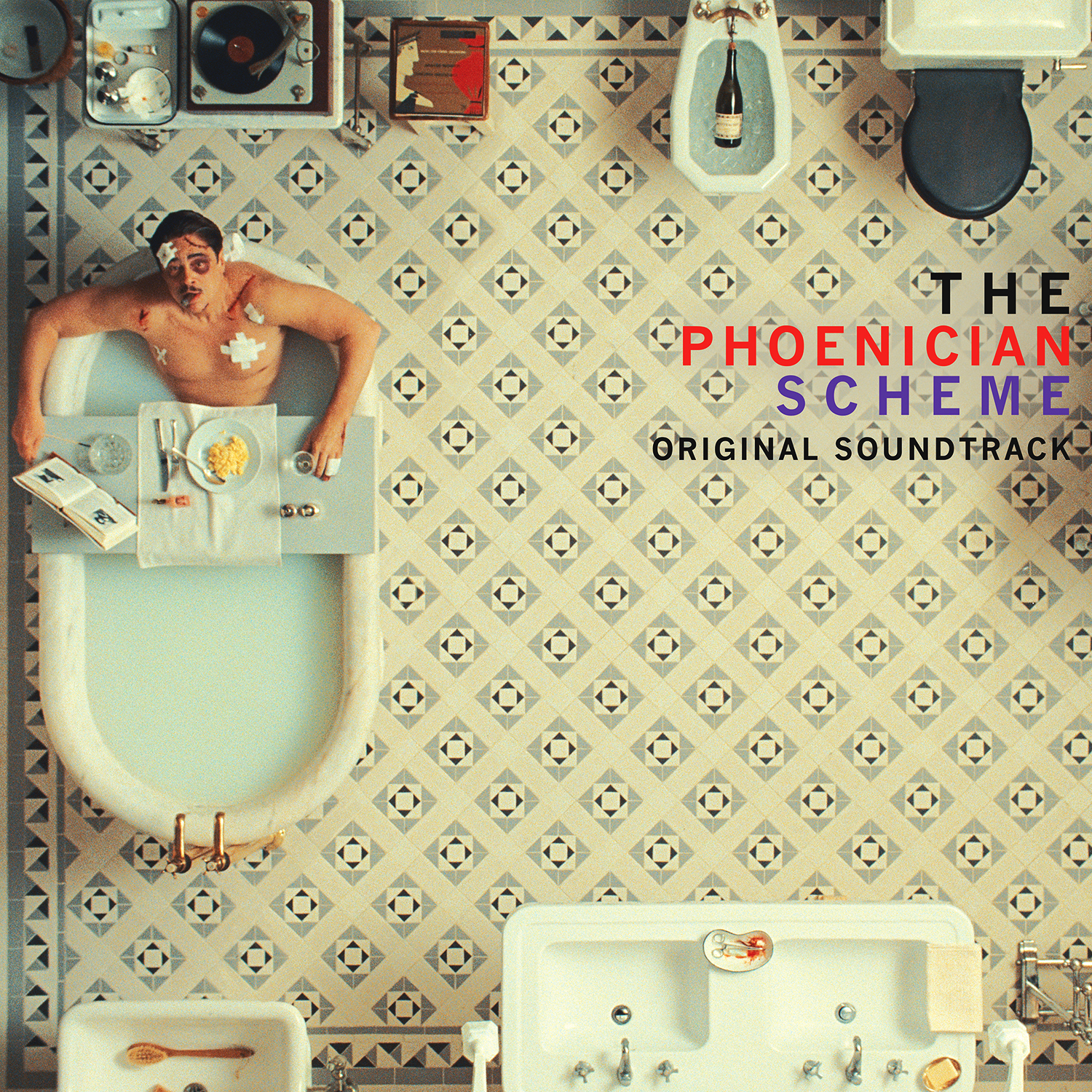
In the case of this new soundtrack, the music consists primarily of Desplat’s music as well as swing-era jazz and classical music. In fact, it is the Stravinsky music here that seems to inform Desplat’s pieces, which have a queasy, menacing, doom-laden, tribal mystery feel. In addition to Stravinsky, Anderson uses Bach and Mussorgsky. Gene Krupa’s “Drum Boogie” and much of the Stravinsky music in the earlier part of the soundtrack have largely inspired Desplat’s music included here. Other music here that works as an upbeat counterpoint to Desplat’s overall minor-key, dark-mood theme and to some of the classical music is swing-era music from Glenn Miller.
The LP edition of the soundtrack comes on sea-foam colored vinyl. There are liner notes, including a short essay from Anderson about the soundtrack music on one side of the insert and a color map of “modern greater independent Phoenicia” and “Korda’s flight plan” on the other. Korda is the main character of the film. It is these kinds of detailed touches that make the world of Wes Anderson so delightful.
In an age of electronic soundtrack music and random collections of songs, Anderson’s use of music is truly imaginative, and major kudos must go to the pure genius of Desplat.
GRADED ON A CURVE:
B