The first time I saw W.A.S.P. I was a kid at the Orange Pavilion in San Bernardino, 1984. They were opening for Krokus and Helix, and I didn’t have the vocabulary for what happened to me that night. Forty-two years and more shows than I can count later, I’m still not sure I do. But I know what kept me there, and it wasn’t the buzzsaws or the blood or any of the things that got the band on the evening news. It was that Blackie Lawless meant it. I could tell that from the cheap seats at fourteen, and I can tell it from a photo pit now.
That’s the thing, people who only know the headlines never got it. The imagery was real because the man was real, and when the imagery stopped serving him, he changed it, at considerable cost, more than once. He made the record his label didn’t want and watched it go gold in a week. He built The Crimson Idol alone in a studio with no clocks. He still records to tape. He’ll tell you exactly why, and he doesn’t soften any of it.
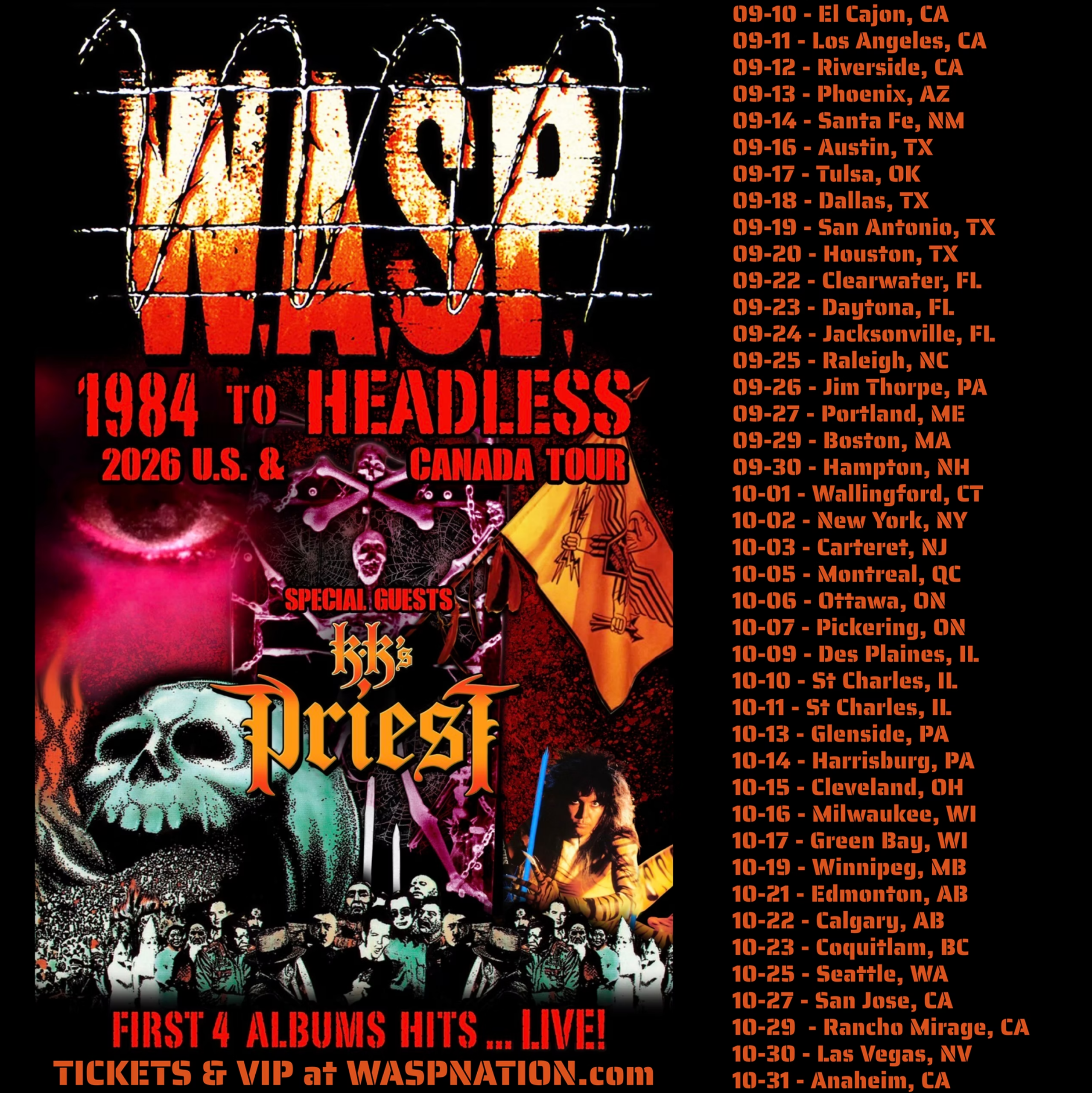
He’s about to take that first stretch of his catalog back on the road (the “1984 to Headless” tour, forty-plus North American dates starting September 10 with KK’s Priest), and he’s six years into an autobiography, Tales From the Square Mile, that turned out not to be about him at all. He talked about the closet he lived in across the street from the Hollywood Palladium, three feet by twelve. The laundromat where they set up between the washing machines. The meat locker. Bela Lugosi dying seventy-five feet from where he slept, which he only learned decades later while fact-checking his own life.
Early in our conversation, he waved off my thanks and said that what he does and what I do aren’t so different. “We’re reporters. We write down what we see, or we record it, and we tell people about it.” I’ve thought about that line ever since. Here’s what he told me.
Take me back to before anybody knew what W.A.S.P. was, before the makeup, before the buzzsaws, before any of it. What was the actual plan when you started in ’82? Because I don’t think the way this began and the way the world eventually saw it are the same story.
You’ve got to understand, how we got started and what the world eventually saw were two completely different things. We were trying to get a record deal, and we’d been here long enough to know that most bands don’t get deals by playing live. They get them off demo tapes, because the label is looking for something they can manage, something they can put a quarterly report on. I wrote those songs in early ’82, “I Wanna Be Somebody,” “L.O.V.E. Machine,” all of that, and we did a set of demos. We put them out and we weren’t hearing back from the labels. So we thought, these demos are pretty good, why don’t we take them out in front of people and see what happens?
We had no clue what to do. We looked at each other and said, “Well, do we just stand still and look at our shoe tops?” And we thought, no, that’s not really us. It started morphing from there.
I was playing guitar then. Don Costa was our original bass player, and Don and Chris were butting heads, and Chris gave me an ultimatum. I knew Randy Piper from having worked with him before, but the problem was we had three guitar players and no bass player, and I knew those other two guys were never going to give up guitar. So, I was basically elected to play that instrument.
We never intended on playing live. And the irony is that we got known for the show. That first record is considered a classic now, but nobody was really listening at the time, because the show was so powerful. We were scratching our heads. At the end of the day we didn’t care, as long as it got us from point A to point B, that’s all that mattered.
Was there a musician or an artist before all that who fundamentally rewired how you thought about music, somebody who gave you the “I want to be on that stage”? I’m asking partly because I want to know if there was ever a single moment where you knew this was going to be your life.
It’s hard to put it into a single artist. Blackie Lawless is a combination of Zorro and Dracula. Those are childhood heroes. Put them both together and that’s who you get.
When I was two years old, my first memory of anything in life was Chuck Berry’s “Sweet Little Sixteen.” I was sitting at a breakfast table with my parents, and they were eating powdered donuts. I can see it right now in my mind’s eye like it was five minutes ago. My parents didn’t believe me when I told them years later, but I described the kitchen to them and they said, “Oh yeah, that’s when we were living over in such and such.” The radio was playing, the song came on, and because of the music the memory was so vivid it put the whole thing into focus. Even to this day, I’ll be going down the street and I’ll hear that song and a strange, bizarre kind of wave comes over me. It’s hard to describe.
My mom always had music around the house. She was a huge Elvis fan, Little Richard, Chuck Berry. She was a country-western girl too; she was from Houston originally. So, I grew up with all of it. That was my university before I ever went to public school. I couldn’t say it was any one person. But if I had to pick one I’d say Elvis, but that’s not really 100 percent accurate.

Your book is called Tales From the Square Mile. From what I’ve read, the deeper you got the more you realized the story was bigger than you, that it was that square mile of Hollywood. Is there something you understand today that you couldn’t have understood while you were living inside it?
That’s the whole premise of the book. I’ll give you an example. The last place we played in LA, the last night of the tour almost two years ago, was the Hollywood Palladium. I used to live literally right across the street. I was living in a place where we rehearsed, and I lived in the closet. It was three feet by twelve feet. It’s fifty feet away.
Somehow in my head I had it envisioned that if I had some success, everything would change, that it was going to be Valhalla. In some ways it was. You’re driving a better car, you’re eating better food, or you’re eating, period, which was a big deal in those days. I was living on five bucks a week, and I’m not kidding, and that went on for years.
When I did The Crimson Idol, I had a commercial studio in Hollywood right at Santa Monica and Vine. What people don’t realize is that diagonally across the intersection was a laundromat, and we used to rehearse in that laundromat after nine o’clock at night. We’d set up in between the washing machines. That’s where we put our gear, and we’d rehearse from nine to one in the morning, all through the time we were playing the Troubadour. We rehearsed in a meat locker for a while too, eight by twenty, thirty-four degrees in there. People hear these stories and they don’t believe it, because the meat all came later. Here’s a band that throws meat at the audience, and they’re rehearsing in a meat locker. It sounds too unbelievable to be true. But it was true.
Fast forward nine years and I’m the proprietor of a state-of-the-art recording studio, and I’d be waiting at the light for it to change and I’d look over and still see that laundromat over there, and I’m asking myself, how in the world did this happen? Because I’ve gone away in some ways, but in some ways I’ve never gone away.
When W.A.S.P. arrived in ’84, ’85, there was this sense onstage that something genuinely unsafe was happening. How much of that was instinctual and how much was engineered? Were you designing a war, or did the world decide afterward what it was?
It was just us being us.
I always say the first five years any band is together are the most crucial, because that’s where they make their bones. I don’t care what band it is. They made their reputation in the first five years. But in those five years they all go through the same cycle: a record and a tour, a record and a tour. And when that first cycle is done, you don’t know who you are.
The last show we played on the Inside the Electric Circus tour was March of ’87. The very next day I got my first house, and I moved in and took about six months and did nothing. I literally got reacquainted with me, because I needed a break. I did not know who I was anymore. Three years on that treadmill. You’re literally crazy when it’s over.
When I started writing Headless, Capitol heard the early demos and said, this is not the record you should do. You should be doing “I Wanna Be Somebody” Part 15. And I said no. This is not who I am anymore. This record is who I am. Well, the record goes gold in the first week and they shut up, and then they’re all patting themselves on the back talking about what a great job they did. It’s pretty ludicrous.
But I learned you make records that reflect who you are at the moment. You don’t follow the trends. Think about what was going on in ’88 and the bands getting airplay at the time. Had we not cut and run from the pack when we did, you and I wouldn’t be having this conversation right now. That record was pivotal to the band morphing into what it would become, and because of that, The Crimson Idol comes along, KFD comes along.
What you saw in the early days when you saw us open for whoever back in ’84, that was not manufactured at all. That was us. And it wasn’t until we were doing Headless that I understood it. I went into a restaurant one night and they were playing Live at the Lyceum, and I hadn’t seen it since we’d done it. We did the Lyceum in ’84 and it’s now ’88. I looked up at us on the screen and for the first time I could understand why people were so upset with us, because it scared me when I looked at it. I looked at the look on our faces, and I know for a fact it was not manufactured. I did not recognize who those people were when I looked at them on that screen.
There were other bands doing things, trying to be outrageous, but it ended up cartoonish. I still see the same thing today, bands doing the occult routine and all that. You can’t do that if it’s manufactured. It’s got to be real.
You just described telling Capitol no when they wanted “I Wanna Be Somebody” Part 15, and you got to say no. A lot of bands in 1988 didn’t have that option. How did you end up with the freedom to make that call, and to keep making it for forty years?
A big part of it was the management, Rod Smallwood and Andy Taylor. I’m still with them, and they have allowed me to work childlike, where I just do whatever I want to do. Same thing with Steve Harris from Maiden; they manage Maiden as well. We’ve been given carte blanche to run our lives the way we want.
There were a lot of times the label would be screaming bloody murder, and Rod would basically tell them to shut up, go do whatever they needed to do to make themselves happy, but we were going to do what we were going to do. Even from the beginning, our contract stated we had right of refusal on everything. Most new bands never get that. Never.
I’m extremely fortunate to have had them in my life, to keep the wolves at the door.
On this tour you’re working backwards from The Headless Children, and some of these songs you haven’t played in a long time. When you sit down with a song you wrote that long ago, do you meet it as the man who wrote it, or as a stranger relearning it?
We did the first record on the last tour, and there were songs on there we hadn’t played since ’85, on that first tour. I thought, how are we going to do this? There are little tricks you learn along the way that change how you approach certain songs. Trying to go back to exactly what it was is difficult. But you get in the mindset of where the songs came from, and it makes it easier.
It’s a little like method acting. You look at the part you’re given to play and you ask yourself, okay, I remember how to do this. Go do it again. That’s really part of what it is, to make that older material come alive.

We’re a vinyl publication, so let’s talk about the format. The Crimson Idol is a record built the way records were built: a story, a side one, a side two, sequenced. Were you thinking about the physical object when you made it? And can a record like that even be heard properly on shuffle?
You’d have to ask the individual that. I can’t begin to assume what they’re thinking. But you’re correct. It was designed to be listened to in a single sit-down, where you listen to the first side and then you listen to the second side. You’ve got what they call the three-minute mentality out there. I don’t profess to know how real that is. It may be in a lot of circles, and then again, it might not be, for certain individuals.
When I was making that record, I had a very definite idea of what I wanted it to be, how it was going to be approached, how it was going to be delivered. I don’t think there’s any such thing as making a perfect record, but that’s about as close to perfection as you’re going to get.
I went into a studio that didn’t have any clocks in it. I did it like a casino. I owned that studio; it was my workshop, my laboratory, and I was going to work until I got tired. Some days that was six hours. Some days it was eighteen. Some days more than that. I was just going to do whatever came natural, and I did. The end result speaks for itself.
Do you have a record collection? Is there an album on that shelf that stands out, one that rewired you?
I’ve got to say the Sgt. Pepper record, and especially the remix. When I listen to what George Martin’s son has done, following his dad’s footsteps, what he did on Sgt. Pepper is pretty astonishing. I have my reservations about some of the stuff that’s come after it, but that record is astonishing when you listen to it.
And you’ve got to do it like you do Dark Side of the Moon. You’ve got to listen to it with headphones on. You can’t do the shuffle routine. You’ve got to take the time to sit down and listen to it.
There’s a new generation coming to vinyl, buying turntables, digging through crates. When one of them drops a W.A.S.P. record for the first time, what do you hope happens in those first thirty seconds?
Two things: the quality of the music and the quality of the recording, because we still record on tape. I have a Pro Tools rig in the studio, but we only use it to transfer. Once we’ve recorded on tape, we put it on digital, because you’re going to have to go digital at some point, but that’s only for storage.
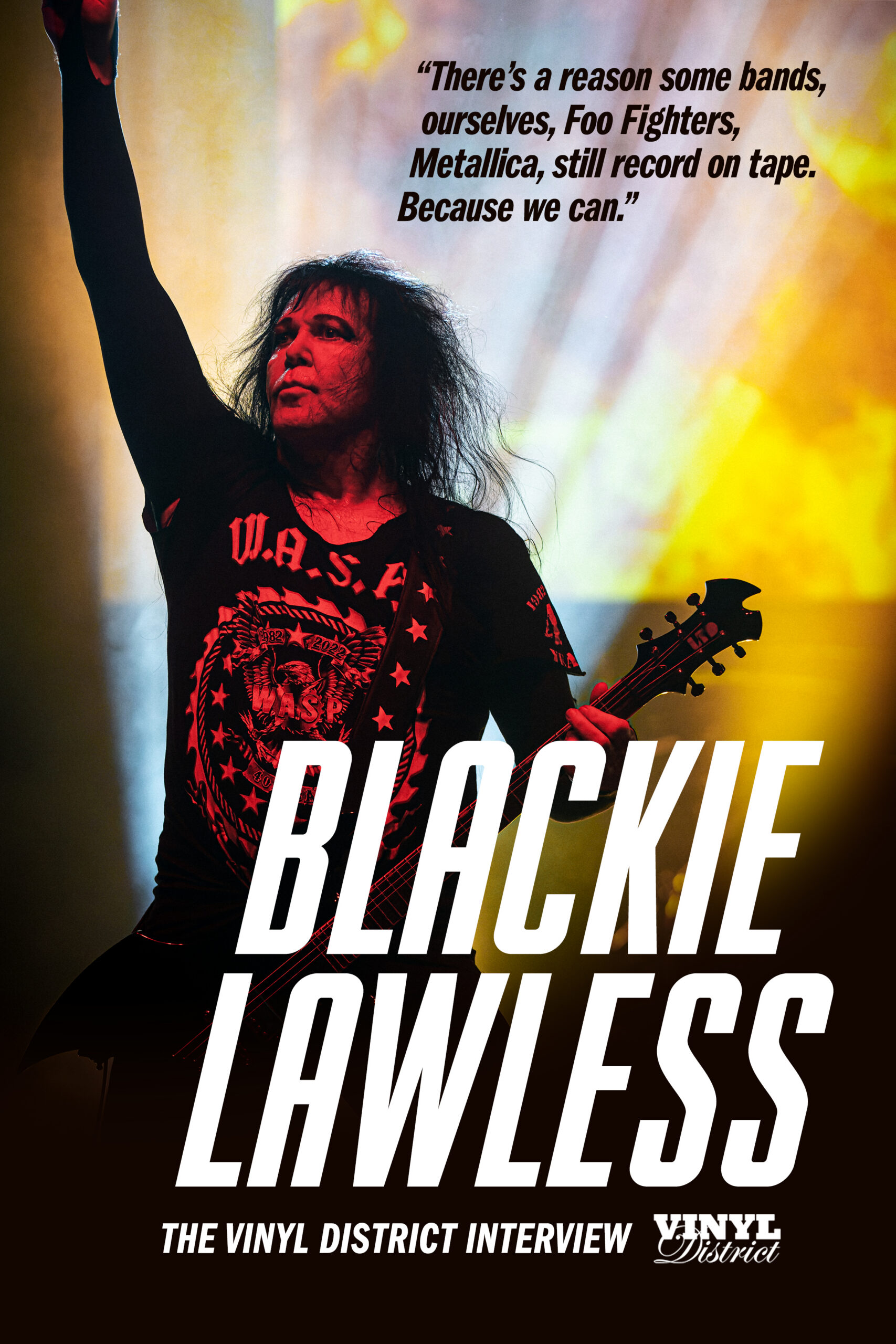
There’s only one way to make an expensive-sounding record, and that’s to spend the money to do it if you want it to be the best quality it can be. There’s a reason some bands, ourselves, Foo Fighters, Metallica, still record on tape. Because we can. And you say, well, the amount of money that goes into it, you’re never going to see it again. That’s true. But we’re not making records trying to make money on them anymore. Anything we’re going to do at this point is going to be done for our legacy.
Because the records you make today end up being the opening act for the stuff you did those first five years you were together. Is it going to be the kind of thing where you say, okay, we’re going to play something from the new record now, and people go to the concession stand or the bathroom? Is that music going to compete with the original stuff they’ve had decades to romance inside their heads?
I’ll be honest with you. The last full record of new music we did, Golgotha, is as good a record as anything we’ve ever done. There’s not one weak track on it. I’m proud of that record for that reason. But you’re not going to sell the records you once did. Anything you do now, you do for legacy.

I want to come back to the book, because you said something earlier that stuck with me, that the more you got into it, the more you realized it wasn’t only your story. At what point did that turn, and what did it turn into?
When I first started the book, I thought it was my singular story. That seemed reasonable. But the more I got into it, the more I realized it wasn’t just my story. There are only two guys left who were here in the mid-’70s, who survived it and went on to have any real success. And I’m not talking about the guys from Orange County or the guys from Pasadena. All those bands lived with their parents at the time. I’m not saying they didn’t have it rough, because they did. But there’s a difference between living with your parents and living in Hollywood like an animal. The only two guys left to tell the tale are myself and Rudy Sarzo.
As the music industry morphed in the ’70s, it took the model the movie studios had built out here, the Dream Factories, where they would literally create stars. That’s what the record companies did. For the longest time the music industry ran Hollywood. All of it’s gone now.
If something of note happened in Iowa, they’d put up a street sign, a marker: such and such happened here on this date. In Hollywood that does not happen, because it happens so often. It just plows over its history every twenty, thirty years, and it moves on. All the recording studios, all the management offices we would later have. All these places had backstories. The original management office we had belonged to Cecil B. DeMille at one point. It was a building he built. Here’s a man who did The Ten Commandments.
I talked about Zorro and Bela Lugosi. What I didn’t realize until I started doing research was that when Lugosi died, the best I can figure, he died about seventy-five feet away from where I was living in that closet. Had I known that at the time, I’d have been over there leaving flowers on his doorstep every day. I didn’t know any of it until I started writing the book.
I asked other musicians who’d done this how long it took them to write. They said, “Ah, six months.” So I’m thinking, that’ll be reasonable. Six years later I’m still working on it, and the reason is the research. It ended up being way different than I thought it was going to be. It’s not your typical sex, drugs and rock and roll book. There’s some of that in there, but very little.
Last one, and it’s the big one. Someday the tours are finished and the book is on the shelf. When people talk about what Blackie Lawless meant, not the controversy, not the chart positions, not the headlines from the ’80s, what do you hope they say? What’s the human legacy?
The only thing I really want is this. I’m making records to make people think. I’m doing shows to make people think. And there’s not a lot of that in the world now. It’s a pretty homogenized diet, the way people approach things.
Listen, we could have sold more records than we did if we hadn’t done some of the things we did. But I didn’t care. Headless went gold the first week; it’s right around platinum status now in America. Platinum status by today’s standards isn’t that big a deal. Next to another band that might do four or five million, you’re going to get lost in the shuffle and it’s going to look like a failure. It’s not a failure. It’s a success, especially if it’s a good record, and it’s a record that the people who bought it like.
I can’t worry about whether people are going to like it or not going to like it. The only thing I want them to do is to think. And if they do that, then my life will have been a success.