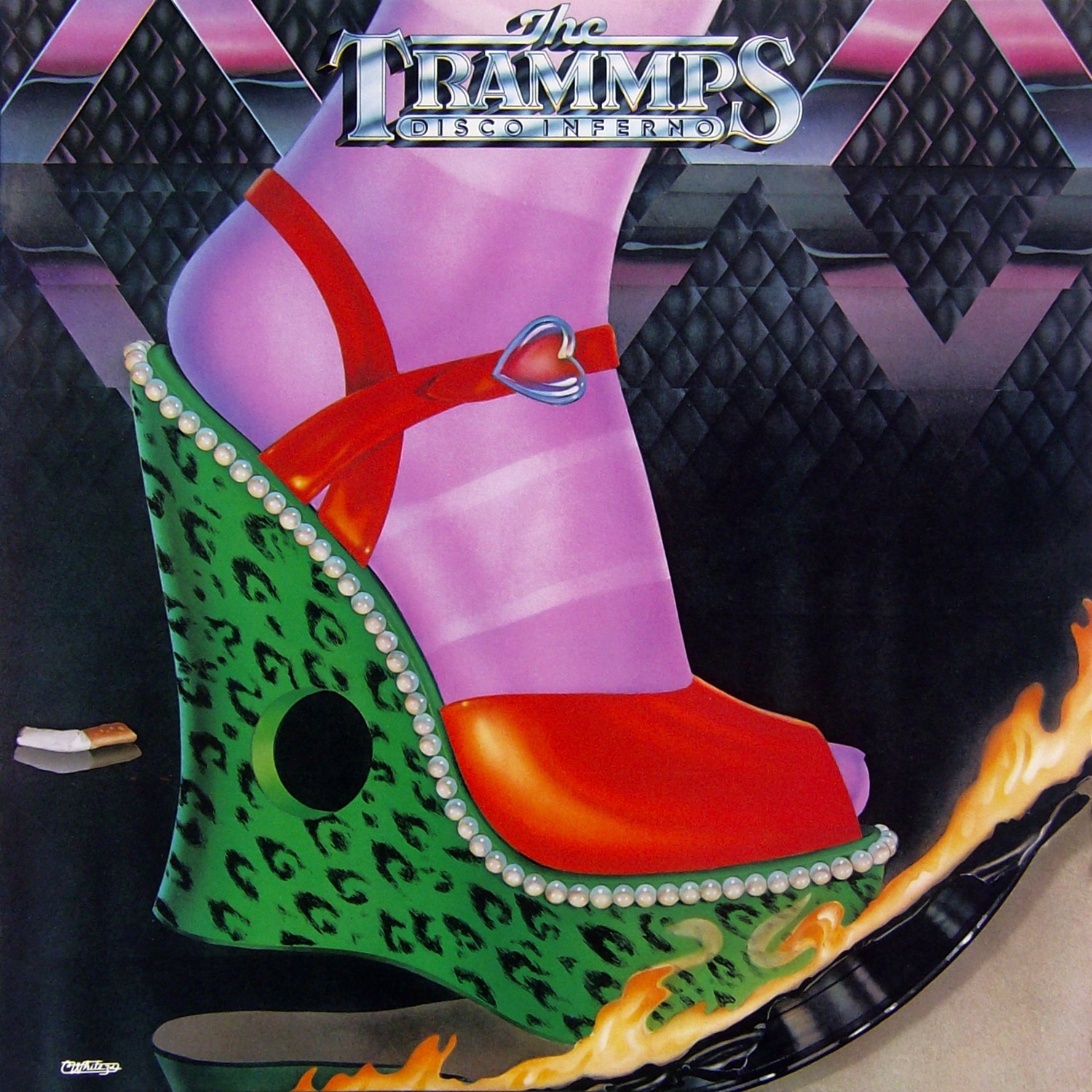
Song inspired by Irwin “Master of Disaster” Allen, performed by early disco heroes The Trammps backed up by the fellow Philadelphians in MFSB–how can you go wrong?
Clocking in at almost eleven minutes, 1976’s “Disco Inferno”—which wouldn’t become a Disco Mountain-sized hit until it was included on the soundtrack of the following year’s Saturday Night Fever—proved that longer could be better.
Covered by the likes of Tina Turner (soul-scream great), Cyndi Lauper (pure technosuck), and the mighty Killdozer (brain-battering brilliant), but not by 50 Cent, whose song of the same name is NOT a remake—“Disco Inferno” has firmly established itself as part of the entire world’s musico-cultural landscape.
Proof lies in the fact that there have been more dance remixes of the song than you can count on your three hands!
Inspired by Allen’s 1974 film The Towering Inferno, Killdozer has recorded the only other tribute to the film in the hilarious “Man vs. Nature”—“Disco Inferno” more than makes up for its lack of funny with a towering sound that has transformed many a checkered disco floor into a dance conflagration capable of setting fire to the disco ball on the ceiling.
The Trammps—who got their name from Charlie Chaplin’s 1915 silent film The Little Tramp, then added the extra “M” to indicate they were “superior tramps”—were largely a vocal group. I’m talking about five, count ‘em five vocalists, only two of whom played instruments (they would be bass vocalist Earl Young on drums and non-singer Ronald Baker on bass).
The Trammps relied on members of MFSB—who gave us seminal 1974 disco instrumental “The Sound of Philadelphia,” a string-powered fantasia I couldn’t hear enough as a kid—to play on “Disco Inferno,” and MFSB contributed not one, not two, but three guitarists. We’re talking about a three-guitar army here, just like Lynyrd Skynyrd’s!
Add the semi-obscure T. G. Conway on keyboards and the wonderfully named Don Renaldo and His Strings and Horns, and what you had was a line-up that would force cartographers to rework the maps of planet Earth’s musical globe.
Important note: The short (just over three-and-a-half minutes) version of “Disco Inferno” is a disgrace. Why, it doesn’t even include soul belter and screamer lead vocalist Jimmy Ellis’ disclaimer about the song not really being about The Towering Inferno, despite the rest of the lyrics being about a Top of the World disco fire. Ellis sings,
“I wanted you to understand what I’m talking about
I’m not talking about burning down a building
It’s coming from the soul (Just can’t stop)
Soul funk (When my spark gets hot)
Burning in my soul (Just can’t stop).”
But I’m not going to let that ruin the song, and you shouldn’t either, because he’s gaslighting us. He’s talking pure arson. The lyrics that stick with me include,
“To my surprise, listen, one hundred stories high
People getting loose, y’all, getting down on the roof, do ya hear?
The funk was flaming, out of control
It was so entertaining when the boogie started to explode, I heard somebody say…”
In short, we didn’t start the fire. The music did!
Great lines all. “When the boogie started to explode!” Genius! And then there’s “I couldn’t get enough/’Til I had to self-destruct.” And for the coup de disco, there’s “Burn the mother down,” which, every time I hear it, my John Travolta get-up starts to smolder!
What else can I say? Evidently, the song “jumps out” at you (just like Leo Sayer on the cover of his 1976 LP Endless Flight!) because of a studio mistake. When sound engineer Jay Mark discovered that the Dolby noise reduction had been set incorrectly and fixed the problem, the song’s dynamic range was much louder than was common for the era. Moral: correct one mistake with another, and what you get is revolutionary brilliance.
Message to young people: fucking up is the sure-fire route to a legendary song!
Finally, people think of the Trammps as one-hit wonders, but they actually had eight Top Ten songs on the US Dance charts, including New York City blackout anthem “The Night the Lights Went Out” and the one-two-three back-to-back No. 1 hits “That’s Where the Happy People Go,” “Disco Party,” and “Soul Searchin’ Time,” which straddled 1975 and 1976.
The Trammps only scored three Top Forty releases on Billboard’s Top 100, but still. The Trammps never became superstars, but they achieved some success both before and after “Disco Inferno,” and it would be their first and last high-achieving song on the Billboard Top 100.
Finally, let’s talk about song length. There were numerous disco songs that went on longer, but frankly, I’ve never heard any of them. I feel like I should have heard Madleen Kane’s “Fever,” but I listened to it, and it rang no bells. Paul Jabara’s “Disco Wedding” should have bells but doesn’t; it is actually a medley that ends with “Disco Divorce,” and at 14 minutes, the song lasts longer than Cher’s marriage to Gregg Allman. And it’s just as much of a fiasco.
As for Patrick Juvet’s “I Love America,” it’s better—which isn’t to say I ever want to hear it again—than it has any right to be. Patriotic Disco shouldn’t exist.
Oh, and then there’s the “Disco Version” of the Charlie’s Angels theme, which is lushly intolerable. And I refuse to even listen to Loose Joints’ “Is It All Over My Face,” although that’s the one I SHOULD have listened to.
As for the longest I could find, it’s the AfromanDisco Mix of MFSB and the Salsoul Orchestra’s “Love Is the Message,” which clocks in at over twenty-two minutes! Who do these guys think they are, Canned Heat? That said, it beats the competition hands down for its percussion alone!
But let’s, damn, I almost forgot, say a few words about “Disco Inferno,” the towering inferno of flaming Philly funk that set the disco world alight. It opens with some drum crash, then you get a royal flourish from Don Renaldo and His Strings and Horns before the band kicks into the deep-dish funk five-alarm fire of a hardcore disco riff that makes the song.
Then in comes the melody and The Trammps singing, “Burn baby burn,” accompanied by Renaldo’s horns. It’s all very upbeat as the musical setting for a song about being trapped in a 100th-floor disco in flames.
The song’s secret weapon is Jimmy Ellis, whose hard soul-tempered vocals give the song more ferocious grit than you’ll find in almost any disco song ever. He even screams, and I mean screams, on multiple occasions, and bites off his words and swallows ‘em whole, and where else will you hear that in a disco song? Not from the Brother Gibbs, that’s for sure.
It’s not until the 1:24-minute mark that you hear the words “disco inferno,” and Ellis delivers them in a positively enthralling manner. And he only ups the temperature from there. Why, fire investigators concluded that it was Ellis who actually started the fire.
And it helps that the rest of The Trammps are always behind him, singing, “Burn baby burn” as the song establishes the perfect funk groove, with interjections from the horns, guitars, and synthesizer. And it just never lets up. Why, the song’s ferociously unrelenting, a dance floor flash fire, that Ellis doesn’t even want to be saved by the Disco City Fire Department. He is very explicit about this, singing,
“Don’t you rescue me, no (Just can’t stop)
Let my spirit burn free (When my spark gets hot).”
And have I mentioned the tres cool synthesizer solo, which is no shorty, and which leads to the Trammps repeating the lines “Just can’t stop/When the spark gets hot” like a million times? Sometimes delivering them straight up, and sometimes tossing them off with some delirious high notes?
What I like best about the song is the way it never lets up, never walks away from that funk riff for a smoke break (pun not intended). The song is inexorable, all disco push push, because if it stopped, even for a second, that would mean the fire had gone out. Ellis really comes through with the aforementioned lines, which he practically howls and are real poetry that would make Shakespeare jealous: “The funk was flaming, out of control/It was so entertaining when the boogie started to explode.”
The last thing Ellis (and us) wants is a fire extinguisher ruining the perfect conflagration.
There’s more going on than there is in, say, “Louie Louie” or Flipper’s “Sex Bomb Baby!”, but one of the greatest things about “Disco Inferno” is the way it disguises its (relative) complexity, and just goes on and on and on, minute after minute of undeviating beat-perfect disco simplicity.
It’s four on the floor from beginning to end, and while the whole verse and chorus structure is intact, you barely notice it, you’re too busy hot-footing it around the checkered dance floor because your boogie shoes are on fire and melting!
So there you have it. Ellis delivers on what has to be the meanest four-alarm vocal delivery in disco history, while The Trammps, their great rhythm section, and the flourishes of MFSB, keyboardist T.G. Conway, and Don Renaldo and His Strings and Horns keep the dancers from jumping out the windows.
“Disco Inferno” is one of a small handful of perfect disco songs. It shares that distinction with classics by Thelma Houston, Yvonne Elliman, the Bee Gees, Gloria Gaynor, Donna Summer, KC and the Sunshine Band, George McRae, Chic, and some artists whose names slip my mind at the moment.
My three faves? George McRae’s “Rock Me Baby,” the Bee Gees’ “Stayin’ Alive,” and “Disco Inferno.” But the last-named gets mucho bonus points for never giving up on the groove. And for being the first of the legendary Towering Inferno tributes, which alone makes it indispensable.
Who needs Barry Manilow’s “Copacabana” when you have Irwin Allen? Barry brings the tacky melodrama. The Trammps bring the hellfire.
GRADED ON A CURVE:
A+