What a wonderful story—English free improvisational guitarist Derek Bailey, finding himself with time on his hands, spends several years playing along with some odd music he hears on pirate radio.
He doesn’t even know what the music is called. So he waylays a six-year-old he runs into at his newsagent’s and gets part of the answer. Then he reads about it in The Times.
He’s been playing along with drums ‘n’ bass. Except the drums ‘n’ bass Bailey’s been jamming along with isn’t even your standard drums ‘n’ bass, because the tape recorder he’s been using to record the music is broken and has sped the world’s fastest music up. Bailey likes it that way.
After that, things take their course. Bailey decides to record an album and takes his idea to John Zorn, who hooks him up with the young Birmingham, England, drum-and-bass producer D.J. Ninj, who provides the musical backing.
Zorn likes it but eliminates the electric piano. Then they run into a glitch with engineer Mick Harris, who can’t seem to produce a recording in which you can actually hear Bailey’s guitar. So Zorn moves shop to Bill Laswell’s studio in New York City.
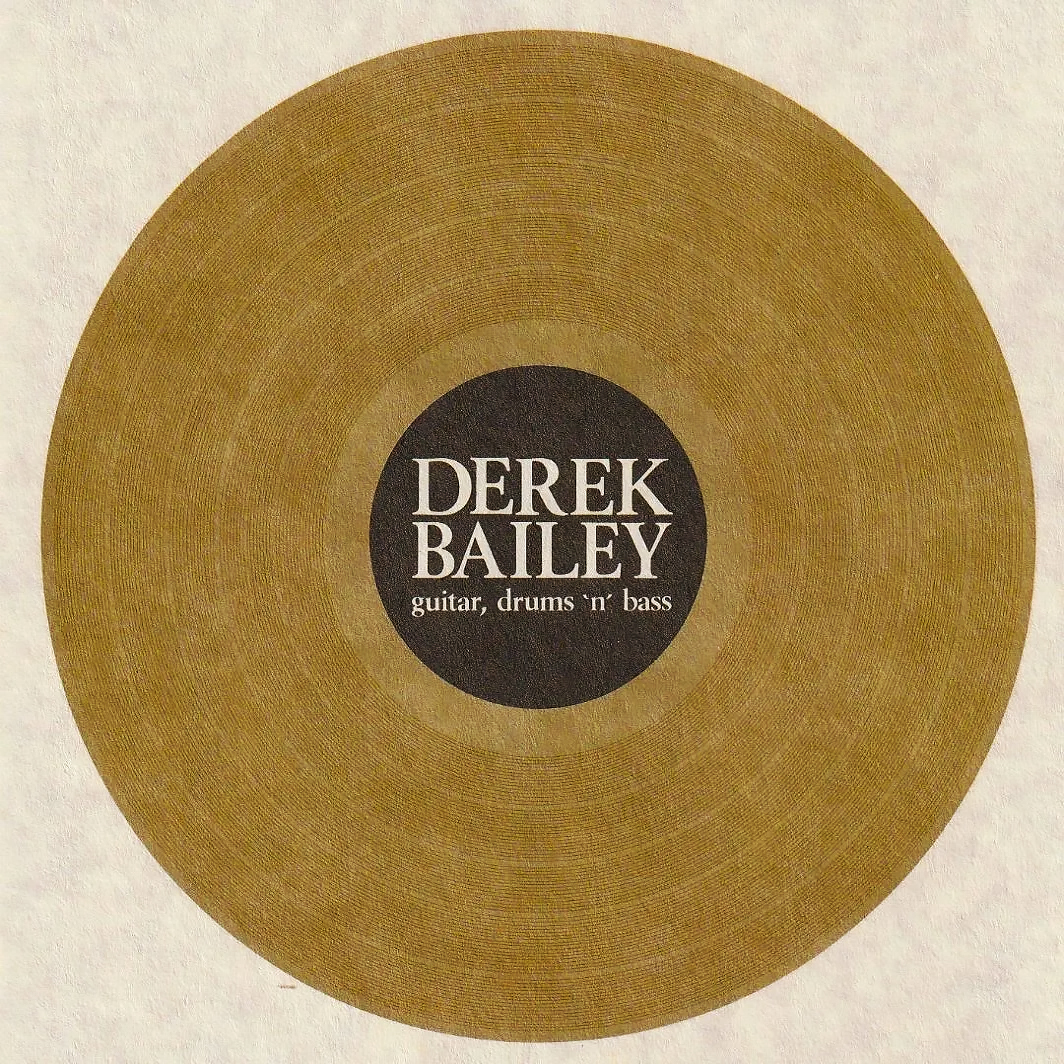
There, Bailey and Ninj made history. 1996’s Guitar, Drums ‘n’ Bass marked the first duet fusion of free improvisation guitar and breakbeat music ever released. And what a fusion—Guitar, Drums ‘n’ Bass is a hyper-kinetic, V2-fast thrill ride, and its six tracks are highly combustible musical laboratory experiments, every one of which works.
What we have here isn’t an album—it’s a volatile admixture of Ninj’s hyperactive minimalism and Bailey’s guitar pyrotechnics that explodes in your face.
Drums ‘n’ bass is a speed freak’s dream, characterized by Bonneville salt flats breakbeats, usually between 165–185 BPM. There isn’t a genre in creation that motorvates at that speed. And the heavy basslines and complex, syncopated drum patterns make it even sound even faster.
Then throw in the “accelerated jungle radio bootlegs” produced by Bailey’s defective tape recorder, which I’m assuming Ninj listened to while producing his own D&B, and what you have is a studio approximation of the arcade game World’s Fastest Drummer.
The genre’s sheer speed forced Bailey to up his game and play as fast as he could. And he came through, and nowhere does he do it better than on opener and stand-out track “N/JZ/BM” (Re-Mix). From Ninj’s scudding drum intro to Bailey’s ferocious response, the song never lets up.
As a writer for the New York Times wrote, “Mr. Bailey was not playing jazz, nor pretending to. He often referred to his work as ‘nonidiomatic improvising,’ meaning that it did not refer to any particular idiom or style.”
Another music critic wrote that Bailey’s playing “moved effortlessly from sheets of distortion to clear ringing chimes,” along with “unorthodox truncated licks.” Abrasive? I guess. But strangely disciplined as well—the jungle breakbeats form a kind of box that Bailey is forced to play in.
“Re-Re-Re (Up-Mix)” is more of the same, only slightly more restrained—the drums and bass aren’t quite as fast, and Bailey alternates single note picking and walls of flaming distortion.
The almost-fourteen-minute “DNJBB” (Cake-Mix) is a shocker—Ninj doesn’t set any land speed records at the beginning of the song, and even drops out occasionally to give Bailey brief moments in the solo spotlight. But Ninj finally kicks things into sixth gear, allowing Bailey the opportunity to do lots of single-finger picking and to shred sheets of notes into tiny pieces of confetti. And Ninj shows you how much you can do with drums ‘n’ bass, including total silence with rat-a-tat-tat drumming leading to frantic breakbeats.
“Concrete” (Cement-Mix) is also a mite slower (at least at the beginning). Bailey comes through with lots of sharply played single notes, brief walls of noise you run into face-first, and moments where he repeats a single note over and over. It’s a sheer joy, following his forays into the sonic possibilities of the electric guitar.
“Pie” (Amatosis-Mix) is a very short but action-packed thrill ride that makes me think of free jazz and features lots of drum stutter, Bailey’s short runs, and ringing guitar notes—a great intro to the collaboration’s genius.
“Ninj” (De-Mix) features a bit of cheating at the beginning—somebody threw some atmospheric synthesizer in there, unless Bailey’s bag of tracks is even bigger than I thought. Then Ninj comes in, which sounds like some distant relative of funk, and Bailey alternates a chiming guitar with some long and almost “normal” passages, passages that go in a straight line and aren’t interrupted by walls of dissonance. To me, this makes it the least interesting song on the album, although later the duo returns to business as usual.
Fusion has always been a dirty word to me—Weather Report and their ilk, to say nothing of Jeff Beck’s pair of fusion albums, have always made my gorge runneth over.
But Guitar, Drums ‘n’ Bass does what great fusion should do—produces a synergy that leaves you with music that is better than the sum of its parts. Each brings out the best in the other, and Guitar, Drums ‘n’ Bass creates something bold and new rather than dumbing down both genres. The album’s an adventure, and it’s a pity the duo never collaborated again. Instead, the ever-curious Bailey followed his muse in ever-new directions.
But then what do you expect from a guy who once collaborated with a tap dancer?
GRADED ON A CURVE:
A