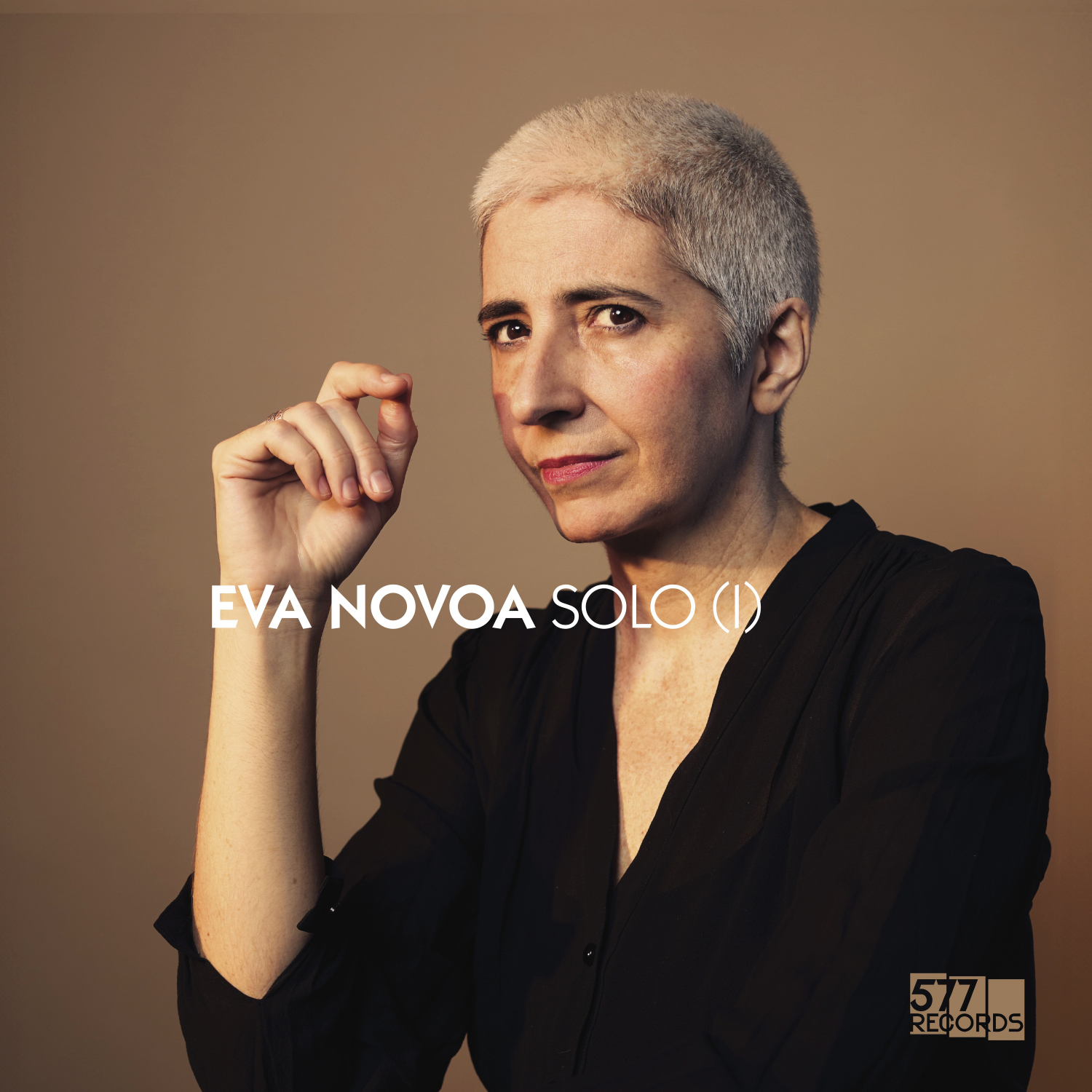
Born in Barcelona, Spain, and based in New York City since 2012, jazz pianist and composer Eva Novoa has excelled in quartets and trios, sometimes explicitly in the leadership role along with other more collectivist combinations. Her latest album, Solo (1), finds her stepping out on her own for the first time with superb results. Wide-ranging on piano and Fender Rhodes while bringing Chinese gongs and percussion into the scheme, Novoa also sings and whistles on what’s decidedly something other than a standard set of ivories tickling. It’s out now on vinyl, compact disc, and digital through 577 Records of Brooklyn, NYC.
Eva Novoa’s recording debut came in 2012 in a trio she led featuring bassist Masatoshi Kamaguchi and drummer Marc Lohr that recorded a CD for Fresh Sound New Talent. Lengthy at 12 tracks, the disc never runs out of creative steam, solidifying that Novoa has a firm handle on swing and is a dynamic improviser and communicator. Furthermore, it was immediately clear she was uninterested in falling back into the oft-predictable piano trio safety zone.
Novoa’s quartet albums for Fresh Sound are even more swinging, but they can wield an appealing inside-outside edge as the bands, like the trio, can turn up the heat, although there are still moments of considerable melodic beauty. To kick off her quartet run, Novoa’s first band with alto saxophonist Ernesto Aurigna, bassist Kamaguchi, and drummer Andre Sumelius cut a sweet CD in 2014.
Then came her Ditmas Quartet with altoist Michaël Attias, bassist Max Johnsion, and drummer Jeff Davis. They recorded a studio CD, Butterflies And Zebras By Ditmas Quartet, in 2016, and then the Live at IBeam CD in 2018. After that, she unveiled the Satellite Quartet with guitarist Rainer Davies, bassist Kenneth Jimenez, and drummer Arturo García. They released one CD in 2020.
Novoa’s move to the 577 label has resulted in a steady flow of releases that have found her navigating nearer to the heart of the contemporary avant-garde. There is a trio with bassist and synthesizer player Drew Gress and drummer Davis, captured in a 2019 session released in two volumes in ’24 and ’25.
There is a trio with Kamaguchi and drummer Gerald Cleaver from a 2020 session released in two volumes in ’23 and ’25, and there is a trio with multi-horn man Daniel Carter and drummer Francisco Mela from a 2021 session released in two volumes in ’24 and ’25. As of this writing, it appears that all but one of these releases have vinyl still available through the 577 Bandcamp.
All these progressions documented by 577 are surely valuable to understanding Novoa’s growth as a player, but Solo (1) is the deepest serving of pure Novoa thus far. It’s multifaceted, and it’s all her, even when opener “Left Behind” connects like a piano-percussion duo, similar to something Don Pullen and Milford Graves might’ve cut in the late 1960s. But there’s no footsteps following going on here, it all undeniably Novoa.
The breadth of the sounds is only heightened by Novoa’s focus on what she’s setting out to achieve. Frankly, rather than a solo piano (or keyboard) record, the album (the first of a planned three volumes) is better described simply as a solo record, though there is in fact nothing simple about it.
Solo (1) isn’t defined by complexity, however, but rather intensity and the aforementioned range. Novoa gets percussive on the piano’s body, gets inside the body to strum those strings, and vocalizes in “Dime Con Quién Tú Andas.” But she also plays those keys, including some wonderfully low plonks.
“Stilte Cabine” is spatially reminiscent of modern classical, but Novoa does get some nice jazzy runs in during the piece. “Just Say It” follows a comparable path but is more furious with the Taylor-ish note clusters. Then comes a big switch to Fender Rhodes in “Time Will Tell,” which certainly gives off a more 1970s Fusionoid vibe, but with a hint of Milt Buckner in the mix. That’s wild and cool.
The whistling comes in during closer “Tumbleweeds,” and if the title gives away the Western motif, it’s pretty swell how Novoa keeps those Morricone-isms in check. Solo (1) never runs out of steam, a reality that’s helped by the decision to keep the set to legit LP length (a continued label strategy). It whets the appetite for the upcoming volumes, in which Novoa will bring the harpsichord into the mix.
GRADED ON A CURVE:
A