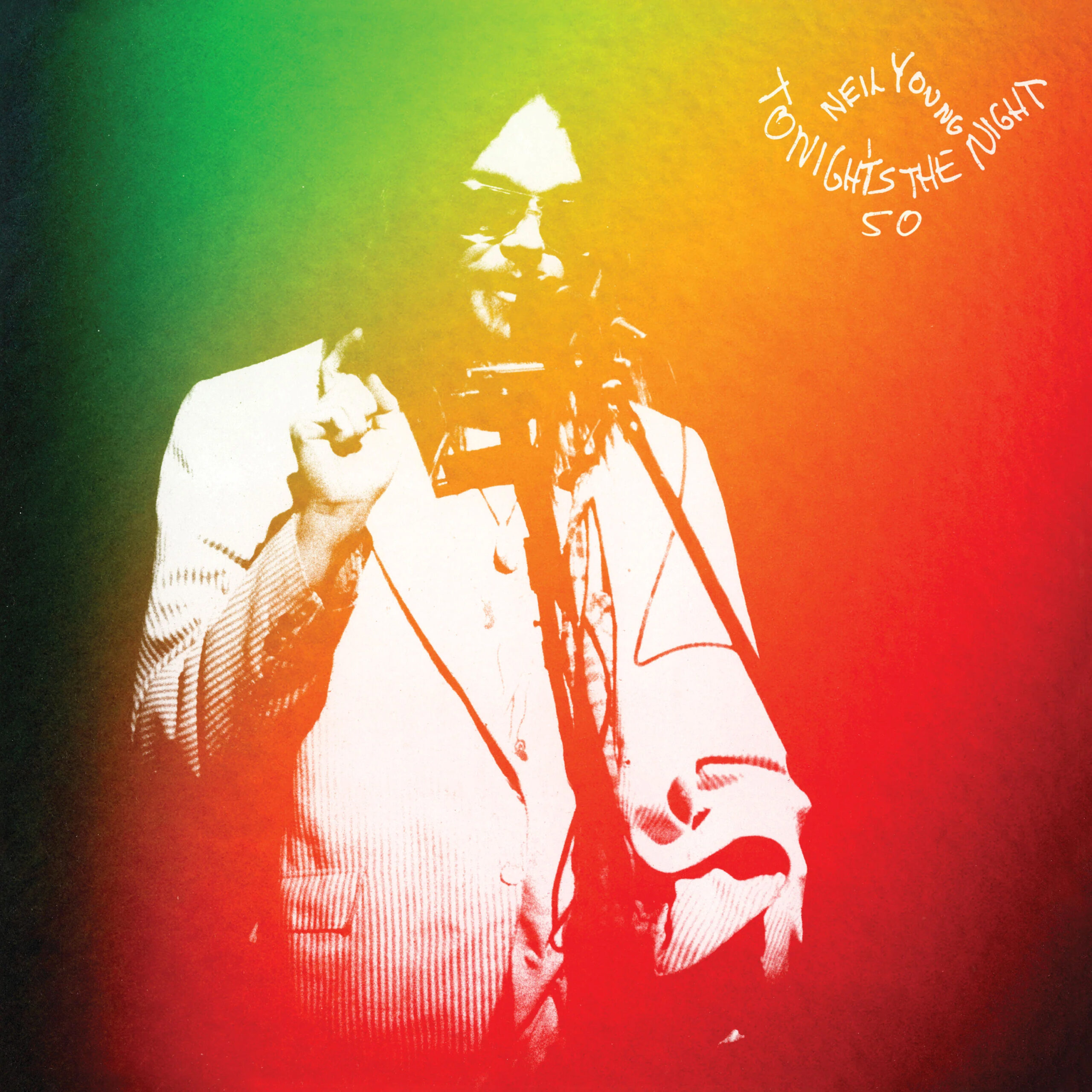
As indicated in the recent review published here on Neil Young’s latest studio album, for some time, Young has issued unreleased music from his bottomless archives, reissues of previous works, often in expanded and creatively packaged editions, and albums of all-new songs and recordings. There have been many releases from Young this year, and the one just coming out is a 2LP reissue of his 1975 album Tonight’s the Night, part of his Analog Originals, Neil Young Archives Official Release Series.
Tonight’s the Night may be one of the most groundbreaking, pivotal, and influential albums of Young’s canon. While fuzzy and organic first-take band-oriented cuts had populated Young’s previous albums, Tonight’s the Night was a stark, revealing album of raw simplicity. The music occasionally has a queasy frankness, particularly about the price of drug addiction, that was almost entirely absent in song lyrics during the drug culture music of the day.
This wasn’t just some “just-say-no” sloganeering. This was a man bearing his soul over the sudden loss of one of his bandmates and one of his roadies. The stark, unvarnished way Young sang of losing his bandmate Danny Whitten, fired by Young during rehearsals for the Time Fades Away tour because his drug problems affected his playing, and roadie Bruce Berry, was both brave and unsettling.
Notably, Berry was the brother of both Jan Berry of Jan and Dean and Ken Berry of S.I.R. Rehearsals, where nine of the album’s studio tracks were recorded (two were recorded at Young’s Broken Arrow ranch studio). Young had written about Whitten’s addiction and heroin’s effect on musicians in general on “The Needle and the Damage Done” on Harvest in 1972. How Young was able to hold it together on the title cut when plainly singing about losing those men is astonishing.
Young himself was uncertain about releasing the album. The album and one called Homegrown were completed, and Young had just released On the Beach, a far easier album to digest and one that was more in line with the kind of music Young had been making for years, and his fans expected from him. The album before On the Beach, Time Fades Away, together with On the Beach and Tonight’s the Night, have been referred to as Young’s “Ditch Trilogy.” These albums supposedly reflect Young’s apprehension and rejection of the fame brought about by being in the Buffalo Springfield and CSNY, culminating in the commercial success of Harvest.
Tonight’s the Night was recorded in 1973, after an aborted attempt to make another album with CSNY. The album came to be released when Young played a tape of Homegrown and Tonight’s the Night for Rick Danko of the Band. Danko contributed to On the Beach. He was taken aback by how moving Tonight’s the Night was, how different it was from what Young had done previously, and how it was a thunderbolt of sound compared to the laid-back, LA West Coast hippie music of the day.
While the release didn’t fare as well commercially as On the Beach (released in 1974) and didn’t have any tracks with considerable airplay like “Walk On” from On the Beach, astute, keen-eyed critics immediately knew they were hearing a pivotal album in Young’s evolution with music that most likely unconsciously hinted at not only the punk sound to come, but also alternative music in general, which was years away. In hindsight, it would also presage Young’s own Rust Never Sleeps, which was released in 1979 and is considered by many to be one of the best albums of the 1970s, as well as the prototype grunge album.
The finished album isn’t all pre-punk and darkness. Some of the music has a bluesy bar-band feel of a bunch of guys having a few shots of tequila, maybe sneaking a toke of some home-grown between sets, and, in the shadow of tragedy, finding solace, camaraderie, and hope in just playing some loud rock and roll for fun with friends. The earlier version of the album was much darker, and Young’s label didn’t like the album at all when he submitted it. The earlier version was altered, with Young doing further production, recording more songs, and changing the running order.
This is truly a band album with Whitten on one track (he had played on Young’s Everybody Knows This Is Nowhere, as part of Crazy Horse, and After the Gold Rush), fellow Crazy Horse members Billy Talbot and Ralph Molina, along with Ben Keith and Nils Lofgren, who had played with Young previously. Jack Nitzsche, Tim Drummond, Kenny Buttrey, and George Whitsell also contribute. Along with being part of Crazy Horse, some of the musicians here were also part of the Santa Monica Flyers, featuring Young (Keith, Lofgren), and the Stray Gators (Keith, Drummond, Butrey, Whitten), who played on Harvest and Time Fades Away.
After the title track sets the mood and loose lyrical theme of the album, “Speakin’ Out” introduces the bar-band piano blues feel of the group sound on the lighter musical numbers. “World On a String” has a fuzzy grunge-rock grit. “Borrowed Tune” is literally that, with Young borrowing the musical base of “Lady Jane” from the Rolling Stones. “Come On Baby Let’s Go Downtown” was written and sung by Whitten, and his ghostly presence here is chilling, as captured in a live performance at the Fillmore East from 1970, which was released on Live at the Fillmore East 1970 in 2006. “Mellow My Mind” closes side one with Young’s creaky voice evoking the wear and tear of life on the road.

“Roll Another Number (For the Road),” a wistful and on the surface playful ode to the ’60s generation, also confronts how drugs ravaged many from that time. “Albuquerque,” with Ben Keith’s beautiful pedal steel, is of a lyrical pair with “Mellow My Mind.” “New Mama” is about the birth of Young’s son Zeke with actress Carrie Snodgrass. “Lookout Joe,” about a Vietnam vet returning home, has a woozy blues sway and sets the stage for the mostly spoken-word “Tired Eyes,” yet another drug song—this one about a drug deal gone wrong.
The album closes with “Tonight’s the Night II,” a reprise and coda that offers no easy answers to the damage done to many of the real-life characters Young writes about on this album. While Young has brief moments of longing and fondness for the ’60s, this is an album about the ravaged bodies and casualties who barely survived and those who didn’t. At the time, Young’s contemporaries, those who were still left and still standing, were viewing the ’60s through rose-colored glasses, wrapped in a soft gauze of nostalgia and various substances to fend off the growing pains of aging, losing their idealistic hippie dream, and facing the hangover of that time.
This new 50th anniversary release features six additional tracks. Young had several sessions for this album spaced out over time, and some of these additional tracks have surfaced before. There’s a different, less polished version of “Walk On,” a song that received considerable airplay from On the Beach. The rollicking “Wonderin’” would surface in a different version of 1983’s Everybody’s Rockin’. “Everybody’s Alone” would receive the complete Crazy Horse treatment and appear on Archives, Vol. 2.
Joni Mitchell dropped in at the S.I.R. sessions and played “Raised On Robbery,” from Court and Spark, with Young and his band. For years, Young wanted to release it, but Mitchell balked. It finally appeared on Young’s Archive, Vol. 2, in 2020. Like Young’s “Borrowed Tune,” Mitchell also evoked the Stones, nicking the hooky riff from “Honky Tonk Woman.” The album closes with early versions of “Speakin’ Out” and the title cut, making for the inclusion of three versions of the title cut on this set. There is no music on the fourth side, just an etching of Young’s silhouette from the original album cover.
The vinyl version of this new release, which is the best way to experience this album, was mastered from the original analog tapes, with the album’s original funereal black labels faithfully duplicated. As stated before, it’s a shame that so many musicians don’t release vinyl album versions of their past albums and even new releases in all-analog format. All of the inserts that came with the original album have been faithfully reproduced and are included here in the gatefold.
In 2018, Young released Roxy: Tonight’s the Night Live, on CD and a three-LP vinyl edition. It was from a concert to celebrate the opening of the venue, with Young’s band consisting of Keith, Lofgren, Talbot, and Molina. It is the perfect companion to this reissue. It was also included in the Archives, Vol. 2, in 2020. Playing that album and then this reissue will make for an unforgettable late-night listening experience at home. The photo on the cover of Tonight’s the Night is from the Roxy gig, and a similar image is on the cover of the Roxy release. The new reissue features an orange tint, contrasting with the stark black-and-white cover of the original.
Summing up this album and reissue in one article is nearly impossible. An entire book, movie, or both would better serve this historic release. This is music that gets under your skin. It might scare the hell out of you, but unlike much of today’s music on the charts, it will make you really feel. In a career of transcendent, classic, historic, and uncompromising albums, this one gets better with every listen. This is an album for every night of the year.
GRADED ON A CURVE:
A+