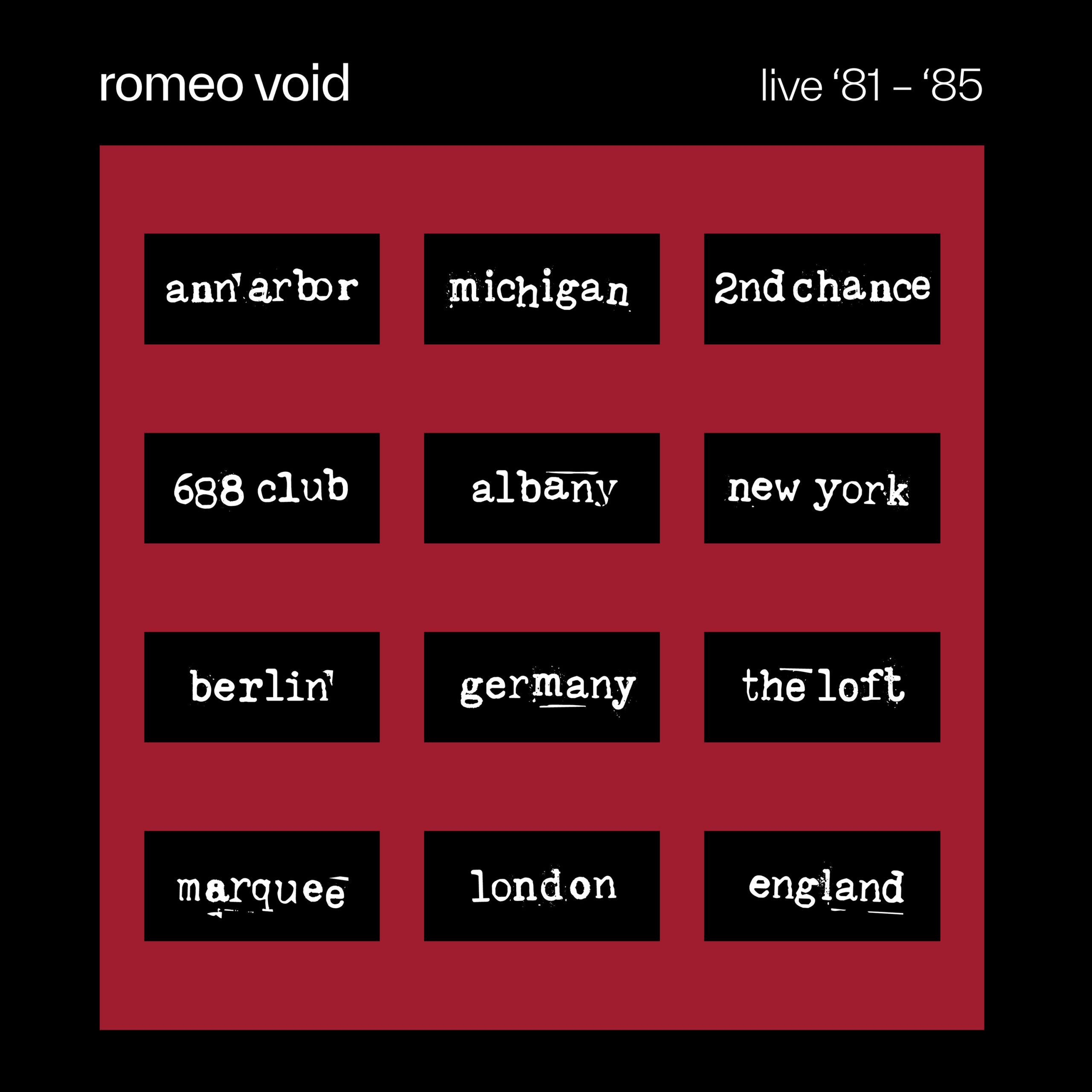
This year’s springtime Record Store Day reissue resurgence continues with two solid ones from the Liberation Hall label, a performance collection from San Francisco-based new wavers Romeo Void, Live ’81-’85, and an odds-and-ends set from the Los Angelino kings of Americana, The Blasters, Rare Blasts: Studio Outtakes and Movie Music 1979-1985. Both albums are worthy additions to any shelf documenting rock music’s transitions in the early 1980s. Both records are hitting the bins on vinyl in limited editions, but are also available on compact disc and digital.
It seems fair to say that when considering the edgier, sturdier side of the new wave spectrum, Romeo Void, if not wholly overlooked, haven’t received enough retrospective acclaim for the tough smarts of their sound. Extant from 1979–’85, the band cut three full-length albums, an EP, and a handful of singles during that stretch. Starting on indie 415 Records, Romeo Void made the move to Columbia and stands as one of the few instances where the switch to a major label wasn’t a botch job.
Back in 2023, Liberation Hall unveiled Romeo Void’s Live from Mabuhay Gardens, a very cool set that caught the band at an early stage, specifically on November 14, 1980. Eight of Mabuhay Gardens’ eleven tracks were recut in the studio for the debut album, It’s a Condition, but neither of Romeo Void’s best-known songs was part of the setlist on that evening.
That makes Live ’81–’85 very necessary. It holds not only “Never Say Never” and “A Girl in Trouble (Is a Temporary Thing),” their most celebrated tunes (the latter even climbed into the Billboard Top 40), but also a cross-section of material from their discography. What’s sweet is that the band is in sharp form throughout, from vocalist Deborah Iyall to guitarist Peter Woods to the rhythm section of bassist Frank Zincavage and drummers Frank Carter (on the ’81–’82 material) and Aaron Smith (on the stuff cut in Europe in ’85).
There’s also saxophonist Benjamin Bossi to consider. Sax playing in a rock context, particularly of an ’80s vintage, is regularly a weak link or even the ruining factor. An exception is post-punk, where horns often expanded into wildness comparable to the intensities of free jazz. Bossi can hint at these outer territories, but mostly he’s just a robust blower rather than a flowery adorner, and that’s appreciated.
Also consistently of value is the bold, scratchy, dancy, and attractively hefty thrust of Romeo Void’s approach, which hits that zone betwixt non-flash-in-the-pan new wave and the vivid horizons of that post-punk impulse. One descriptor that didn’t fit Romeo Void was rootsy, which is where The Blasters were coming from, inhabiting another plane of the new wave’s early ’80s unfurling.

The Blasters, namely Phil Alvin on vocals, guitar and harmonica, Dave Alvin on lead guitar, John Bazz on bass, and Bill Bateman on drums, with Gene Taylor on keyboards and Lee Allen and Steve Berlin on saxophones, tackled and sometimes blended the genres of rhythm & blues, country & western, straight up blues, rockabilly, and related strains of early pre-sophisto rock & roll.
For an observer unfamiliar with the lay of the musical land in the early 1980s, The Blasters’ approach might seem like a reaction against the new wave, but the band played with such lean verve that they appealed to and were indeed connected to the rootsier side of the Los Angeles punk scene; that’s X, The Flesh Eaters, and Gun Club, all bands, like The Blasters, signed to Slash Records.
Of course, occasional comparisons to the Stray Cats still sometimes crop up, but that’s not very astute, as The Blasters were ultimately defined by their range (being proto-Americana) and the Stray Cats were limited by the confines of neo-rockabilly. Interestingly, it was The Blasters who played with cornerstone rockabilly cat Carl Perkins, an association they shared with another foundational band in the Americana scheme, NRBQ.
There’s nothing unreleased on Rare Blasts: Studio Outtakes and Movie Music 1979-1985, but for anybody who’s been curious into what The Blasters were up to but were hesitant to drop the considerable scratch needed to take home the box set An American Music Story: The Complete Recordings 1979–1985, this single LP culled from the box serves as a fine introduction. The actual albums The Blasters cut, and in particular the self-titled Slash debut, might cohere a bit more as listening experiences, but nothing this band ever did was second-rate.
GRADED ON A CURVE:
Romeo Void, Live ’81-’85
A-
The Blasters, Rare Blasts: Studio Outtakes and Movie Music 1979-1985
A-