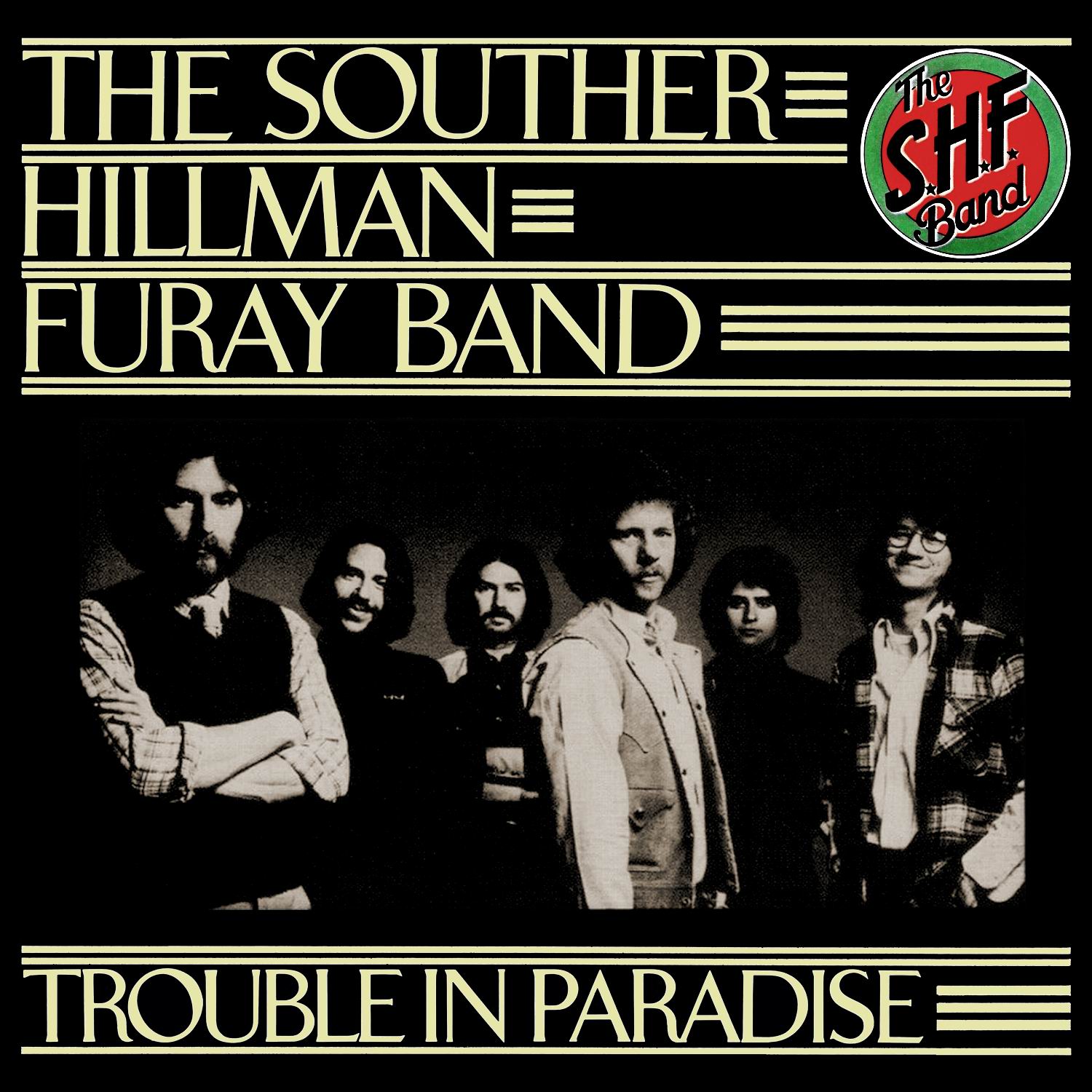
Call them Geffen’s Folly. It was Asylum Records head honcho David Geffen who came up with the misguided idea of taking three of the less successful solo artists on his label and turning them into a Crosby, Stills, Nash & Young supergroup. The results of his miscalculation were two failed albums, in part because the combined forces of J.D. Souther, Richie Furay, and Chris Hillman did not a supergroup make.
Their 1974 eponymous debut didn’t exactly change the world, and led Barney Hoskyns, the author of 2006’s Hotel California, to write, “…nothing could describe the blandness of the songs; this was lifeless country pop shading into homogenous album-oriented rock.” And Hillman to quip, “Our debut actually shipped gold and probably came back gold in return.”
But Souther-Hillman-Furay Band’s 1974 debut was a stunning work of incomparable greatness compared to the Superfund Clean-Up Site that was their sophomore LP, 1975’s aptly titled Trouble in Paradise.
This buyer-retardant led Robert Christgau to quip, “…this band usually goes by its initials because they stand for Shit Hits the Fan. Or do I mean Fans?” And inspired Rolling Stone scribe Bud Scoppa to write, “Why don’t SHF redeem themselves while they still can and just forget the whole thing?” Fortunately, they did.
After the band had come tumbling down and the dust had settled, Geffen himself said, “A lot of the problems came from the fact that [SHF as supergroup] was a figment of my imagination.”
One of those problems was that Souther, infamous Eagles sycophant and co-writer of more than a dozen of their songs including the immortal “Teenage Jail,” had a sneering contempt for former Poco vocalist/guitarist Richie Furay. On one memorable occasion, J.D. refused to get out of bed and go to the studio with the words, “Fuck him! I ain’t singing on his song!”
For his part, Furay said, “Why did I leave Poco? For this?” Hillman watched from the sidelines, probably wondering how he’d gone from superstardom with The Byrds and a stint with the Flying Burrito Brothers to a job shoveling elephant shit for a flea-bitten country rock circus.
But the biggest problem lay with the songs—the guys could sing, play, and probably even dance, but they couldn’t write a decent song to save their collective grandfather from being executed via livestream.
It speaks volumes that there isn’t a single collaboration on the album. The Eagles achieved greatness by sitting down and writing songs together. Theirs was a team effort. SHF didn’t want to be in the same room together, and no way were they going to let somebody else touch one of their precious solo contributions.
The results are just what you’d expect. Trouble in Paradise sounds like a conglomeration of the parts of three solo albums—there’s nothing organic about it. Supergroups become supergroups through collaboration and musical synergy. Trouble in Paradise is a cautionary case of musical onanism by three guys who were anything but songwriting geniuses.
Look at the evidence. The only immortal song Hillman contributed to The Byrds was “So You Want to Be a Rock ‘n’ Roll Star,” which he co-wrote with Jim McGuinn. Furay contributed the greats “A Good Feelin’ to Know” and “Pickin’ Up the Pieces” to Poco, which makes him the best of the three but doesn’t make him Bob Dylan. And the only J.D. Souther song I’ve ever been able to stomach is the doo wop/Roy Orbison/Eagles hybrid “You’re Only Lonely.”
Not surprisingly, SHF’s downfall was their inability to write a single good song. And by that I mean zilch. Not only did Trouble in Paradise lack a single, suck-you-in insta-hit on it, but it also didn’t boast a single song that reached the pop charts. Hillman’s “Follow Me Through” is as close as they came to conjuring up the ghost of charisma, and it amounts to an Eagles reject redeemed only by some fancy playing.
Turgid, take-no-chances bland—that’s Trouble in Paradise summed up in five words. The trio (and hired hands) sound like they’re going through the motions—which would have made for the perfect album title—from Souther’s opener “Trouble in Paradise,” whose only bright spots are its lively melody and Paul Harris’ honky tonk piano. It’s forgettable, but at least has a pulse. Hillman’s “Move Me Real Slow” also has a heartbeat and some forward momentum, but it’s second-rate to the extent that the only thing that puts color in its cheeks is Harris’ piano.
Furay’s “For Someone I Love” is dreck in the form of a spiritless MOR ballad, with some good country-rock singing undermined by the song’s lack of a melody and some overly bright keyboards—bad Harris, bad! It’s third-rate Eagles, at best.
Souther’s “Mexico” features a cliché of a South of the Border mandolin and not much else. Hillman’s “Love and Satisfy” doesn’t satisfy; that is, basically it’s some lively piano and guitar in search of a song.
Furay’s “On the Line” is a Poco song brightened somewhat by Richie’s trademark vocals, some nice harmony vocals and a perfectly adequate organ solo—the problem is I can’t hear it without thinking Loggins & Messina. Which makes the hairs on the back of my neck stand up. Souther’s “Prisoner in Disguise” is a completely forgettable ballad that I’ll bet you any money Souther tried to shop to the Eagles, who said, “Nice, J.D., nice. Now get out of our Learjet.”
Hillman’s “Follow Me Through” is a mid-tempo faux rocker with a jazzy organ solo, followed by a rock-and-roller of a guitar solo, and a real humdinger of an instrumental breakdown as the song goes out. But once again all the fancy playing is wasted by the absence of a solid song. Still, if I were forced at gunpoint to listen to a song on Trouble on Paradise again, it would be this one.
As for the Souther closer “Somebody Must Be Wrong,” it’s a homely wallflower of a ballad nobody’s ever going to ask to dance. You get more overly bright keyboards, and its only positive attribute is the way Souther muscles his way through the choruses. Inspirational lines: “You see the rings on your finger would be turned into dirt/And the smile beginning to hurt.” The guy’s a real poet.
The Souther-Hillman-Furay Band was a terrible idea that spawned terrible songs, and what really terrifies me is that there’s probably someone out there listening to it at this very moment and enjoying it. I would much, much sooner listen to Longbranch Pennywhistle, and that’s scary. The only positive thing to be said about Geffen’s Folly is they never made another album.
One album I get. Two albums constituted sadism. Three may well have marked the end of Western Civilization. David Geffen called the Souther-Hillman-Furay Band a figment of his imagination. But they were real, David, they were very, very real. And they hurt innocent people. They hurt me. SHF weren’t a band. They were a thought crime.
GRADED ON A CURVE:
D-