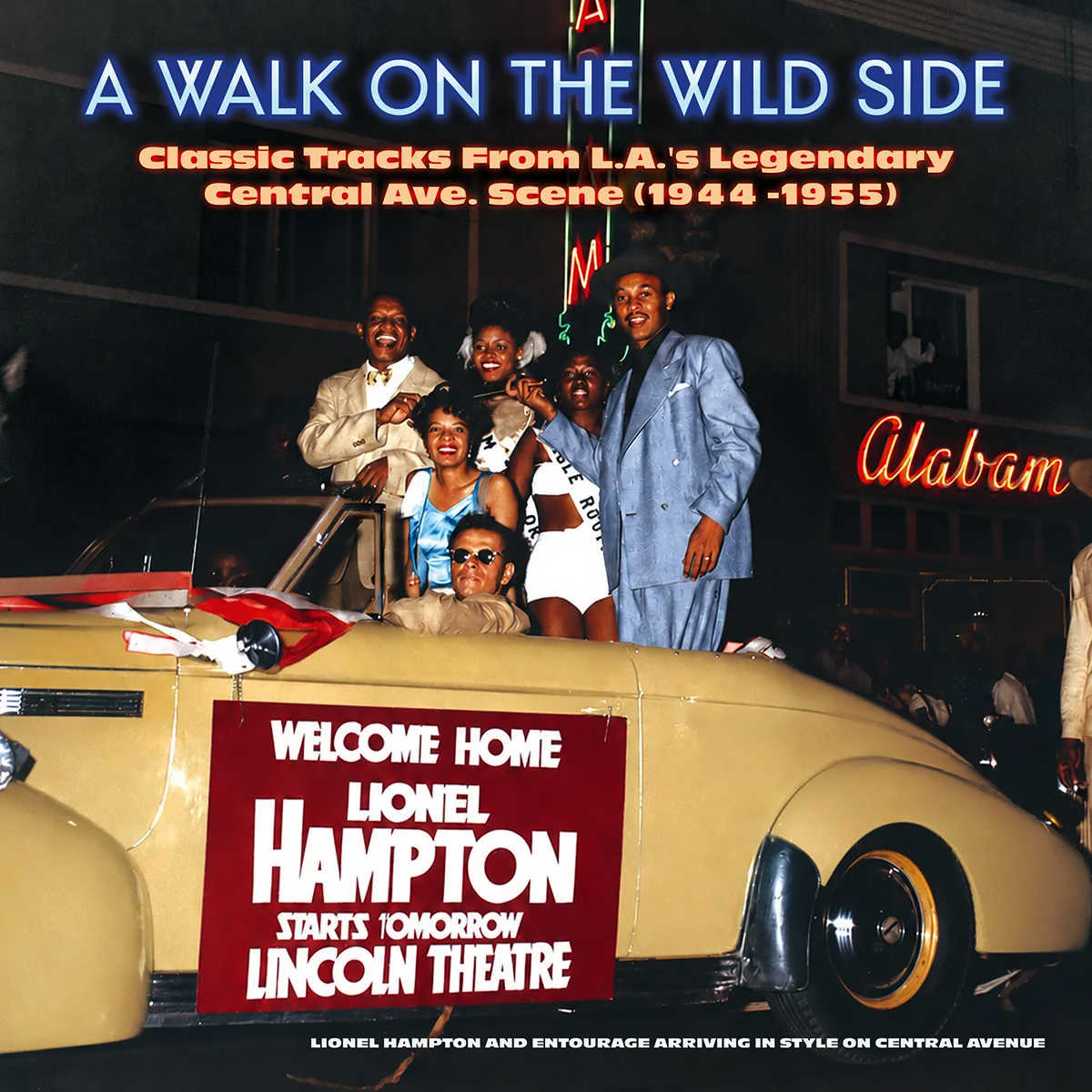
Like many historical compilations, A Walk on the Wild Side: Classic Tracks From L.A.’s Legendary Central Ave. Scene (1944-1955) delivers a succinct soundtrack to a delineated time and place, with the specifics outlined right there in the album’s title. It’s a wild, grooving, wailing, bluesy, jazzy, proto-rock & rolling ride, and one can only hope it’s the first of multiple volumes spotlighting the sounds associated with this fertile historical locale. It’s out now on LP from Shanachie Records.
It’s taken decades to change the perception of the 1950s as an utterly square decade saved from sustained conformist tedium by a gang of majestic African American groundbreakers and the Caucasian wildcats inspired by what they found by defying the color line: Chuck Berry, Jerry Lee Lewis, Little Richard, Gene Vincent, Fats Domino, Buddy Holly, Bo Diddley, Carl Perkins, and yes indeed, Elvis Presley.
Doo wop’s harmonic wizardry and a bunch of one-shot rockabilly maniacs serve to underscore the belief that there occurred at mid-decade a musical Big Bang of sorts. The reality is that all music is built upon precedent. A Walk on the Wild Side is an exquisite dive into the Great Black Music captured on shellac and vinyl by numerous enterprising labels and sold in shops in the South Central district of Los Angeles.
Side one kicks off with the honking and bar-walking proto-R&R of Big Jay McNeely’s “The Deacon’s Hop,” an instrumental cut for Savoy that topped the R&B chart in 1949. McNeely was noted and captured in photographs as a performance showman, but the sound of the man and his band (with trombonist Britt Woodman subbing for baritone saxophonist brother Bob McNeely) has lost none of its potency on record.
“Thrill Me” by Roy Milton and His Solid Senders with Camille Howard on vocals offers an unfiltered dose of jump blues circa 1947. Sophisto-tinged with a robust, bluesy, swinging foundation and just a hint of the gutbucket, the band is firing on all cylinders, and Howard’s singing is a delight.
Next comes the great if undersung tenor saxophonist Wardell Gray with “Sweet & Lovely” from 1952, a full-on, richly blown jazz experience that includes Hampton Hawes on piano and Art Farmer on trumpet. It’s Gray’s team-ups with Dexter Gordon (“The Chase,” “The Hunt”) that are most frequently anthologized, so it’s a treat to soak up this ballad standard as part of the album’s sequence.
Jimmy Witherspoon cut “Ain’t Nobody’s Business” a whole bunch of times. It can be fairly called his signature song. Witherspoon’s initial recording from 1949 for the Supreme label (the top-selling R&B release of that year) is likely the best. The man is in perfect voice, the band is totally locked in, and it’s easy to understand why everybody needed a copy of this one.
Joe Liggins and His Honeydrippers were a pretty huge jump blues deal, scoring a slew of hits, with the majestically sauntering “Pink Champagne” holding the top R&B spot for 13 weeks in 1950, and it wasn’t even the band’s biggest hit. Side one of A Walk on the Wild Side concludes with a full immersion into the blues, Pee Wee Crayton’s “Blues After Hours,” an utter gem that always sounds best at 2 a.m. (or later).
The aforementioned Dexter Gordon opens side two with “Mischievous Lady,” another uncut dose of jazz from the early bebop era, recorded in 1947 for Dial Records. Today, Gordon is often celebrated for his comeback records for Blue Note, Prestige, and Columbia, but his ’40s stuff (like this side) is indispensable.
Chuck Thompson plays drums on “Mischievous Lady,” and he’s also in the band of Charles Mingus (Baron Mingus and His Rhythm) for a 1948 version of “These Foolish Things,” the bass way up front (cool) and with Buddy Collette on reeds and Jimmy Bunn on drums (also cool). Collette has a track of his own here, the ballad “It’s April,” cut in 1949 at Dolphin Studios.
Vocalist Helen Humes is sequenced between Mingus and Collette with the brightly hued “All I Ask is Your Love,” from 1955, sounding like something that could’ve been cut for Atlantic during the same period (it was actually waxed for Dootone). For the home stretch, it’s Percy Mayfield’s smooth and deep “How Wrong Can a Good Man Be,” taking it back to 1949, originally recorded for the Supreme label.
The close of side two is a beauty, Cecil Gant’s oft-covered “I Wonder,” just vocals and piano, another late-night jewel from the beginning of this set’s timeframe, 1944, cut for the Bronze label. It’s a fine track to sit and ponder after it plays, and A Walk on the Wild Side is the sort of comp that gets played dozens of times.
GRADED ON A CURVE:
A