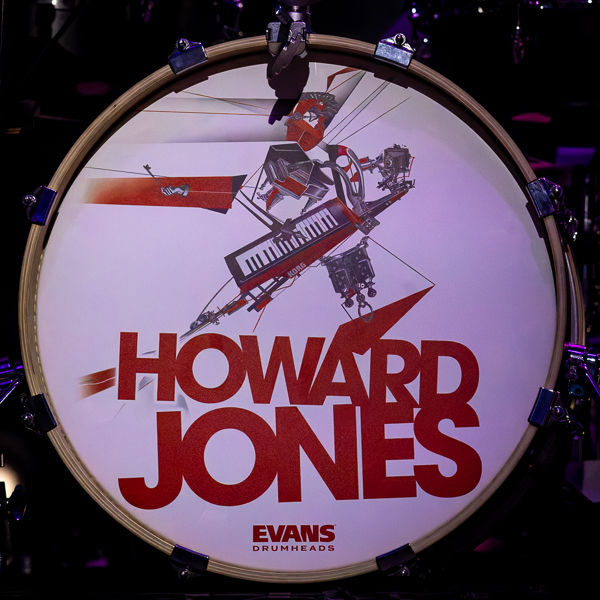

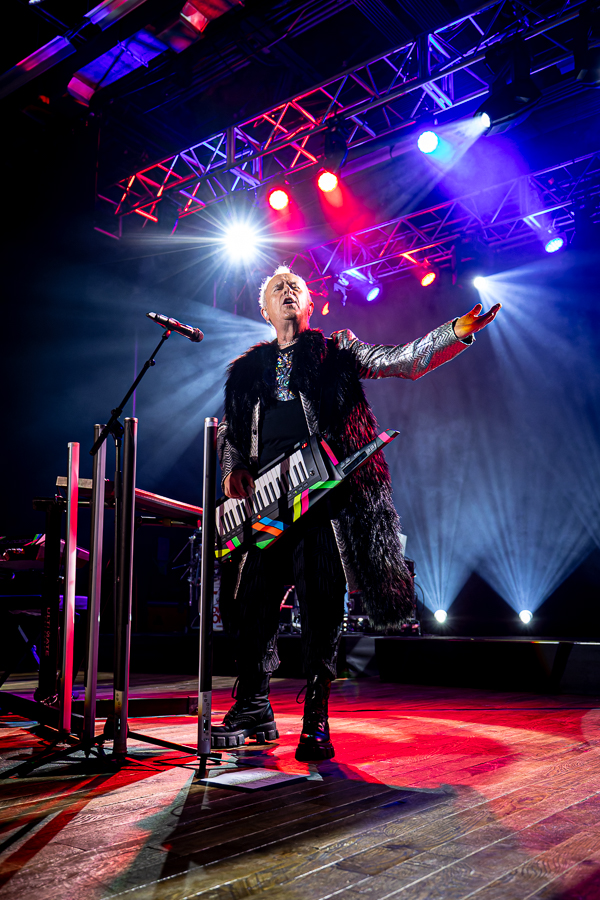
PHOTOS: MATTHEW BELTER | The first time I heard Howard Jones, I was a kid sitting too close to a stereo speaker, trying to figure out how a single guy with a stack of synthesizers could sound so big. The second time mattered more. April 28, 1992. The Variety Arts Theater in Los Angeles was one of my first dates with my future wife. He walked out with nothing but a piano and Carol Steele on percussion, and over the course of one evening, he quietly dismantled every lazy assumption the world had ever made about “synth-pop.”
The songs didn’t need the machines. They never had. Listening to that show—which would later become Live Acoustic America—I understood, maybe for the first time, that what I’d loved about Howard’s records all along was his songwriting. The keyboards were just the delivery vehicle.
That memory is why this conversation felt particularly good to have. Howard is heading back out across North America this summer with the Things Can Only Get Better tour—twenty-one dates kicking off July 19 in Napa and rolling east through August—and for the first time, he’s curated the bill himself.
Wang Chung, The English Beat, and Modern English are riding shotgun. Richard Blade is hosting. Four British acts who came up together in the early ’80s, finally on the same buses, in the same backstage hallways, on the same stages—full sets, no second-tier slots, no “opening act” treatment. It is, by Howard’s own description, his mini-festival. And it is exactly the sort of bill that anyone who wore out the grooves of Human’s Lib in 1984 would have drawn up on a napkin and quietly tucked away as a fantasy.
What struck me most, talking to him from his studio across the Atlantic, was how little distance there is between the man on the records and the man on the phone. He is unhurried, generous with his answers, and openly Buddhist about the work—he chants every day, he says, that he’ll go out there and really see every person in the room.
He talks about kindness the way other artists talk about chord changes. He’s also, I’m delighted to report, a full convert to vinyl, engaged with the Voices Around the World project for schools, and—if I have anything to say about it—now officially on the hook to finally press Live Acoustic America on wax. He said he’ll talk to Cherry Red. I’m holding him to it.
Howard, how’d you get your start in music?
Well, I come from a musical family, really. Not professional but just embedded in music. My parents were Welsh, so they both sang. When we visited our relatives—uncles, aunts, grandmothers, and grandfathers—we were expected to either sing a song or play something at the piano. My parents used to sing duets together at home, so music was always part of my life.
When I started learning the piano at seven, I listened to the radio and to all the artists from the ’60s. It was just music all the time. I knew right early on, around nine years old, that that’s what I wanted to do. I wanted to be involved in pop music, be on the radio, write songs, and make records. So that goes right back to the beginning.
You broke through in ’83 with “New Song” at a moment when the synthesizer was still a divisive instrument in pop—who were the artists, classical or otherwise, that convinced you those keyboards belonged at the front of a song instead of buried in the mix?
It’s a good question. I was a huge fan of Keith Emerson, from the days of his first band, The Nice, and then obviously Emerson, Lake and Palmer. But at the same time, I was a massive fan of Stevie Wonder—completely different keyboard style. Both were very interested in technology and in using new sounds in their records.
I studied at music college in Manchester but came home halfway through my course because I wanted to get on with my own music, and there was no one around who I wanted to play with. I came up with this idea of the one-man electronic band—synths and drum machines, playing lots of different instruments at the same time and singing as well. I think that’s how I really put the keyboards at the forefront. I realized you could be the front man and the keyboard player, which both of those guys were. So, Stevie and Keith were the biggest inspirations for me.
Human’s Lib hit #1 in the UK in ’84, and Dream Into Action went Top Ten Platinum in the States the following year. When that level of success arrives that quickly, what’s the part of it that nobody warns you about?
I guess you think, oh well, I’m just going to play my music, things will be a bit bigger, I’ll be playing in bigger places. What you don’t realize is that it’s the end of a normal life. I lived in a place called High Wycombe, in a tiny house where my little studio setup was in the front room. After I’d done that first TV appearance on Top of the Pops, every time I went out, I got chased by young people. That’s a pretty dramatic change to happen overnight, and it took a bit of adjustment.
I’m a music guy. I play and sing—I’m not a celebrity. It’s all about the music to me, so that was a bit of a shock. But I had to adapt to it, and of course, I’m so grateful that people like the music so much that they want to chase me. I’m not complaining. It just took some adjustment.
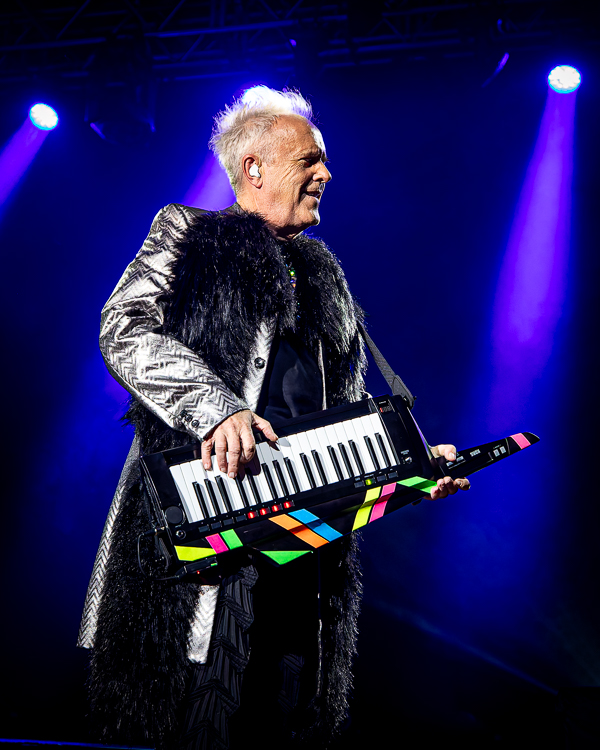
This is your first ever curated package tour, and you’ve said you dreamed of putting something like this together with your favorite bands. Walk me through the moment you knew “Things Can Only Get Better” was the right banner to hang over the whole summer—was there a single conversation, a phone call, a setlist scribble, that made the dream feel real?
I’d always wanted to have my own mini festival and really give a platform to other bands—for them to be looked after on the tour and not seen as a secondary thing. Everyone’s traveling together, and everyone is respected regardless of where they sit on the bill.
At this moment, when everyone’s having so many struggles—the cost of living, what’s going on in the world, things are quite extreme—I wanted a tour where people can have a feeling of hopefulness, even though things are tough. I wanted them to realize the power of their own lives and the power of their own behavior toward each other. The way we behave toward each other is so important.
That’s why I wanted to call it the “Things Can Only Get Better” tour—it’s a hopeful thing. Hopefully the whole show gives people a boost, and they can go back to the difficult sides of life with renewed energy. That’s basically the motivation for this tour.
You’ve known Jack and Nick from Wang Chung since the ’80s but never properly toured together. When you’re sharing a bill with The English Beat, Modern English, and Richard Blade hosting—four British acts swapping war stories backstage every night—what’s the conversation you’re most looking forward to having that you could never have on a phone or a Zoom?
It’s just regular things—how’s the family doing, where are you living now, how’s your life. It’s a chance to really connect with people on a personal level. When you travel with everyone, it’s one of the things I love. I always travel with the band on the bus, with the crew as well. It’s a unique experience: you’re all traveling together, living together, and then doing a show in the evening. I personally love that. I don’t want to be separated from my team, and that’s the attitude I’m going to have with the whole mini festival.
You framed the tour as “a message of hope for a future that we can create.” How do you keep a feel-good summer pop tour from feeling escapist when the world outside the venue is doing what it’s currently doing? Is there a responsibility there, or is the joy itself the point?
It’s both things. It’s a joy to do it, but also, as I was saying, we all need a boost in these times. The thing about a gig is that everyone gets together in the same space and shares the same experience—it’s a unique thing. Even with sport, you’re on one team or the other; at a gig, everyone’s on the same team.
For me, it reminds us that we have power over our own personal lives—with our family, with our friends, with our community. We may not be able to affect the big picture, but we can affect what’s going on in our community, on our street, in our family. I’m always encouraging people to have that attitude: double down on being kind, double down on being respectful. That’s the way we change things permanently—on that micro level.
Modern English’s Robbie Grey said “every night will be a top night.” What’s your version of that promise—what does a successful night on this tour actually feel like from where you’re standing onstage?
It’s really having the intention to connect with the audience—to connect with every single person in the room. The people right at the front, the people right at the back. I want to make everyone feel valued from the stage.
I’m a Buddhist, and I chant for those things every day—that I’ll go out there and really do it. People have paid a lot of money, traveled a long way, made a huge effort to be at that show. It’s up to me to be respectful of that and to embrace every single person who’s come. That’s the way I go about it.
Human’s Lib and Dream Into Action were vinyl-first records made for vinyl-first ears. When you listen to those albums on a turntable today versus on a streaming service, what do you actually hear that gets lost in translation?
Now, everything I release comes out on vinyl as well. I’m definitely a vinyl convert. I went through a period where I thought, why do people want vinyl? It’s an old format. But when we started putting my work out on vinyl again, you realize how enjoyable it is to physically connect with the music—put it on the turntable and play it.
It’s got a wonderful sound that your ears really like. I don’t know what’s going on physics-wise, but it’s not a harsh experience to hear vinyl. Because it’s so analog, your ears really enjoy it. There are four or five tracks on one side, four or five on the other, and you get a break to digest the first half before you flip it over. The whole physicality of it is wonderful. And you get the artwork, nice and big, you can read the credits, see who’s on the album. There are so many things that are great about it, and I totally get it now.
I love the fact that people—and especially young people—are really taking it on board. They want to have this wonderful physical thing called vinyl.
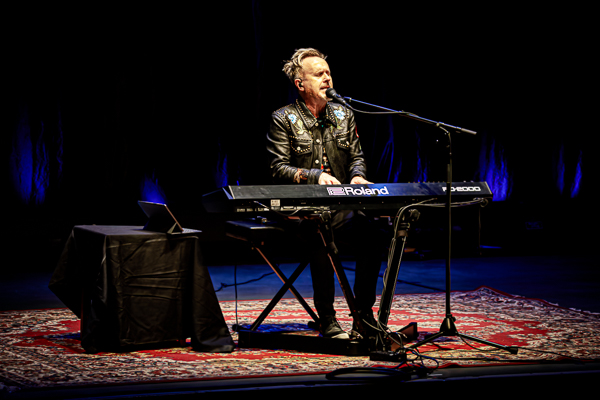
Live Acoustic America, recorded at the Variety Arts Theater in LA on April 28th, 1992, just you at the piano with Carol Steele on percussion, is hands-down my favorite live performance of all-time. I was fortunate to be there for this once in a lifetime show. You stripped a catalog the world had filed under “synth-pop” down to wood, wire, and voice, and the songs more than held up—they bloomed. What do you remember about that night, and did taking the machines away change how you heard your own material afterward? Why was this never released on vinyl?
On the first part of your question: it was really great for me to strip the songs back to just piano and percussion, because then you get to the real essence of the song. Does it work when you take away all the fancy synths and the production values? Does it still work? I found out during that tour that they do work like that. It’s a different experience hearing the songs that way.
What you’re making me think now is that I really should do something like that again at some point, because it was very enjoyable. I really enjoyed working with Carol Steele—she’s such a wonderful person to have around. It was a great way of reimagining the songs, and I’m so glad I did it. But you’ve just reminded me that we really should do a vinyl release of that. I’ll talk to Cherry Red about doing it.
What’s a record in your personal collection—could be one you played to death as a kid, could be something you stumbled on last week—that you’d want a TVD reader to pull off the shelf tonight?
Well, I’m just looking at my pile of vinyl here in the studio. Obviously, I’ve got my own records, but people have bought me some presents recently. Let me see what I’ve got here. Oh, I’ll tell you what I played today—the self-titled Blood, Sweat and Tears album circa 1968. I loved playing that and played it for ages and ages. That was great.
I’ve also got three albums here that someone gave me for my birthday. They’re vintage, and they’re all by The Nice, the band Keith Emerson was part of. There’s Elegy, and there’s an album just called Nice—that one says autumn ’67 to spring ’68. And then there’s Five Bridges, which Keith wrote to celebrate the five bridges crossing the Tyne in Newcastle. I haven’t had a chance to listen to them properly yet, but they’re next on my list. I’m going to really enjoy them.
You’ve sold 10 million-plus records, but you’re also one of the few artists from that era still actively making new music while touring the hits. How do you keep the new songs honest when the audience came for the old ones?
It’s a difficult balancing act. I know people love to hear the big songs—the ones I’m known for, the ones that made it on the radio. But for me, it’s really important to play some of the more recent songs as well.
What I do is give the older stuff a bit of a facelift regularly to bring it into line with the way I hear music now. And then I slip in a few songs that people may not know—like “The One to Love You,” which I did with BT, and “Eagle Will Fly Again” from the Eddie the Eagle soundtrack. I don’t want to become a museum piece from a particular period. I want to show people that things are still moving forward.
Even with the songs everyone knows, we add extra things. With “Things Can Only Get Better,” we end with a full-on banging EDM version of the song. It’s got to be interesting for me to play as well, so I can still feel passionate about the songs. It’s a difficult thing, and I’m sure all artists feel this. I hope I get the balance right—I haven’t had any complaints so far. If I missed out some of the big songs, people would be very upset, because they’ve traveled all that way to see the gig and they want to hear their favorites. I won’t disappoint them.
“Things Can Only Get Better” has lived in Stranger Things, Breaking Bad, Watchmen, and Bumblebee—it’s outlived trends, formats, and probably a few of the synthesizers it was written on. When all is said and done and someone forty years from now drops the needle on a Howard Jones album they’ve never heard before, what do you hope that song teaches them about the guy who wrote it?
I hope it gives them an idea of the way I think. The lyrics are pretty straightforward—they say what they mean. “We’re not scared to lose it all, security thrown through the wall, future dreams we have to realize.” There’s a lot to unpack in those lines, but it’s the way I try to live my life. I hope people connect with that.
I find it really exciting when people hear the music for the first time, even though it was written and performed maybe 40 years ago, and they still like it. The whole Stranger Things thing is great because a young audience is watching that show, and that’s the first time they hear the song—it’s a new song for them. That’s really exciting. Music is so powerful and amazing, and if they care to listen to the lyrics, they’ll know a bit more about me.
Anything in closing you would like to share with our The Vinyl District readers around the world?
Actually, there’s something I wanted to mention. I’m involved in a project called Voices Around the World with my friend Laurie Lewin. What it’s about is that we send out songs to schools around the world—literally around the world: Africa, the Middle East, America, Europe—and invite them to form groups together to sing uplifting songs, many of which I’ve written myself, and then record them.
All those tracks get mixed together into one giant global choir, and then it’s made into a video with clips of the young people singing the song. It’s a way of joining people together through music, across different cultures, different countries, and different regimes that people live under. It links people together with a common thing, which is this music. I’m kind of proud of that.
At the moment, the song we’re using is “Like to Get to Know You Well,” so I can’t wait to hear what the schools do with that.