

There is a version of every record you own that you have never heard. Not a remaster, not a better pressing—the one the people who made it were hearing while they made it. Ultimate Ears Pro has spent three decades building the hardware that grants that access, starting in 1995 with a pair of custom monitors for Alex Van Halen and ending up in the ears of a startling percentage of the artists on your shelf.
I have spent my listening life on the other side of that glass: speakers, a room, a needle, the compromises of moving air across fifteen feet. So, I sat in an audiologist’s chair and had impressions taken of my ear canals, then sat with UE Pro and blind-tested all eight monitors in its lineup until my own ears picked a winner, and about ten days later, took delivery of a pair of UE Premiers that fit nobody else on earth. Then I plugged them into a turntable. What came back wasn’t a smaller version of my system. It was a much bigger one. And because UE Pro would rather you hear this for yourself than take my word for it, they’re giving a pair away to one of you.
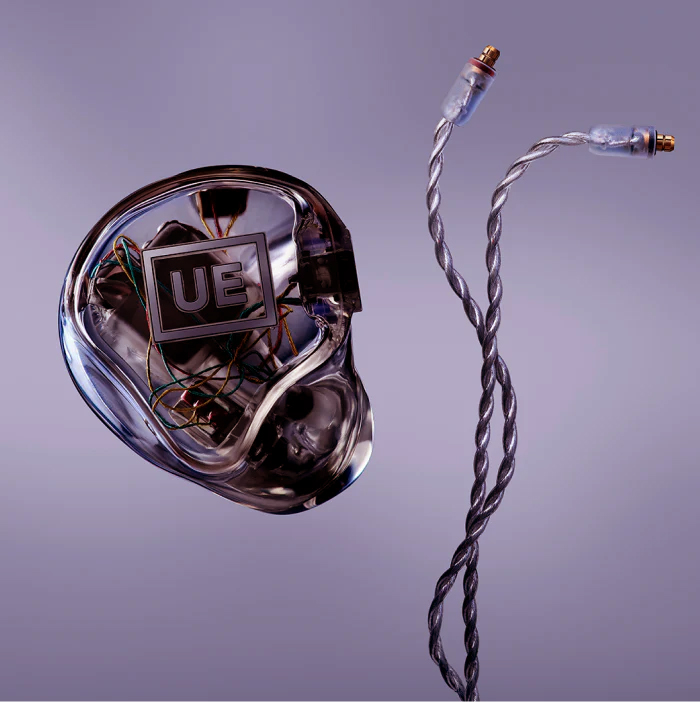
It starts with your ears, and that is where I had badly underestimated things. The mold is not packaging. It is the first component in the chain, and everything the monitor does downstream is built on top of it. A custom shell seals the canal completely, and that seal is what gives twenty-one drivers something to push against—without it, there is no real low end and no isolation worth the name. A universal tip approximates your ear. An impression doesn’t have to approximate anything.
I went to Ann Mundell-Noel at Amazing Hearing in Laguna Hills, and the appointment felt closer to a medical exam than a fitting, which is essentially what it is. She inspected both canals first, reading the depth and shape she’d be casting, clearing anything that would compromise the mold, and narrating every step a beat before she took it.
An oto-block goes in first, a small foam dam on a string, seated deep in the canal to shield the eardrum and give the silicone something to stop against. Then the silicone itself, two-part and medical-grade, sets in about 15 minutes. No two ears are the same shape, including your own two, which is the entire point of the exercise. You walk out holding a cast of your own ear canals, a strange thing to carry through a parking lot, and the reason these fit like nothing off a shelf ever will.
Then the audition, and this is the part I’d do again for free. John Talley, global account manager at Ultimate Ears Pro, ran me blind through all eight custom models in the lineup, each one fed from my phone, each one playing the same track: Dream Theater’s “Space-Dye Vest.” Not the shred piece anyone would expect. A slow one, mostly piano and film dialogue and empty space, which is far harder on a monitor than speed is. One song, one source, eight monitors, no labels, no prices, no idea what was in my ears.
I gave him my reaction to each, and he wrote it down. He never once tipped his hand, never named a model, never nudged me toward the expensive end of the table, and he knows that catalog cold—which driver array does what, and why you’d want it. This is the same process he runs for touring artists, and he ran it for me exactly the same way, which is a small thing that felt like a large one. I walked in as a writer and got treated like somebody due on stage in an hour. When we got to the end, and he told me which one I’d picked, it was the UE Premier—the flagship. I’d like to report that I have subtle, thrifty ears. I do not.
The Premier is a $2,999 monitor, and it makes no apology for that. Twenty-one drivers per side, split across a five-way passive crossover, running from 5Hz to 40kHz, with roughly 26dB of passive isolation from the seal alone—no batteries, no active cancellation, just the shape of your own head doing the work. UE Pro’s proprietary True Tone Plus driver handles the upper harmonics. I ordered mine with a clear faceplate specifically so I could see the driver stack, which looks less like a headphone than like something you’d find under the hood of a very small, very expensive car. Standard cable. Roughly ten days from impression to doorstep.

My rig for this was deliberately modest because the whole point was to find out what a normal vinyl setup can do when the last three feet change. Audio-Technica AT-LP70xBT, Bluetooth switched off entirely, output set to line, RCA into a Schiit Midgard. From the Midgard’s 6.35mm front output into the Premiers via a gold-plated Furutech F63-S (G) adapter from Moon Audio. Wired the whole way, no exceptions. If you’re spending three grand resolving detail, please don’t hand the signal to a codec.
The LP70xBT deserves more credit than its price invites. Under $300 buys a fully automatic belt-drive deck with a J-shaped tonearm, a die-cast aluminum platter, a three-piece anti-resonance chassis, and an AC adapter that moves the AC/DC conversion outside the plinth where it can’t dirty the signal. The cartridge is where the real value sits. It ships with an integrated AT-VM95C dual moving-magnet cartridge. Because the body accepts any stylus in the VM95 series, you can switch from conical to elliptical to microlinear to Shibata without ever replacing the table.
I made the first jump myself, to the elliptical AT-VMN95E, which is a two-minute swap and the cheapest meaningful upgrade anywhere in this rig. Everything I heard through the Premiers came off that stylus. Press one button and the arm sets itself down. I fed a $2,999 monitor from a sub-$300 source, and the source never once embarrassed itself, which tells you something about where Audio-Technica has quietly been putting its money.
The Midgard deserves its own paragraph. It’s $219, built in Texas, and it’s overqualified for the job I gave it. Fully discrete, linear supply, Alps Blue Velvet pot, Neutrik connectors, two gain settings, balanced and single-ended in and out. Schiit’s Halo topology—which folds the headphone driver itself into the feedback loop—runs only through the four-pin XLR, so on the 6.35mm jack, I was hearing the conventional single-ended output. It was still the most transparent thing I’ve ever put between a turntable and my head: low gain, volume barely off the stop, dead silent floor. The Premiers are sensitive enough that a noisy amp would have been unlistenable. This one disappeared.

The record was Ziggy Marley’s Brightside, and I could not have picked a better test if I’d commissioned one. It arrived as a Record Store Day exclusive on April 18—my copy came from Ziggy’s publicist via Tuff Gong, a variant on black wax with a Jamaican flag label rather than the hand-numbered translucent orange that went to shops—and it is the first album Ziggy has said he keeps returning to himself. Eight tracks on the vinyl.
Co-produced with his brother Stephen, cut with a live band in a studio rebuilt at the new Tuff Gong campus, and, critically, recorded with the instruments tuned to 432Hz rather than the standard 440. That is a decision made entirely on feel. It only means anything if your playback chain is honest enough to pass it through. Ziggy himself wears UE Pro monitors on stage. I can’t tell you what he listened through while making this record, but the company that decides what he hears in front of a crowd is the same one that built what I’m hearing in my chair.
“JAH We Give Glory” opens the record, and the bass separation stopped me cold. Not more bass—clearer bass, deep and articulate, each note landing with its own shape instead of pooling into one warm blur the way it does across my Audio-Technica AT-SP3X speakers. “Racism Is A Killa” was where the keyboards finally stood up. Through speakers, they’ve always politely blended into the middle of the mix. Through the Premier, they pop forward, sit in their own space, and then step back when the vocal needs the room.
“Many Mourn For Bob” is Ziggy singing about his father, and this one got me. His voice channels Bob so directly it’s almost uncomfortable, and at this resolution it never turns harsh or overbearing—clean and powerful and completely unforced, close enough that you notice him breathe.
“Brightside” is the one I keep going back to. Total separation, every vocal and instrumental line laid out in front of me, and I could point my attention at any one of them—percussion, keys, guitar, bass—and follow it all the way through the song. That’s a skill I did not know I had. I had simply never been given a system that allowed it.
Talley put it better than I can. I asked him what he’d do with a lifelong speakers-and-vinyl holdout—one record, one side, one listen through the Premier—and he didn’t hesitate. Steely Dan’s Aja, the title track, his desert island record. He wants to be in the room when the five-way crossover pulls that arrangement apart in front of somebody who thinks they already know it. He also told me he still finds new details in records he grew up with, and that he gets a real kick out of catching a bass drum pedal squeak, because it reminds him there were humans behind those microphones trying to paint a picture.
On where a vinyl listener should start, he was refreshingly unfussy: a good turntable and a headphone amp, onboard or separate, and go from there. On universal versus custom, he didn’t hedge—if the budget allows, go custom. Having now done it, I agree, and I’d add that the fit is the feature—nothing you can buy off a shelf seals like a mold of your own ear.
Which raises the fair question: what if you aren’t ready for that? Three thousand dollars and an appointment with an audiologist is a real commitment, and I would rather hand you a door than a wall. So I spent a week with the UE 350, UE Pro’s universal monitor at $399.99, running the same side of Brightside through the same turntable and the same Midgard. Three drivers per side across a two-way crossover, dual low-mid and a single high Knowles balanced armature, wrapped in UE Pro’s PerForm fit design. There is also a small raised red dot on the right earpiece so you can find the correct side by touch in the dark, which is the sort of detail that only appears when the people designing something have actually watched musicians work at two in the morning.
They are not the Premier, and they make no attempt to be. But judged on their own terms, they are excellent: clean, crisp, comfortable through a full side without fussing, and honest about the frequencies they handle rather than hyping the ones that sell. “JAH We Give Glory” still had shape in the bottom end. The keyboards on “Racism Is A Killa” still stepped forward. Less resolution, less isolation, less of that unnerving sense of standing inside the mix, but the same fundamental argument intact—that your record has more in it than your speakers are telling you. If the Premier is where this road ends, the 350 is the on-ramp, and it is a considerably better on-ramp than whatever is loose in the bottom of your bag.
None of this replaces speakers, and I’m not going to pretend it should. What it does is give you a second, forensic way into a record you already own—one that works at 11 p.m., disturbs nobody, and gets you closer to the master than a room ever will. If you have spent years perfecting a turntable and dismissed IEMs as gym earbuds or gear for touring drummers, you have been standing outside your own collection.
Put the needle down, close your eyes, and meet the record where it was made.

Ultimate Ears Pro and The Vinyl District are giving away a pair of UE 350 universal in-ear monitors, a $399.99 value, to one reader. Entry is open now and closes on October 1. Enter RIGHT HERE, where you will also find the full terms and conditions.
The Ultimate Ears Pro UE Premier and UE 350 monitors, the Schiit Midgard, and the Audio-Technica AT-LP70xBT were provided by their manufacturers for this review and were not returned. Ultimate Ears Pro reviewed a draft for technical and brand accuracy only. All listening impressions, opinions, and conclusions here are my own, and no company has influenced them.