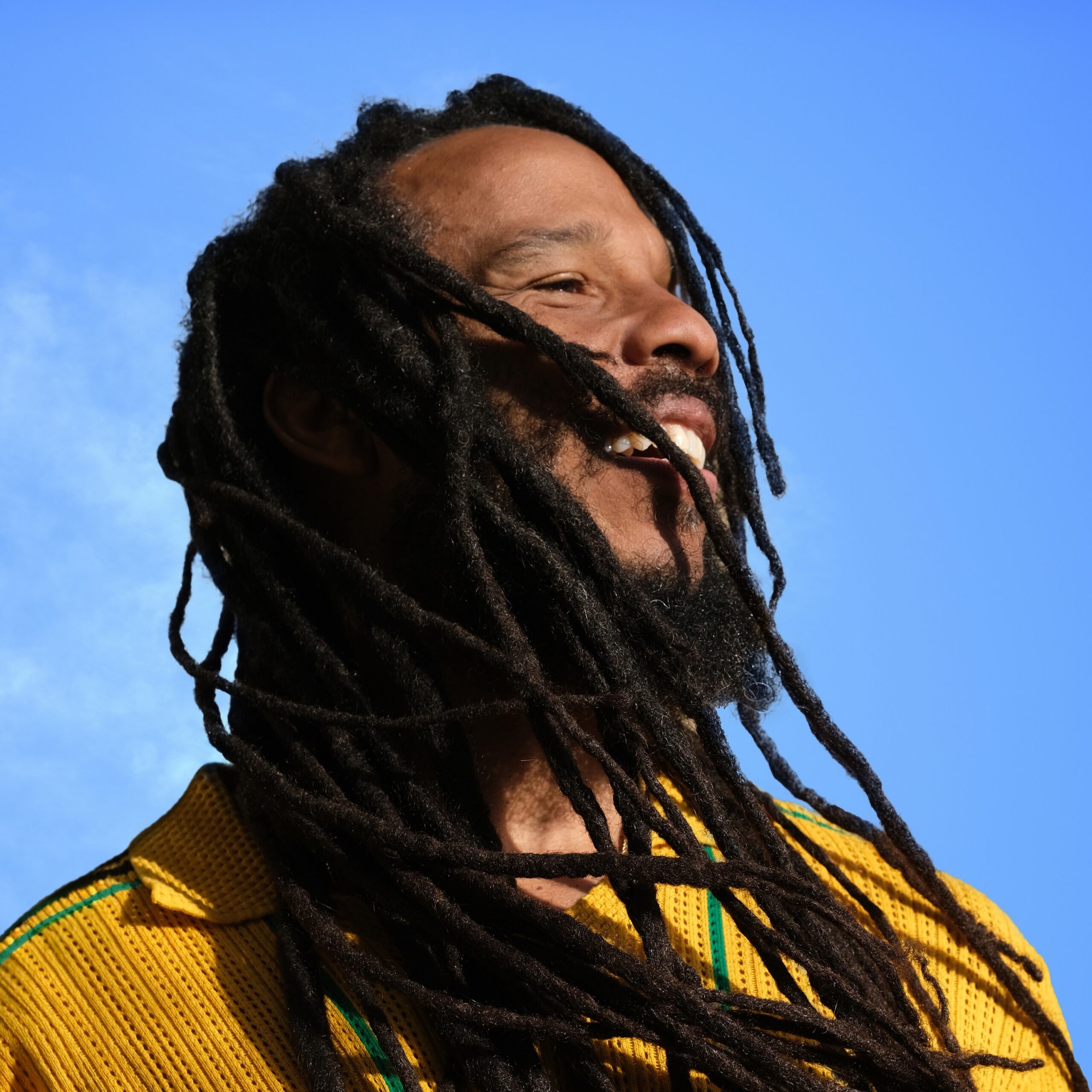
Some voices carry a country on their back. Ziggy Marley has been doing it for forty years, and the weight has only made the man more graceful, more centered, more himself. Nine Grammys and a lifetime spent stewarding a global musical inheritance, and he still sounds like he has something to prove—not to us, but to the work. Brightside, his ninth solo studio album and his first new material in eight years, arrives as a quiet act of defiance against the noise of the moment.
A pre-release review copy landed on my doorstep ahead of Record Store Day, and what I pulled from the mailer was a stripped-down version of what fans would soon find in shops—a clean, uncluttered cover, a plain white inner sleeve, no insert, no handwritten note from Ziggy, no colored wax. Just a black-labeled disc spinning in those classic Tuff Gong colors, the way the originals always looked. Sliding it out of the sleeve, that unmistakable new-vinyl smell hit me first, that warm petroleum-and-paper perfume every collector knows. I dropped the needle and let it ride. A faint crackle, a whisper of static, then the music breathed in.
Eight tracks total, co-produced by Ziggy and his brother Stephen at the newly built Rebel Lion Studio in Los Angeles, all of it tracked at 432Hz—that warmer, slightly detuned frequency reggae heads and meditators alike swear by—and you feel it. The low end sits lower in your chest. Trombone Shorty’s horns breathe instead of blare. Sheila E.’s percussion, Nikka Costa’s vocals, Jake Shimabukuro’s ukulele—this is a deep bench playing soft, and the restraint is the whole point. There are tiny imperfections in the pressing on my copy, a little surface noise here, a barely-there pop there, and somehow it makes the record feel more alive, not less. Reggae was always meant to be heard this way.
Of the eight tracks, four planted their flag in me and would not leave. Two of them gut you. The other two lift you clean off the floor.
Start with the gut. “Many Mourn For Bob” is the one I keep coming back to, a son writing about a father the whole world thinks it owns—real ache in his delivery, no self-pity, the arrangement giving him room to just be a man missing his dad. Floored me. Pair it with “Racism Is A Killa,” which hit me harder than I expected. The metaphor is blunt by design—inequality as a disease, plain and lethal—and the groove rides a stripped, almost militant pulse that lets the lyric do the cutting. Not a protest song dressed up. A diagnosis. Side by side, those two tracks make Brightside hurt in the right places.

Then the lift. “JAH We Give Glory” opens the record like sunrise through a window you forgot was there—acoustic guitar, hand percussion, that unmistakable Marley phrasing. Here is where I have to say it: there are moments on this album where Ziggy sounds so much like his father that it stops you cold. Not imitation. Genetics. Then the very next phrase is unmistakably his own, weathered and patient in a way Bob never lived long enough to become. “Why Let The World” might be the album’s secret weapon. Mid-tempo, sun-drenched, that classic skank under a melody that lifts higher every chorus. Had me moving in my kitchen on the second spin. Pure roots medicine.
I have lived with this record now through more spins than I can count, and it keeps unfolding. Eight songs, no filler, no wasted breath—the kind of focused, unhurried work that only an artist this far into his craft could make. There is a generosity in Brightside, a hand-on-your-shoulder quality, that I did not realize how badly I needed until I heard it. This is grown-folks reggae, music made by a man who has watched the world long enough to have something true to say about it, and it sits next to his very best work without flinching. I love this album, full stop.
The digital release lands May 1 for everyone who did not snag a Record Store Day pressing, and it is well worth your time and a few of your dollars. Then the Brightside Tour kicks off June 19 in Tucson and runs twenty dates through July 22, hitting the Hollywood Bowl, Red Rocks for Kaya Fest with brother Stephen, and a closing two-night stand at Nantucket’s Chicken Box. Catch him if you can—this material was built to breathe in a room full of people. Eight years was a long wait. Brightside earns every one of them.