The first time I heard “I Sit on Acid,” I was 20 years old, out on the dance floor at Club Metro in Riverside, and I had no idea what I was listening to, let alone who the Lords of Acid actually were. Nobody did. It was slow, dirty, and hypnotic, with lyrics you weren’t supposed to say out loud, let alone over a club sound system. Nobody around me cared. We just moved.
Not long after, I walked into my first warehouse rave in San Pedro, Krusty’s Funhouse, under a huge circus tent. Around 2 a.m., the DJ dropped Lords of Acid’s latest, “Take Control,” and the whole tent lifted off the ground. I’ve been to a lot of shows in the decades since, and I’ve photographed plenty of them. I can count on one hand the times a single record changed the temperature of a room like that. It was life-changing.
That was the beginning for me. Before the festivals, before EDM became a business, before anyone had a phone to film it, there was a guy in Antwerp named Maurice Engelen putting out records under a pile of different names, and they were landing 6,000 miles away in tents and warehouses full of kids like me. Praga Khan. Channel X. Lords of Acid. “Rave the Rhythm.” “Injected with a Poison.” To us he wasn’t a name on a sleeve. He was the source.
Here’s the part that floored me: he had no idea. No internet, no cell phones, faxes with sales figures coming back from America. He didn’t know we existed until a fan cornered him at a party in Miami and recited his discography back to him.
More than 35 years later, Lords of Acid is still doing what it has always done: pushing buttons, making people dance and laughing the whole way through. Mundo Bizarro, the band’s first album of all-new material since 2018’s Pretty in Kink, is out now on Metropolis Records, with the LP following November 9. It’s the first record with Carla Harvey, who grew up dancing to the songs she now fronts. It moves between English, Spanish, German, and Japanese. And true to form, the cover is already getting flagged by the algorithms: a woman holding a banana to her head like a gun. Praga Khan is still too much for the internet.
I got on the phone with the man who started it all for me, on the eve of the Cheeky Freaky Pt. 2 tour, to talk about the new beat accident that launched a genre, why he still trusts an ARP 2600 over a laptop, and what he’d say to the kid on the dance floor.
Before there was Praga Khan, there was Maurice Engelen growing up in Belgium. What was the first record that made you think, “I need to make sounds like that,” and how far was it from the music you ended up making?
I started out in my early twenties as a booker for international bands, bringing acts like Soft Cell and Cabaret Voltaire over from England to the continent. In 1982 I started my own record label, Antler-Subway, and it became a very influential independent label for electronic body music, with bands like Klinik and A Split-Second. In America, most of the best bands from that scene were on Wax Trax! at the time.
I started making records myself in 1987, when Atari came out with its sequencing software. Before that I’d been working with a Commodore sequencing system. I’ve always been in love with technology and in love with music, so combining the two was the perfect thing for me. The very first record I made was a song called “Blow Job,” and I honestly didn’t know what the word meant. I thought a blow job was a bad job, when somebody does something wrong. Only later did I find out what it really was.
Back then I was influenced mostly by German records like 16 Bit, and by the bands on our own label: A Split-Second, Klinik, Poésie Noire, The Neon Judgement. But that music was a little too dark for me. I wanted to make something less depressive and show the funnier side of it.
“I Sit on Acid” came out in 1988, in the middle of Belgium’s new beat scene. How did that record come about, and how did it lead to Lords of Acid?
There was a new beat scene in Belgium, a musical wave that existed only there. It was quite unusual, because people went to discotheques specifically to hear Belgian music. It started by accident with a record on our label, “Flesh” by A Split-Second. A DJ played it at 33 RPM instead of 45, and people started dancing to it differently, slow and sexy. Then DJs started doing the same with other records, slowing them down. I saw the reaction it got from the crowd and thought it would be great to build a movement behind it, so I asked the people working at my label to start making that kind of sound originally. That’s how new beat was born, and “I Sit on Acid” was part of that wave in the late ’80s.
After about two years the scene died out and nobody was interested in new beat anymore, but there was one record that kept selling, and that was “I Sit on Acid.” Because it was my record company, I had to do the reorders every month, deciding how many copies needed to be pressed, and it was so strange that out of that whole era only that one record kept selling. Then a call came from America: could we make an album for Lords of Acid? I had almost forgotten about Lords of Acid, because we had so many projects under so many different names. I realized all those repressings must have been going to America. I checked, and that was the case. The rest is history.
I was 20 years old in Southern California in 1990, and “Rave the Rhythm” and “Injected with a Poison” were the soundtrack to warehouse parties 6,000 miles from Antwerp. Did you know what those records were doing over here, and when did you realize America had adopted you?
Not at all. At that time there was no internet, not even cell phones. I remember that right after we recorded Lust, we went on tour as Praga Khan and forgot about the album. Then we got a phone call from Caroline saying it had already sold over 100,000 copies. The only information we got was faxes with updated sales figures, so we couldn’t see what was happening. We knew about England, because the records entered the charts there and you’d see yourself in the Top 40 and do Top of the Pops. But in America it was more big hits on college radio, and we had no idea of the impact.
The first time I really noticed was at the Winter Music Conference in Miami. I sat on a panel with Paul Oakenfold about the illegal raves in England, where you didn’t even know the location until you phoned a number the day before. Afterward, Rick Rubin threw a little party for the Digital Orgasm album that had come out in America. When I arrived, a girl came running up to me and said, “Wow, my boyfriend is going to be so happy to see you.” I thought, what is this? Then I started talking to him, and he knew all my records, when they were made, who they were made with. That really blew my mind. That was the first time I realized I had an audience on the other side of the ocean.
What did the early-’90s rave scene have that today’s festival culture has lost, and what’s genuinely better now?
Now it’s much more commercial and way better organized. It’s a real business. Back in the day it was chaos. I remember playing in Wolverhampton and then finding out we had a rave to play in Basingstoke, in the south of England. We knew the town but had no address. We arrived in the middle of the night, opened the car windows and listened for where the bass was coming from, then drove in that direction until the police stopped us. Then you knew you were in the right place.
Today’s festivals have nothing to do with that rave scene anymore. They’re very expensive and very well organized, and people come from all over the world for events like Tomorrowland. But the way I see it, a handful of DJs are running the place. It’s always the same people showing up and playing these gigs and collaborating with each other, with ties in every possible direction. In the beginning it was a wild party for music lovers, dancing all night. Now it’s more of a commercial event.

Mundo Bizarro is the first all-new Lords of Acid album in eight years and the first with Carla Harvey. She has said she first heard “I Sit on Acid” as a teenager dancing in a Detroit club. What does it mean to have someone who grew up on the music now fronting it?
I had no idea until she was already in the band. She told me that when she was 16 they went to private parties and listened to our music. Nowadays it’s very common for artists, especially in rap, to use the filthiest lyrics ever, and compared to that the Lords of Acid lyrics sound like lullabies. Lords of Acid always had the fun factor in there, and that’s the way I wanted it. There’s nothing wrong with having sex, and nothing wrong with being sexy.
But in ’92, ’93, ’94, when the first albums came out, it was the forbidden fruit. In Europe we were used to it. The dance scene sampled a lot from people like Karen Finley, and new beat used plenty of sexual lyrics too. I had no idea that wasn’t done in America. We only found out afterward that it was a big thing, because for us it was the most normal thing in the world. So it was nice to discover that Carla knew the catalog. When I first met her she kept talking about Lust and Voodoo-U and Our Little Secret. It’s nice to work with someone who appreciates your work.
The four singles—“Karaoke Superstar” with Princess Superstar, “Dream Boy” with Carla, “El Mundo Está Loco” with Tony & The Kiki, and “Ich Will Nur Das” with Mari Kattman—point in four very different directions. What ties the eleven songs together, and why is “bizarre world” the right title for this moment?
I’ve been around for quite some time, and to me this is a pretty weird, strange world we’re living in now. That’s why I called it Mundo Bizarro. Everything has become a little surreal. You don’t always know anymore what’s real and what isn’t. There’s AI, deepfakes, social media, strange wars, drugs, political madness. Sometimes the whole world feels like one bizarre movie. A lot of people feel depressed about it, but I didn’t want to make a dark or depressing album, because Lords of Acid has always dealt with serious things through humor, sex, absurdity and dance music. So I wanted Mundo Bizarro to be colorful, funny, sexy, and sometimes completely over the top. It’s my projection of what the world is like nowadays.
It’s also a completely globalized world. You wake up in Belgium, watch something from Japan on Instagram, hear Spanish on TikTok, there’s German techno in the club and American politics on the news, all within half an hour. That mixture has become completely normal, and I wanted the album to reflect it. English is still our main language, but sometimes a song simply asks for another one. German has a completely different rhythm and aggression. Spanish has this wonderful sensual flow. Even Japanese words can become part of a pop song. I worked a lot in Japan in the early ’90s, and I always wanted to do a song about those weird Japanese fetishes. This was the right moment. I didn’t use different languages to make the album sound international. I used them because the bizarre world is international. There are no borders in it.
Mundo Bizarro dropped digitally on October 15, the same night the second leg of Cheeky Freaky kicked off. How have the new songs landed live next to the classics, and has the crowd’s reaction changed how you hear the record?
The crowd is reacting really, really well. When I went into the studio, I had this feeling that I had to make an album about this crazy world now, because you never know how long you’ll be here. You see so many people falling away around you.
“Ich Will Nur Das” asked for German, but I didn’t want a German singer. I wanted an American girl singing German with an accent, because that’s what makes it special. Mari Kattman did it wonderfully. I coached her over the phone and Facebook Messenger, and it’s unbelievable how it came together. With Tony & The Kiki, we already had the plan to do something together. When I made the demo for “El Mundo Está Loco,” I knew it was a very, very weird song with a little bit of everything in it, and that it needed to be done by them. I recorded a guide vocal, and they made it their own. When it came out, I was really surprised. It’s in Spanish, it has guitars, a beat like Bad Bunny, some punk. It’s completely different from anything else you can listen to, and it’s in my top 20 of every song I’ve ever made. When we play it live, everybody starts cheering.
People are also reacting very well to the song with Princess Superstar. We have her and Tony & The Kiki with us on tour, so it’s great to perform those songs live. Everybody in the band loves playing them, and Carla loves them too. It also gives her a break to do a costume change before she goes back into action.

The catalog came back on Metropolis in 2017 with redesigned artwork, and Lords of Acid covers have always been part of the provocation. Mundo Bizarro hits LP on November 9. What did you want fans to feel when they pull it out of the sleeve, and how involved were you in the cut and the packaging?
Nowadays the cover is way more difficult than it used to be. Voodoo-U is one of the most amazing covers ever, but it’s banned on social media everywhere, even on Discord. That album has been out since 1994, and for the last four or five years it’s been impossible to put it on the internet because it gets taken down in no time. When you look at the great artists from centuries ago, Rubens, Michelangelo, they were all painting naked women and there was no problem at all. When artwork from an amazing artist like Coop gets censored, it really hurts me.
So with this album we had a lot of different designs, and we had to test whether they would get through the filters, because I don’t want to release an album where you can’t even show the cover. A couple of designs were filtered out immediately by the AI. We thought we were safe with this one, but people have already told me they tried to upload it and it got censored too. What’s wrong with a girl pointing a banana at her head like a gun?
The guy working on the artwork even tried a photo of Hedy Lamarr, the Hollywood star of the ’30s and ’40s, relaxing in the grass. A very beautiful picture, nothing but a shoulder and a head, no nudity at all, and it was rejected because the pose was “too sexual.” How crazy can it get? It’s part of the bizarre world we’re living in, and it makes me a little bit sad.
Your sound was born from analog machines—303s, samplers, tape, a needle on a 12-inch—and today almost everything is made inside a laptop. People talk about the “warmth” of vinyl and analog. Is that real to you or nostalgia? Do you still reach for hardware, and what does a Lords of Acid track gain or lose when it ends up on a record instead of a stream?
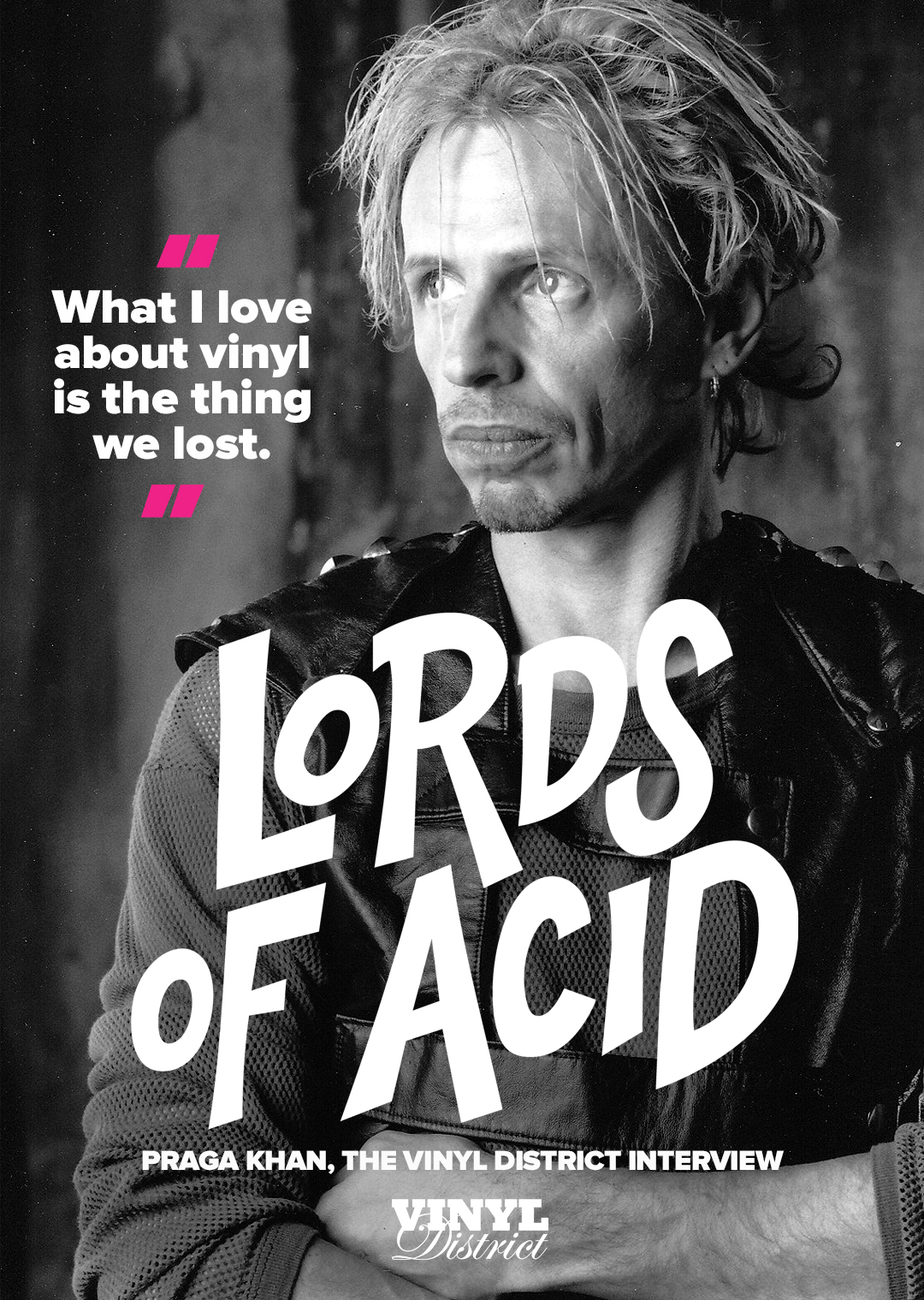
First of all, I’m really happy that vinyl is back, but people shouldn’t exaggerate it. It’s still a very small percentage of sales. What I love about vinyl is the thing we lost. When I was young, you looked forward to an album coming out, to the cover and all the lyrics inside, the whole package. With vinyl you can go back to holding a real cover in your hands and reading everything on it.
In the studio, I’m not going to say we don’t use soft synths. They’re there, and I’ve always been open to new things. But we also keep using the analog synths. Olivier and I have this discussion all the time when we’re recording, and in some weird way we still think analog sounds better than digital. Maybe I’m completely wrong, but to my ear it sounds rounder. It gets into my mind more. When I hear what they’ve made of a synth from the ’80s now and compare it to the original, I still hear a lot of difference. That’s why we keep using the old gear. We still use an Oberheim, an ARP Odyssey, an ARP 2600, and we even used the EMS Synthi on this album, in combination with today’s soft synths. There’s nothing wrong with combining them, but for the most important sequences, I love to stay with the analog sound.
There are people, and I’m one of them, whose whole relationship with music started with your records in a warehouse in 1990. Many of us are now in our fifties, running businesses and raising families, and we still play those records. When you think about all those strangers whose lives you shaped without ever meeting them, what do you hope they carried with them? And if you could say one thing to that kid on the dance floor, what would it be?
Everything I did, with my record company and with my own music, I did out of passion, out of love for music. If you chase your dreams, make sure it’s something you have a passion for. That’s always been my number one rule: when I lose my passion for making music, I stop making music. My dad died when I was 11, but I still remember a few of his sayings. If you try your best and work hard enough, you can get wherever you want. I’ve always kept that in mind.
What pleases me a lot is how many young people come to the shows. What I like most is talking to the fans before and after, and the young ones tell me they listen to a lot of music from the early ’90s and are discovering all the originals. When we played America in the spring, a girl came up and asked if I knew what drum and bass was. Of course! I’ve made a lot of drum and bass and jungle, and there’s plenty of it on Voodoo-U, along with breakbeat. It’s nice that they’re still open to new things.
When I was 16 or 17, my group of friends listened to symphonic rock: King Crimson, Jethro Tull, Genesis, Uriah Heep, Yes. I’m still in touch with them, and they’re still listening to the same stuff, over and over. They missed so many amazing waves of music. I loved punk, new wave, the New Romantics, electronic body music, acid, new beat, house. It’s strange to me to stick to one style when there’s still so much amazing music coming out. For me, music is like food.