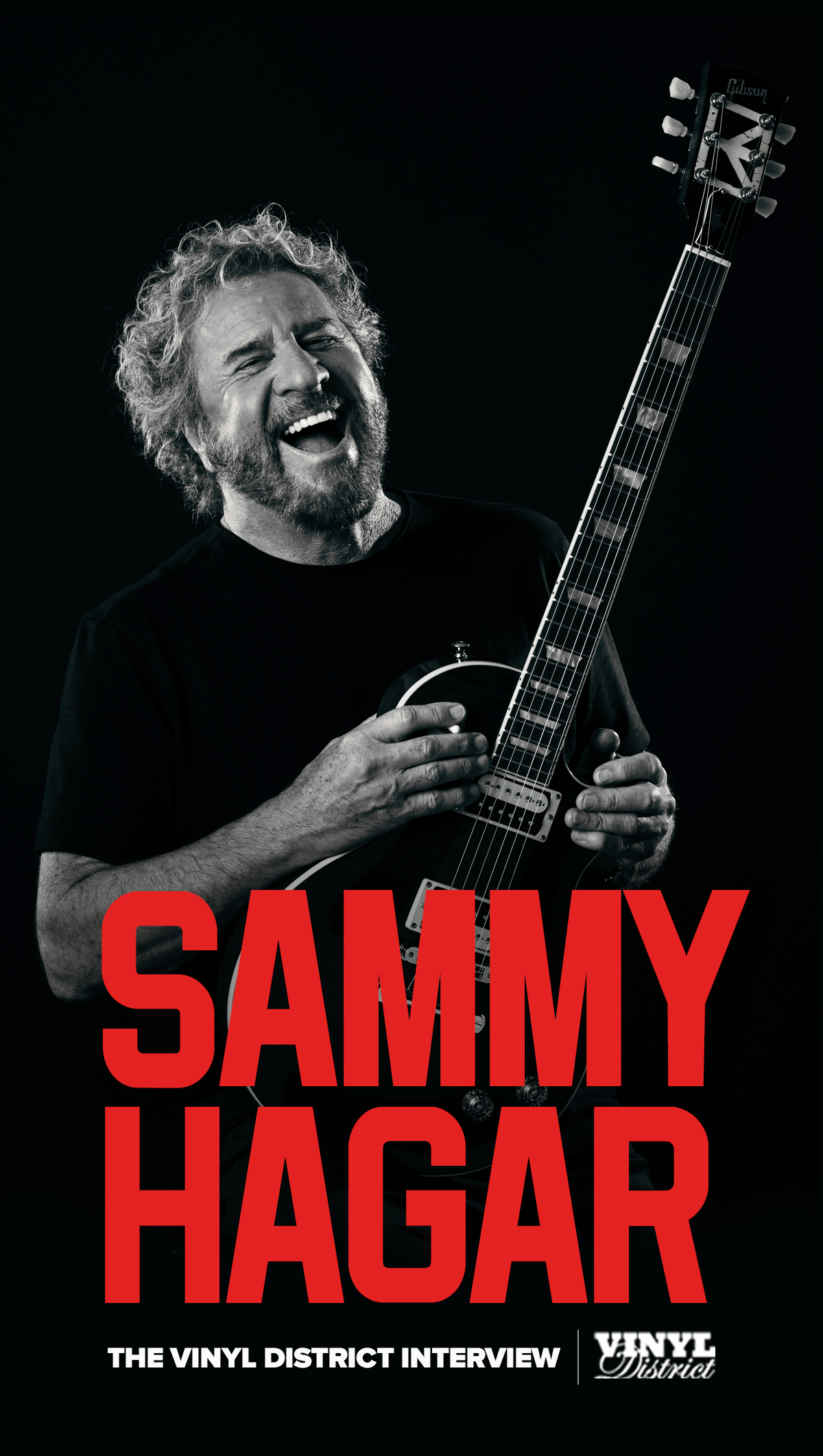
Some interviews you prepare for. You build the questions, you do the research, you know exactly where you want the conversation to go. And then the person on the other end of the line says something that stops you cold—something that has nothing to do with the prepared question in front of you and everything to do with why you got into this work in the first place. That’s what a thirty-minute phone call with Sammy Hagar on a Wednesday morning will do to you.
I had just come off reviewing his Best of All Worlds Tour residency at Dolby Live at Park MGM in Las Vegas—a show that ran 145 minutes, covered 17 songs, and left me genuinely undone in the best way a rock and roll show can. I had left my camera at home that night and experienced it purely as a fan. By the time “Eagles Fly” came around, I wasn’t holding it together. By the time the house lights came up, I knew I needed to talk to this man.
Here at The Vinyl District, we write about music because we believe it matters—not as background noise, not as content, but as the thing that reaches into places language alone cannot touch. Sammy Hagar has spent sixty years proving that point, and this tour, with this band—Michael Anthony, Joe Satriani, Kenny Aronoff, and Greg Phillinganes—may be the finest chapter of the whole remarkable story.
What follows is a conversation about beginnings and legacies, about what it means to stand on a stage at seventy-eight and still feel something new, about vinyl and the records that shaped a life, and about a homeless man in Las Vegas who recognized the Red Rocker at midnight and quoted things he said onstage thirty-two years ago. It’s about a song called “Eagles Fly” that his mother asked him to sing at her funeral, and that mine would have loved just the same. It’s a conversation I will carry for a long time. I think you will too.
Take me all the way back to the very first time you stepped onto a stage. Not a rehearsal, not a garage—an actual stage in front of actual people. What did that feel like, and did any part of you in that moment know this was going to be your life?
I remember a few different early moments, but the one that really sticks was playing a party for five dollars at a little union hall for a car club called the Swampers in Fontana, California. My brother’s friend—an older guy, really hip, really into cool music—taught me how to play a couple of songs on rhythm guitar. We had one amplifier, two guitars, and a microphone, all running through the same amp. I was probably fifteen.
We played “Gloria” and some surf songs, and I just loved it. I got dressed up, I felt like a performer—and the second I stepped on that stage, it became official. There was an adrenaline rush like I had never felt in my life. I thought I wanted to do it long before I even knew how to play guitar, but I didn’t feel it until that moment. From then on, I knew this is what I’m going to do, by hook or by crook.
Every musician has a shortlist of artists who fundamentally rewired how they heard music—the records and performers that made them think, “I want to do that.” Who were yours, and is there one that stands above all the others?
Honestly, it was more about the people around me than any particular rock star. I was in my teens, and I had three or four friends who genuinely believed in me. We’d get together, listen to music, and I’d tell them I was going to be famous someday. I dressed the part—psychedelic clothes, the right hairdo, the language—and they’d introduce me to people at parties saying, “This guy is going to be a big star.”
They really believed it and they had me convinced too. Having that circle of people around you who see what you’re going to become before you’ve become it—that’s the thing that drove me. I could already play a few songs from that guy who taught me when I was fourteen, and I could sing them. I just hadn’t started a band yet. But those friends, that belief—that’s what lit the fire.
You’ve performed under so many different banners—solo, Van Halen, Chickenfoot, the Circle. When you look at the lineup you’ve assembled for the Best of All Worlds Tour, what is it about this specific combination of Michael, Joe, Kenny, and Greg that made you feel like this was the right moment to do something this ambitious?
It all happened organically. I’m one of those people who just keeps their head down and keeps swinging—I aim high and chip away at it without mapping the whole plan out in advance. Chickenfoot is how Joe Satriani and I really connected. I’d tried to get Joe years before that—I wanted him to play at Bill Graham’s funeral, and he said he didn’t play other people’s songs. But when Chickenfoot came together and we were writing new music, I called him again and he was in.
Michael and I bonded the day I walked into Van Halen—we ended up going out for tacos and margaritas and just clicked immediately. He followed me down to Cabo, played the birthday bash, all of it. Then when we decided to go out and keep this music alive—because we sold sixty or seventy million records and those fans deserve to hear it live—we needed the best people.
Kenny came in with no rehearsal, flew in day-of, stayed up all night making charts, and made fewer mistakes than I did. When Jason Bonham had to leave, I wasn’t going to let Kenny go after what he’d done. And the bonus is that Kenny and Joe work together constantly, so if one’s available, the other is too. I didn’t plan on having some of the greatest musicians in the world backing me. I just got spoiled.
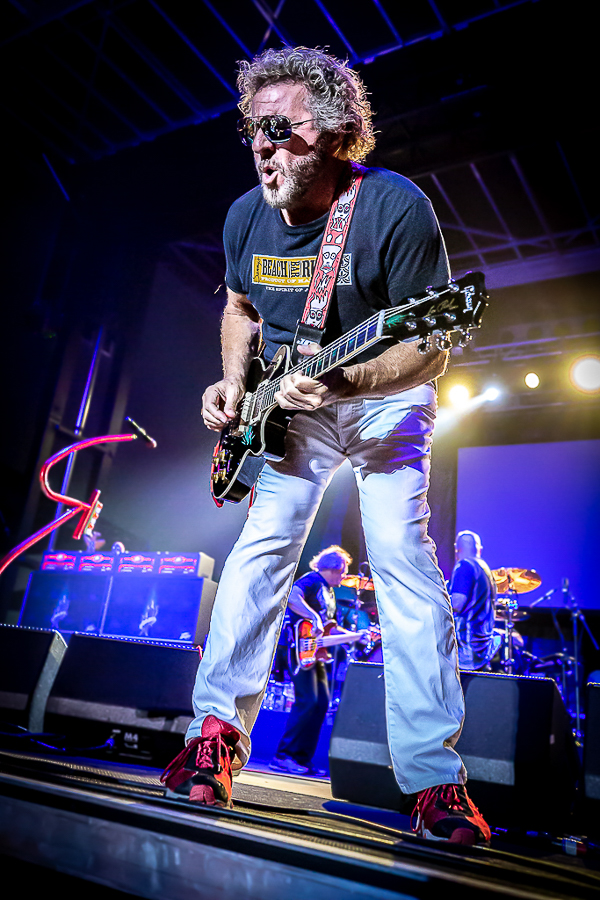
Watching you and Michael Anthony interact onstage, there’s a shorthand that goes beyond the music—a language built over decades. How do you describe what the two of you bring out in each other that nobody else can?
We’re both fun guys who had some difficult experiences early on that made us appreciate what we have now. I got fired from Montrose with nothing, and it really hurt—I thought, what did I do? From that point forward, I said I only want to play with people I like and people I can trust.
I think Mikey had a similar experience in the early Van Halen days—he was kind of the low man on the totem pole. When I walked in, we both just felt it immediately. He thought, I can trust this guy. I thought, I like this guy. And from there, we’ve built so much history together that we don’t even have to talk about most things. We have a saying: “what is understood need not be discussed.” And we have a huge understanding of one another. It comes from years of being there for each other. Mikey is always the first one there and the last one to leave. That’s a great bandmate and partner.
You made a deliberate choice to rotate the setlist every night during this residency rather than lock it in. That’s a real gift to your fans, but it’s also a serious commitment from the band. What does that kind of nightly reinvention do for you personally as a performer?
It was hard, I’ll be honest with you. I got a little worn out in Vegas trying to do it. Back in the Waboritas days I never even had a setlist—just an opening song and a closing song, and I’d whisper the next song to the band during the crescendo of the one we were playing. We did that for about three years and it eventually wore me out.
This residency was similar. The caliber of this band makes it possible because everyone can play a song without practicing, but it was still a real challenge. The second night fell apart because I changed too much—we opened with “Soap on a Rope” and then “Mine, All Mine,” which are deep cuts, and the show didn’t really lift off until we hit the bigger songs. I learned something important: you open with your biggest hit. Set the tone. Give people that moment right away where they look at each other and go, yes, that’s why I’m here.
I also think I made a mistake catering the setlist to the fans who were there multiple nights—if I pull out a hit for a deep cut, three thousand other people are going, “That’s my favorite song.” So, I’m going to make changes when a song isn’t working, not to accommodate regulars. By Friday and Saturday night, we had it right. And I finally found the right place for “Eagles Fly” and “Encore, Thank You, Goodnight”—they are the closers. That’s exactly where those songs belong.
At my age, doing this as long as I have, I’m still looking for the greatest setlist ever. When I find it, I’m not changing it again.
Joe Satriani playing “Surfing With the Alien” in this room, with this band, felt like an event inside an event. Did the two of you ever sit down and have a real conversation about how he would approach the Eddie Van Halen catalog—what he would honor, what he would make entirely his own?
The conversation started with me telling Joe we were going to play at least fourteen Van Halen songs and asking if he was interested. He said he needed to think about it. Part of his hesitation was genuine respect—Joe told me he didn’t want to emulate Eddie because Eddie was so good that he’d start absorbing it and playing like him, and he didn’t want that. Coming from Joe Satriani, that’s about as high a compliment as Eddie Van Halen could ever receive.
Eventually Joe came around, and part of what made it work is that he has real skin in the game—he gets to play one of his own songs every night, and we play some Chickenfoot too. My three favorite Joe Satriani songs are “Satch Boogie,” “Surfing With the Alien,” and “Summer Song,” and I told him so. He picks which one each night. We also let Michael pick one David Lee Roth-era Van Halen song each night—“Somebody Get Me a Doctor,” “Ain’t Talkin’ ‘Bout Love,” or “Running With the Devil.” It gives me a nice break—like when Mick Jagger steps off and Keith sings a couple. You come back out and everything sounds fresh again.
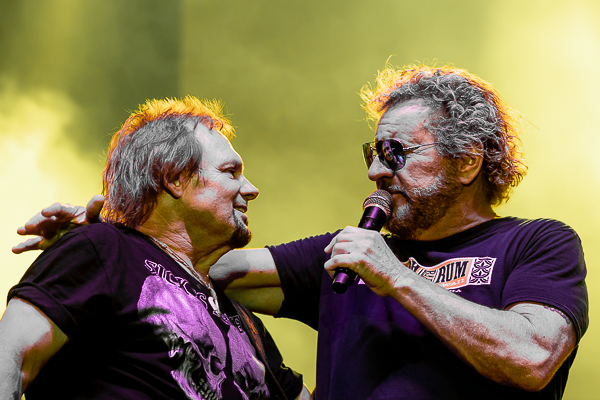
Michael Anthony taking the lead on “Somebody Get Me a Doctor” brought the house completely down. He is one of the most underappreciated vocalists in the history of rock and roll. Do you think he fully knows how much the fans love hearing him step to that microphone?
Oh, he knows how much I love it—I give him that love all the time. And I’ll tell you straight up, those songs haven’t sounded that good in a long time. He’s singing them really well. My personal favorite that I’d still love to add to the set is “Unchained”—that’s a badass tune. I also love singing “Panama” because it’s just fun, great lyrics. And I’m always threatening to add “You Really Got Me” because I do some real acrobatics with it vocally—start low, jump up an octave, just grunt it out. We used to play it in Van Halen and it was always awesome. But for now, I stick with “Panama.” Mikey gets his spotlight, and the crowd responds every single time. They love him.
We’re a vinyl publication, so we have to ask—do you still have a record collection? And if so, is there a single album sitting on that shelf that you would call the most important album you’ve ever owned?
I’m going to be honest with you—since the invention of that voice assistant I can’t name aloud without triggering it, it has ruined my life musically. I just blurt out whatever I want to hear and it’s there instantly. The old ritual of digging through your vinyl, pulling out a record, cleaning it with the little brush, sitting down and listening to the whole thing because you’re not going to bother changing it—that’s a real part of the musical experience that I’ve let slip out of my life.
I’m guilty as charged. But I do have quite a collection. Every musician friend I have—Green Day guys, Aerosmith, Alice in Chains—whenever they do a box set or a vinyl reissue they always make sure to send me a copy. I’ve got them sitting in my office and I look at them and just… don’t quite get there. And I have a big basket in my warehouse going back to the ‘60s—Ray Charles, John Lee Hooker, Lightnin’ Hopkins—so scratched up you’d need a dollar and a half in quarters on the needle. I really need to get back to those records. I just haven’t done it.
There’s a whole generation of younger listeners coming to vinyl for the first time right now—buying turntables, digging in crates. When you think about a kid picking up one of your records on wax for the first time, which album do you hope it is, and what do you want them to feel when that needle drops?
I’ve been around so long and in so many different eras that it’s hard to pick just one. But if I had to choose, I’d say Marching to Mars. It was my first solo record after Van Halen, and I had so much music and so many lyrics built up inside me that I think it’s a really great record—underrated, undersold, went gold, but to me it’s one of the finest things I’ve ever made.
I’d also say the same thing about the first Montrose record. And my first live record, All Night Long from 1977—every song is four times faster than the studio version and it’s just on fire. No fixing, no overdubbing, no Pro Tools. That’s just who we were. My most recent record, Crazy Times, produced by Dave Cobb, is also really strong. And then there’s the live Best of All Worlds record—no fixing, no overdubbing, just the band as we are right now. If you want to know who I am today, that’s the one. I’ve written over five hundred songs, and I think about three hundred of them are good. That’s not bad.
“Eagles Fly” stopped me cold on Saturday night. Before you played it you shared something about what that song means to you. I lost my mother recently, and she loved that song—when those first notes came I was not okay, in the best possible way. What is it about that song that continues to reach people so deeply, night after night?
Because it came from a deep place, and that’s the difference between writing as an exercise and writing because something is moving through you like lightning. I was alone in the low desert above Palm Springs, up in Idyllwild at about 4,800 feet elevation. It was warm, completely silent, deeply spiritual—just me, the wind, and a moment I’ll never forget.
I saw an eagle gliding around and something happened to me. I felt like I understood what it had felt like to take my first breath when I was born. First time I smelled anything, heard anything, felt anything. Taking your first breath is a big deal. It may have been the most spiritual moment I’ve ever had. And out of that came the song.
Something that comes from that kind of place will always touch people, always. And it’ll always touch me—I get emotional just talking about it right now. My mother wanted me to sing that song at her funeral. She told me years before she passed. I said, “Sure, Mom—let’s not get in a hurry.” The fact that it meant that much to her, and that it means that much to you—that’s everything. That’s what the song is.

You’ve said this might be the happiest you’ve been onstage in a decade. What does that happiness actually feel like from the inside when you’re up there with these four guys—what changed?
Five or ten years ago I was still trying to prove something—I don’t know what, but something. I still have all the pre-show anxiety and nerves. I’m quiet and reclusive until about four or five in the afternoon, thinking about the setlist, what I said the night before, making sure I’m not wearing the same shirt twice. I take it seriously and I’m proud of that.
But now when I walk out there, I’ve finally learned something. These people are in the room because they already know I’m good. So, if I crack a note or sing a little off-key for a moment, so what? Get back in it. Don’t overthink it onstage. I wrote a song about that—“Right Here, Right Now”—and that’s where I am every night.
We were supposed to play ninety minutes and we made a deal to play a hundred and five because people are paying too much money these days to get a short set. And every night, that hour and forty-five minutes flies by because I’m completely in the moment. Before I know it, we’re at the last two songs. I’m not trying to prove I’m great anymore. That’s the difference.
Last one, and it’s the big one. When the music finally stops—when all the tours are done and the records are finished and the Red Heads have gone home—what do you hope people say about what Sammy Hagar meant? Not the hits, not the platinum records. What is the human legacy?
First of all, it’s closer than people might think—I’m not threatening retirement, I would never announce a final tour, that’s too money-grabbing for me to ever do—but I also know that when my body or my health tells me it’s time, I’ll listen. My family and my life come first.
But what I want people to remember is that I made them feel good. I gave them hope. I want to have touched them in a way that’s everlasting—not just “Oh, I saw him once and he was great,” but a life-changing memory. Something that awakened them, the way a great song can connect your body, your mind, and your soul all at once and make you think, wow. I want to enlighten people without preaching. I want to lift them up.
I’ll tell you what made me think about all this. A few nights ago in Vegas, I was walking down the street around midnight and a homeless man —probably in his sixties, been living on the street for years—called out my name. I stopped. He told me he’d seen me play in Pensacola, Florida in 1994 on the opening night of the Van Halen Balance tour. He remembered things I said onstage. This man has no cell phone, no Instagram, no way to follow me—just that memory, carried for over thirty years.
I gave him some money, but more than that, he gave me something. He reminded me that I did it. I touched people in a way they never forgot. That’s the legacy. That’s a miracle. That’s what I want to keep doing for as long as I can.

PHOTOS: LEAH STEIGER
LIVE IMAGES: MATTHEW BELTER