
VIA PRESS RELEASE | There’s a tension that runs through the music of Los Angeles-based duo, Born Rivals, the kind that only exists between brothers. Born from years of creative friction, John & Paul Thornley channeled their differences into something undeniably their own. The sound is lush and deliberately crafted, channeling American heartland grit through a ’90s Britpop lens. Commanding drums anchor cascading guitars and intricately layered keyboards, while vocals turn from half-mumbled to soaring in a breath, punctuated by sibling harmonies that seem to argue and agree simultaneously.
 Purple Western Skyline, their self-produced album arriving November 14, 2025 via Sheltering Sky Records—a label founded by John Thornley to maintain creative control— carries the marks of its unusual birth. Recording began in a Hollywood studio just before the lights went out in early 2020 and not long after, kids arrived. New life intervened with its own demands. What started as an attempt to control the process became an exercise in surrender.
While they worked largely alone, chasing a sound that belonged to them, certain collaborators proved essential: Cian Riordan (St. Vincent) and Andrew Lappin (Cassandra Jenkins) brought clarity to the mix, Michael Harris (Arctic Monkeys) and Justin Long (Grace Potter) lent engineering expertise, Sam KS (The War On Drugs) provided drums, and Lindsay Pitts Lazarus (GEMS) contributed the project’s first outside vocal, a duet that opened something new. The songs became what they needed to be, made in the margins of a changing life.
When it came time for the artwork, they used David Hockney’s “joiners” as inspiration. Hockney’s technique of bringing the viewer into the photo rather than capturing frozen moments resonated with them. Making the album followed a similar process: fragments stitched together, time layered over itself.
Working with designer Bryan Minnich, photographer Mikael Kennedy, and painter Adam DeBoer, they shot over 200 images atop a parking garage in Atwater Village overlooking the San Gabriel Mountains, then assembled them into a single collage painted with purple streaks to capture the western glow they were chasing.
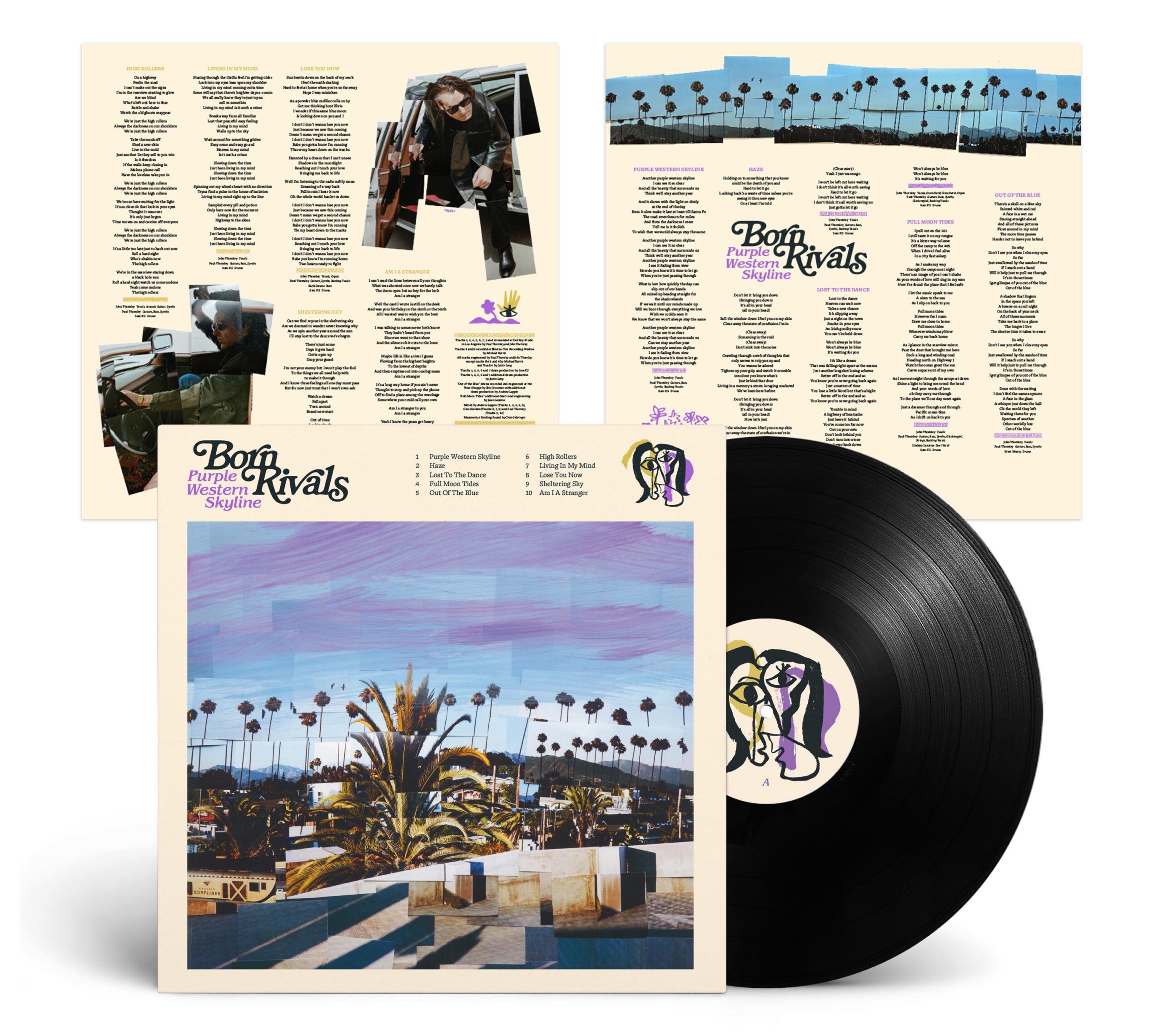
The songs on Purple Western Skyline reflect the fractured timeline of their creation, snapshots of moments that won’t stay still. Themes of transience, new beginnings, and the difficulties in letting go run through tracks like “Purple Western Skyline,” “Lost to the Dance,” and “Haze” that feel widescreen but lived-in.
“We kept coming back to this idea that the harder you grasp at things, the further they slip away,” John reflects. “The album became about accepting that we never really arrive and learning to live in what fades,” Paul adds. It’s rock music that embraces uncertainty because we’re all just passing through.