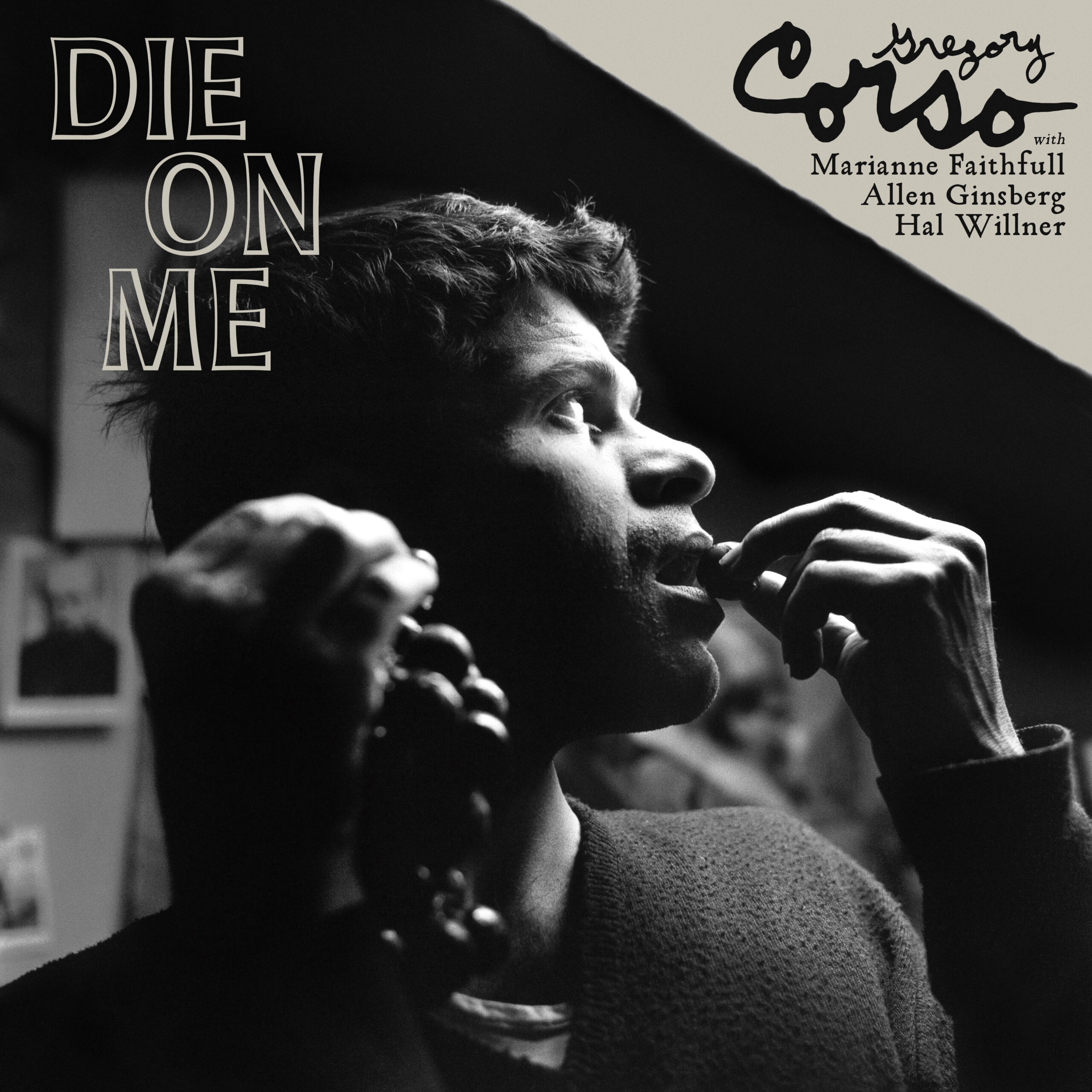
VIA PRESS RELEASE | Gregory Corso—both the youngest and one of the most influential members of the Beat Generation—stood alongside literary icons like Jack Kerouac and Allen Ginsberg as a defining voice in American poetry. Now, Die On Me, the rare and intimate collection of his final spoken word recordings, is being re-introduced to the world by Shimmy-Disc, the cult-favorite label founded by legendary producer, multi-instrumentalist, and archival visionary Kramer.
 Originally released on CD in 2002, Die On Me is now available for the first time ever on vinyl. Newly remastered and edited by Kramer, the collection spans archival recordings from 1959 and culminates in Corso’s final sessions, recorded by the late Hal Willner between January 7–10, 2001—just days before Corso’s death.
Today, Shimmy-Disc shares the project’s second release, “A Bed’s Lament”—a poem that takes Corso less than a minute to read, yet leaves an impact that lingers for a lifetime. In just a few lines, Corso delivers a stark and vulnerable meditation on aging and decline: “Once a long time ago I held the royal couple, I was straight, I was strong,” versus “Now I stand in a dank room with shakey legs and sunken back.”
Kramer shares his thoughts: “What is more sad, more beautiful, more passionate, more filled with all the things that make life worth living, than a bed? Our lives are tied like bootlaces to hundreds upon thousands of beds, but there is often one that stands out, never to be forgotten.
Gregory chose these words with great care, with great love, and with god-like precision as he composed this brief poem many years before the reading you hear on this recording, made just days prior to his death in 2001. Slowly over the years between its birth and this reading, it had taken on new meaning for him. It is difficult not to cry when I listen to it. Corso at his best, as he is here, cannot be matched. As Ginsberg so often said, “He is the greatest of us all.”
Within this deeply personal and revealing document are the last known voice recordings of Corso. Conversational, reflective, and raw, Die On Me captures Corso in dialogue with close friends and fellow legends—including Allen Ginsberg, Marianne Faithfull, and Chicago writer Studs Terkel—as he recounts stories, revisits formative memories, and reads aloud some of his most beloved poems. The result is an unfiltered self-portrait of an undersung literary giant.
Marianne Faithfull, in one of the album’s most striking moments, urges Corso to share stories—and, at his request, recites several of his own poems. The sessions showcase not only Corso’s voice and verse but his thoughts on mortality, love, and the poetic form itself. Produced by Hal Willner and lovingly reassembled by Kramer, Die On Me offers a rare and luminous insight into the mind of a poet facing the end.
Corso passed away on January 17, 2001, at the age of 70—just days after completing many of the recordings featured on Die On Me. On May 5, 2001, his ashes were laid to rest in Rome at the Cimitero Acattolico, at the foot of Percy Bysshe Shelley’s grave. John Keats lies nearby.
As Allen Ginsberg once said of his closest friend: “People say that I’m the greatest American poet of the 20th Century. I tell them they’re wrong. GREGORY CORSO is a far greater poet.”
Gregory Corso was both the youngest and one of the most prominent members of the Beat generation, alongside notable figures like Jack Kerouac and Allen Ginsberg. Born in 1930 in Greenwich VIllage, Corso survived a traumatic childhood which included orphanages, foster homes, reform school, prison, and mental hospital experiences. It was during his prison term he was able to self-educate and develop a unique poetic style that combined classical language alongside the newer lexicons of modern verse.
He became involved with the Beat literary scene, meeting influential writers and traveling with them extensively. His first book of poetry, The Vestal Lady on Brattle was published in 1955. His subsequent published output was sparse, as he would labour for years over a handful of poems.